
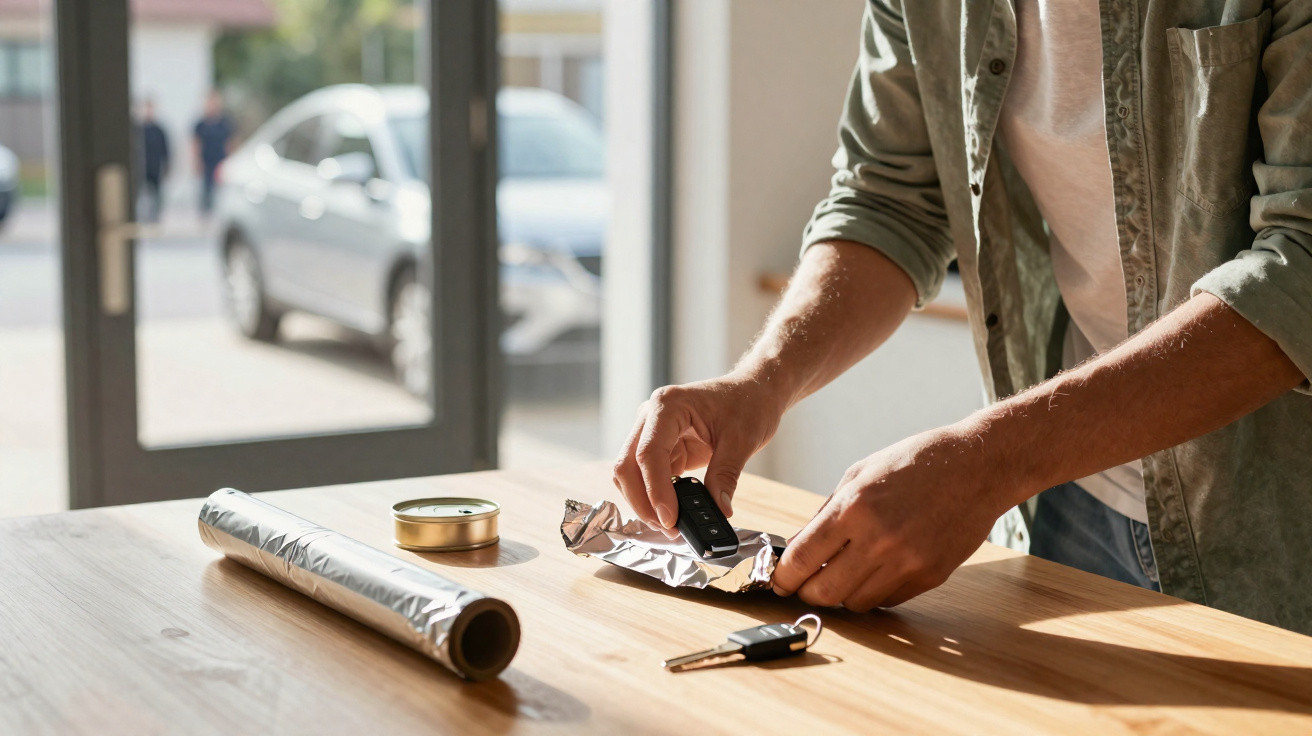
There is a very specific reason behind it.
Anyone driving a modern car with keyless entry is, quite literally, carrying a security risk in their jacket pocket. Organised criminal groups have long been exploiting the radio technology used by Keyless systems - often leaving no trace, making no noise, and without smashing a single window. Surprisingly, a simple piece of aluminium foil from the kitchen can close this gap very effectively.
How Keyless systems make life easier for car thieves
At first glance, keyless access looks brilliant: the driver simply keeps the key on them, the car detects it via radio, and then unlocks or starts at the press of a button. Inside the key fob is a small radio transmitter that continually communicates with the vehicle.
Those signals operate within a specific frequency range, typically around 315 or 433 megahertz. That is exactly where criminals focus their efforts. They do not necessarily need to steal the key - instead, they extend its range or copy the signal.
Relay attack: when the key is inside the house - and the car is gone
The most common method at the moment is known as a relay attack. Two offenders work together: one stands close to the front door or flat entrance, while the other is by the parked car. Using specialised devices, they boost the key’s radio signal - even though the key is supposedly safe in the hallway, in a handbag, or on the kitchen table.
"The car 'thinks' the key is right next to it - and can be unlocked and started, even though the owner is sitting inside the house."
It all happens in seconds. No broken glass, no damaged lock, and often not even a triggered alarm. Many victims only realise what has happened the next morning, when the driveway is empty.
Signal and code grabbers: the digital car-key clone
Another risk comes from so-called signal or code grabbers. These devices capture the key’s radio transmission when, for example, someone briefly presses the button while parking or locking the vehicle. From the intercepted data, the thieves create a digital duplicate of the key.
As the price of the necessary equipment has dropped, these tools have become increasingly widespread. They appear in shady online shops and forums, are small, discreet, and easy to conceal. Many drivers have never even heard of these attacks - and are understandably shocked when their car disappears without any signs of a break-in.
Why aluminium foil works - the physics behind it
As ridiculous as it sounds, ordinary kitchen aluminium foil can seriously disrupt these radio-based attacks. The explanation lies in a principle known since the 19th century: the Faraday cage.
A Faraday cage is an enclosure made of conductive material that electrical fields and radio waves can barely penetrate - or cannot penetrate at all. Aluminium is an excellent conductor. When radio waves hit aluminium foil, currents flow along the outside of the foil, while the inside is largely shielded.
"A car key wrapped in aluminium foil practically stops sending and receiving radio signals - to thieves, it becomes 'invisible'."
How to wrap your car key properly
For the shielding to work reliably, it is not enough to wrap the key loosely. A few details matter:
- Wrap the key completely, leaving no exposed gaps.
- Use two to three layers of foil so small tears do not immediately create a leak.
- Press the edges down as tightly as possible and seal folds well.
- Test it straight away: can you still unlock the car outside your front door, or not?
- Replace the foil regularly, as it gets damaged through creasing and everyday use.
The key advantage is that this works regardless of make. Whether it is a small hatchback, an SUV, or an electric car - the fob uses radio frequencies, and those can be shielded in the same way. Purpose-made RFID protective pouches rely on the exact same principle, but are usually more robust and convenient in daily life - they simply cost more than a piece of foil torn from the roll.
Where you keep the key makes a big difference
Out of habit, many people drop their car key into a bowl in the hallway - often right by the front door. That is precisely what offenders exploit, because it keeps the distance between key and car small. With powerful amplifiers, the signal can then reach the vehicle.
If you store your (wrapped or protected) key more deliberately, you increase security noticeably:
- Keep keys as far away from doors and windows as possible.
- Choose internal rooms, such as a bedroom chest of drawers or an inner cupboard.
- Use metal containers - biscuit tins or small cash boxes - as an extra layer of shielding.
A simple household trick is enough: a sturdy metal tin in the kitchen, lined with a bit of fabric, can hold all the family’s keys. Lid closed - and the radio signal is significantly weakened or completely blocked.
Layered strategy: how to make the car genuinely unattractive to thieves
Relying on aluminium foil alone does not go far enough. Anyone who wants to make life genuinely difficult for criminals should combine multiple measures. Security professionals often talk about "layers".
Mechanical barriers still deter thieves
A steering wheel lock, a visible alarm, a wheel clamp - these solutions may feel old-fashioned, but they have one major advantage: you can see them immediately. Many thieves deliberately look for easy targets. If it is obvious at first glance that a car will take time and effort, they often move on.
Where you park also matters. A well-lit car park, a garage, or bays on busier streets all reduce risk. Secluded yards, poorly overlooked rear courtyards, or dark side streets are more inviting.
Use and maintain electronic aids properly
Almost every newer car comes with an immobiliser, an alarm, or GPS tracking. However, many owners barely know how these systems work - let alone whether they are still functioning correctly.
"An immobiliser that hasn’t been checked for years can simply fail when it matters - without the owner realising."
Having a quick check carried out by a garage or auto electrician from time to time is worthwhile. They can test whether sensors trigger, sirens sound, and tracking systems are still active. If you keep your vehicle for a long time, you should also keep an eye on software updates.
Family habits: one weak link is enough
In households with multiple vehicles, key management can quickly become messy. One key ends up in the hallway basket, another stays permanently in a jacket pocket, and a third sits on the windowsill. For criminals, just one easily targeted key is enough.
A clear rule for everyone in the home helps:
- All car keys go to one fixed place in the house.
- Store them as centrally as possible, well away from doors and windows.
- A metal box, tin, or RFID container should be the standard, not an optional extra.
If you have children or teenagers at home, it is worth explaining why the key should not be left "just for a moment" on the shoe cabinet. A single forgotten key near the front door can undo even the most careful precautions.
When it is worth switching Keyless functions off entirely
Many manufacturers allow you to partially disable keyless access via the car’s on-board menu. The remote locking still works, but the vehicle stops constantly searching for the key.
This setting is especially sensible if you often park outside your house, live in an area with higher theft rates, or drive a particularly popular model. Convenience may take a hit, but it removes the route used for relay attacks.
If you do not want to give up convenience, a combination of aluminium foil or an RFID pouch, a more thoughtful parking/storage routine, and mechanical locks can deliver a similar level of security.
What terms like RFID and Faraday cage actually mean
Many reports on this topic refer to RFID protection or RFID blockers. RFID stands for "Radio-Frequency Identification" - identification via radio. The car key sends a kind of digital identifier to the vehicle. It is this radio communication that aluminium foil, or a suitable protective pouch, blocks.
The Faraday cage mentioned earlier is not some laboratory high-tech product, but a fundamental concept in electrical engineering. Any closed enclosure made from conductive material - aluminium foil, a metal box, or a specialist pouch - can form such a cage. In everyday life, a sturdy metal tin with a tightly fitting lid, tucked away in a cupboard, is often enough.
Ultimately, it comes down to a simple calculation: a few seconds to wrap the key, moving it away from the hallway, perhaps adding a steering wheel lock - and your own car drops much further down the target list for professional gangs. For many drivers, that is reason enough to use aluminium foil not only for packed lunches, but also for their car key.






Comments
No comments yet. Be the first to comment!
Leave a Comment