
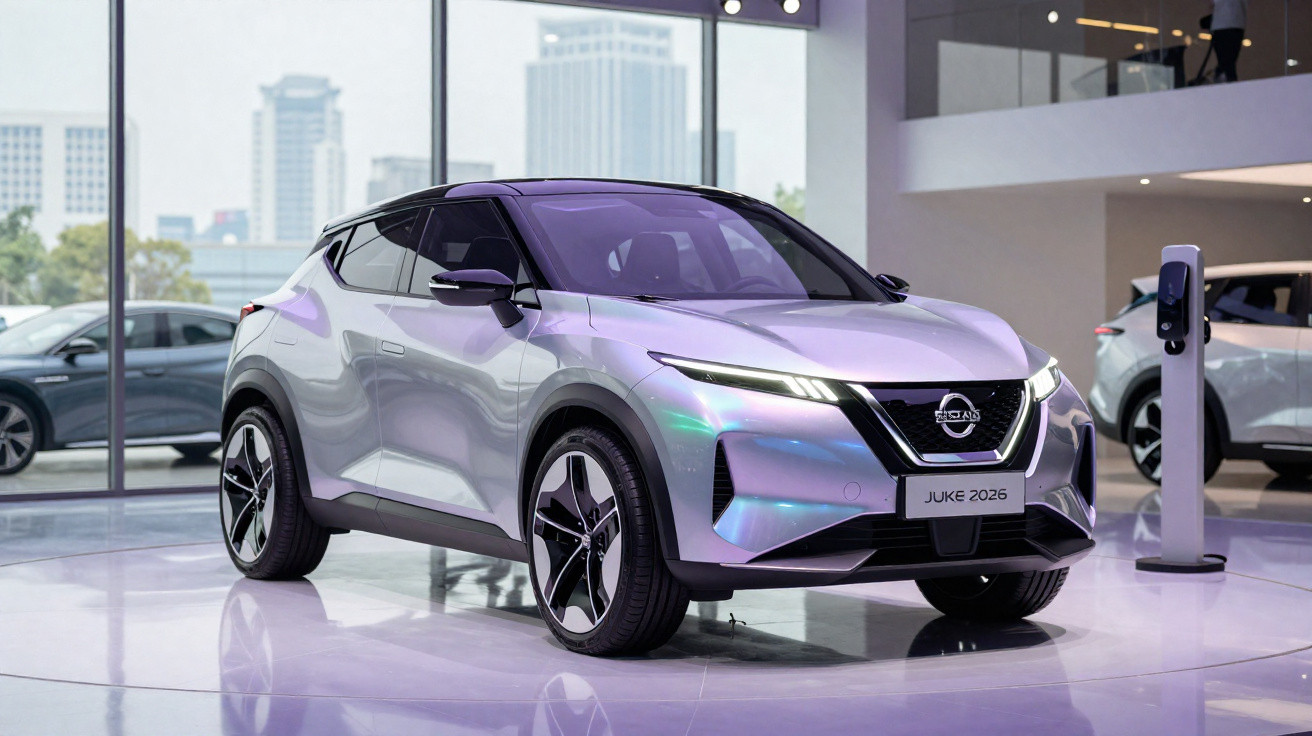
Almost a year ago, back in March, Nissan offered a first glimpse of what could become the next-generation Juke - the Japanese crossover that, when it arrived in 2010, effectively set the template for the segment.
Now, 15 years on, the Juke is getting ready to move into its third generation. With a market launch pencilled in for 2026, test prototypes have already been “caught” out on the road and, despite the heavy camouflage, all signs suggest development is well advanced.
The new model is expected to draw heavily on the Hyper Punk concept, unveiled at the Tokyo motor show in 2023, which stood out for its bold styling language built around sharp angles and polygonal surfaces.
What can we see?
Even through the dense disguise, several key exterior changes can be made out. Up front, the new Juke appears to move away from the rounded forms that defined the first two generations, replacing them with flatter panels and more pronounced creases.
The lighting remains split across two levels - a layout used since the original - but the upper daytime running-light signature looks slimmer, echoing Nissan’s latest design direction.
From the side, although it stays true to compact dimensions, the proportions point to a higher waistline. Also notable are the flush-fitting door handles on both the front and rear doors.
At the rear, the next Juke also seems straighter-edged and cleaner in its surfacing, with more angular tail-lamps and a tailgate that looks to be larger overall.
All-electric only
While the third-generation Nissan Juke appears, in broad terms, to remain recognisably a Juke, the biggest shift will be hidden beneath the bodywork. For the first time, the Juke will be a fully electric model, joining the new Leaf and Micra.
And contrary to what you might expect, it is not expected to use the new Micra’s platform (AmpR Small). Instead, it is set to share the AmpR Medium platform with the new Leaf. If that proves correct, the Japanese crossover could use the same 52 kWh battery, which in the Leaf enables up to 445 km of combined-range (WLTP).
In the same vein, the electric motor may also be carried over, producing 130 kW (177 hp) and 345 Nm. However, it could alternatively adopt the electric powertrains used in the Renault 4 and 5, with outputs ranging from 70 kW (95 hp) to 110 kW (150 hp).
Second generation to stay on sale
In the past, a new generation arriving would usually signal the end of the one before it. Today, with electrification reshaping product lines, the “new normal” increasingly means keeping the outgoing model alongside its replacement.
It is easy to see why. The industry’s sales expectations for electrification have fallen well short of forecasts, and to protect overall volumes Nissan will continue selling the current combustion-engined generation at the same time as the new, electric-only model.
We may still not know a great deal about the third-generation Nissan Juke, but we do know it is due in 2026. Production will continue at Nissan’s Sunderland plant in the United Kingdom, where the Leaf is also built.
Comments
No comments yet. Be the first to comment!
Leave a Comment