
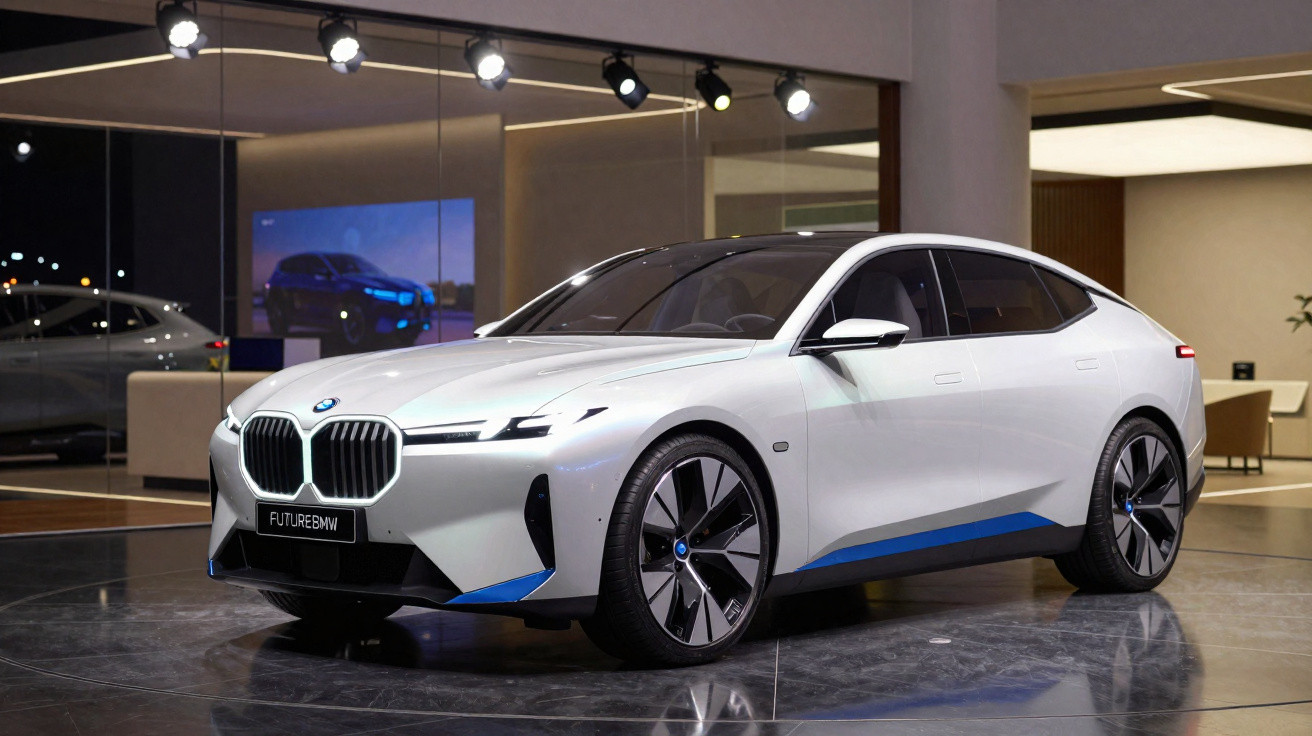
Expectations for the new BMW iX3 were sky-high, and the German brand didn’t disappoint: it has raised the bar once again.
These are slightly uncertain times for established premium car makers. Electric propulsion has scrambled many of the old reference points, and what truly defines premium no longer aligns exactly with what mattered six years ago.
That helps explain why some long-standing manufacturers clung to their dogmas and are now trying to claw back ground lost to newer players in an industry undergoing full-scale reinvention.
In that context, the BMW iX3 becomes the first member of a new generation of models built around a fresh electronic platform, an all-new chassis and a completely revised electrical system (including motors and battery). From March next year, when production begins and the first iX3 deliveries to customers start, we will see this family expand.
Dozens of Neue Klasse models will arrive by the end of this decade-an authentic revolution in the Bavarian manufacturer’s line-up.
On the outside, the vertical “kidneys” of the front grille stand out, sculpted in a way that calls to mind BMWs from the 1960s. Next comes the new lighting signature (an option called Iconic Glow), which takes on roles previously handled by chrome trim strips. Along the sides, the generous glazed areas draw the eye, as do the flush-fitting door handles.
Spacious interior, but there are areas to improve
With a wheelbase of almost 2.9 m, it is no surprise that the BMW iX3’s cabin can comfortably take five adults without major compromises. Rear legroom is exceptionally generous: I’m 1.80 m tall and there is ample space for both legs and head. In terms of width, three adults of “average” build can sit across the back.
The boot offers 520 litres to 1,750 litres of luggage capacity, plus an additional 58 litres under the front bonnet-handy for storing the charging cables-and it includes a cover to keep everything tidier.
The upper dashboard and the door tops use soft-touch materials, but the central section of the dash is hard, with only a thin covering in different finishes depending on trim level.
Build quality feels reassuring, although it is a shame the budget didn’t stretch to soft-touch linings inside the door bins-unlike what you get in the storage area between the front seats or in the glovebox.
Two door-related novelties: first, opening is electric (the initial action is assisted, then the user has to move the door further for entry and exit), and second, the switches for electric seat adjustment are located on the door panel (more typical of Mercedes than BMW). The windows aren’t double-glazed, but they are notably thick, which helps deliver strong cabin sound insulation.
Pillar-to-pillar display
BMW combines four elements in a concept it calls Panoramic iVision: Panoramic iDrive, a digital strip spanning the full width of the lower windscreen area with a wide range of information; the 17.9-inch central screen; a new small-diameter steering wheel with a thick rim that is highly ergonomic (and packed with haptic controls); and, optionally, a 3D head-up display.
Over three and a half hours driving on Andalusian roads, I tried to absorb as much as possible about the central screen and panoramic bar-both their content and control logic-and, overall, the verdict is very positive. The graphics look modern, responsiveness is fast, the layout is sensibly organised, and personalisation options are extensive.
However, because these were pre-production cars, a few rough edges still remained-particularly the return of certain menus that do nothing but waste time, as BMW’s own technicians acknowledge (and promise will be fixed).
Too many modes and too few buttons
On the other hand, My Modes (Personal, Sport, Efficient and Silent) go beyond driving-related settings, also changing display colours and screen content, yet they are fiddly to operate. The reason is that within Modes sit the Driving Experience Programmes (Eco, Comfort, Dynamic and Individual)-and it’s here that you can change settings that actually influence how the SUV drives and behaves.
But while the Dynamic and Comfort programmes let you adjust acceleration response, steering and regeneration, Eco does not. Everything would be clearer if every programme had fixed settings and only Individual allowed adjustments. And, while we’re at it, if the Driving Experience Programmes weren’t nested inside My Modes…
That’s before even addressing the lack of physical controls. There isn’t a dedicated switch to select My Modes or the Driving Experience Programmes; that gap is partly covered by a shortcut on the first layer of the central screen. But for choosing regenerative deceleration levels, hunting through menus feels highly impractical. Paddle shifters behind the steering wheel would be a far better solution.
Ultra-competent dynamics
In fairness, the missing paddles are one of the few flaws I could identify while driving the new BMW iX3 50 xDrive, the only version available at launch. It uses two electric motors producing a combined 345 kW (469 hp) and a maximum torque figure of 645 Nm. Throttle response is always immediate and very strong, which is backed up by a 0–100 km/h time in under five seconds (and a top speed of 210 km/h).
The rear motor is the more powerful unit-240 kW (326 hp) and 435 Nm versus the front motor’s 123 kW (167 hp) and 255 Nm-giving the BMW iX3 a character that largely feels rear-wheel-driven. In fact, at steady speeds with good grip, it operates solely with rear-wheel drive. The front wheels join in when you drive more assertively through corners and/or when traction is limited.
The braking response is thoroughly convincing: prompt, strong and linear, with none of the awkward handover between regenerative and hydraulic braking that spoils many electric cars. BMW already did this well in the i4 and i5, but with this new technical base it has clearly pushed the standard higher.
As for regeneration, there are four levels, plus an additional one when selecting B, which enables true one-pedal driving (one pedal drive). In everyday use, BMW claims that up to 98% of braking can be handled purely through energy recuperation, without applying the friction brakes (which are ventilated discs on all four wheels).
Chassis performance is equally impressive. Even without electronically variable dampers, the iX3 (the test car wore 255/40 R21 tyres) consistently delivered a well-judged balance between stability and comfort, showing little lateral body movement and absorbing road imperfections effectively. It’s firm, but never harsh.
The steering is pleasantly communicative and not “plastic” as it is in the vast majority of electric cars, though I would have liked a touch more weight in Sport mode. And despite requiring 2.8 turns lock-to-lock, the Bavarian engineers have tuned it so you don’t need excessive arm movement, even in tighter bends.
At the Ascari circuit
After all those kilometres on Andalusian public roads, four laps of the entertaining Ascari track reinforced the sense that this isn’t merely a capable electric vehicle-it’s a capable BMW.
In a cone-based exercise, accelerating to 130 km/h on the straight was followed by a full-bore stop and a simultaneous obstacle-avoidance manoeuvre. It highlighted the ability of the advanced dynamic-control “brain” that the German brand calls “Heart of joy” to brake and drive the correct wheel, shift torque transitions from the front axle to the rear, and manage stability and traction control in a very progressive way. This appears to support the claim that it is up to 10 times faster than conventional dynamic control units.
Completely new electrical system
The springboard for all the advances in BMW’s sixth-generation electric drivetrain is the new 800 V platform. It enables charging at up to 400 kW (direct current, DC), whereas BMW’s current on-road EVs top out at 205 kW.
Cylindrical cells replace the previous prismatic format, delivering higher energy density (+20%) and higher charging power (+30%). They are also mounted directly into the chassis, without modular subdivisions or structural elements-reducing weight and cost-to the point that the top of the battery forms part of the car’s underfloor.
Up to 805 km of range… in theory
The 108.7 kWh battery is huge-larger than those of its main rivals-and the iX3 50 xDrive claims a maximum range of 805 km (WLTP combined cycle) on a full charge.
But, of course, that 805 km figure is quoted with the 20-inch wheels, which are smaller than the 21-inch wheels fitted to the test vehicle; that alone increases consumption and reduces range.
On a 216 km route, driven at reasonably demanding speeds and in temperatures around 10 ºC (batteries don’t like the cold), the recorded consumption was 18.6 kWh/100 km-the official combined figure for the iX3 on 20-inch wheels is 15.1 kWh/100 km. That makes the stated range unattainable.
Competitive pricing… among the premium
Even though the entry price of 72,900 euros for the BMW iX3 50 xDrive places it within reach of only a very small minority, it is the most affordable option among its direct rivals.
The new electric Mercedes-Benz GLC starts at 78,000 euros, and the equivalent Audi Q6 e-tron is 10,000 euros more expensive than the iX3. As a sportier alternative, there is also the Porsche Macan 4, which begins at 84,000 euros. And these figures still exclude the options that typically inflate German premium prices.
Yet in the EV world, being premium and German is no longer an absolute guarantee of the best propulsion technology. Widen the search and it won’t be hard to find technologically comparable proposals (albeit with weaker attributes elsewhere), better equipped and costing 30% less, including some more ambitious Chinese models.
Comments
No comments yet. Be the first to comment!
Leave a Comment