
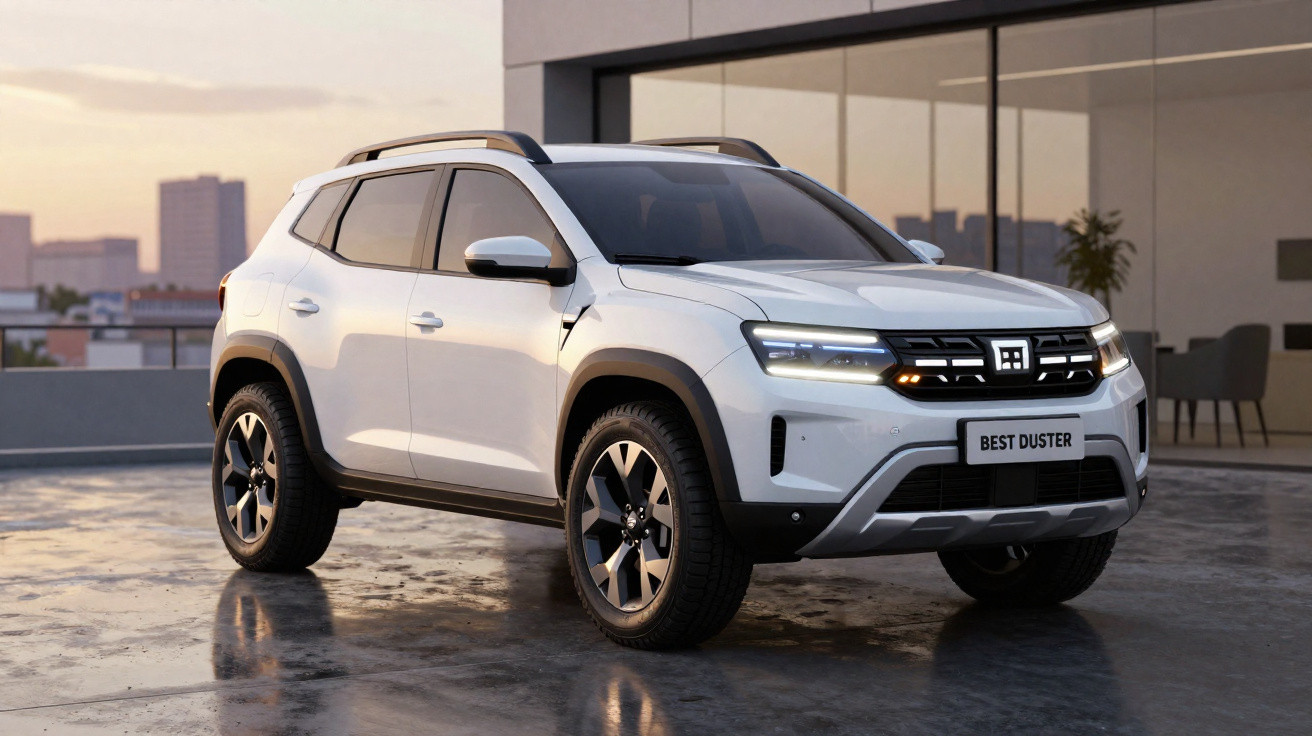
Lower running costs and a 1500 km range are the Dacia Duster Hybrid-G 4×4’s trump cards. Do they hold up in the real world?
Almost everything has already been said about the Dacia Duster. In this latest generation, it has become the best Dacia ever made and has quickly carried on the success story it has been building since its debut in 2010.
It arrives with fresh styling, a much improved cabin and an all-new platform, which has opened the door to newly electrified powertrains. One of them is entirely new: a single package that brings together four elements at once - hybrid, LPG, automatic gearbox and 4×4 drive.
Yes, it sounds complicated. Don’t click away yet, though. On paper, this could be the most adaptable Dacia ever. I went to try it and see whether it lives up to the promise. Here’s what I found:
Looks as a selling point
Where older Dacias were hard to defend on exterior design and merely acceptable inside, the story has changed dramatically. To the point that the Duster’s more rugged, outdoorsy look is now a genuine reason to choose it.
The cabin follows the same pattern. You’ll still find plenty of hard plastics, but the build feels tight and the overall layout is far more pleasant to live with.
It’s also impossible to ignore the new tech offering: a fully digital 7” instrument display and a 10,1” infotainment screen, both with wireless smartphone mirroring via Android Auto and Apple CarPlay.
Hybrid + LPG
At the bottom of the Duster range sits the bi-fuel version (petrol + LPG). It has become an increasingly important pillar for Dacia and a solution that has been attracting more and more buyers in this market.
Recognising that growing interest, Dacia decided to take the concept a step further by combining it with other technologies to create something the market hasn’t seen before.
Up front there’s a 1,2-litre turbocharged petrol engine producing 140 cv, while at the rear axle you’ll find a 23 kW (31 cv) electric motor. Working together, the system delivers a maximum combined output of 113 kW (154 cv).
The combustion engine makes 230 Nm of torque and is paired with a six-speed dual-clutch automatic gearbox, which can be operated via steering-wheel paddles (another first for the Romanian brand).
At the back, the electric motor provides 87 Nm and is matched to a two-speed gearbox: first gear delivers high torque at low speeds, which matters when driving off-road or on low-grip surfaces; the second ratio lowers the electric motor’s revs at higher speeds, maintaining drive to the rear axle up to 140 km/h.
And the rear motor’s gearbox has more “tricks” up its sleeve: it includes a Neutral mode that can fully decouple it from the rear axle, removing potential friction losses. That’s yet another unusual solution for a 48 V electric motor, powered by a 0,84 kWh lithium-ion battery.
Record range
This setup doesn’t deliver true 100% electric driving range, but because the battery is continually replenished while driving, the Duster Hybrid-G 150 4×4 can run for up to 60% of the time in urban use without burning a single drop of fuel.
The real headline, however, is the use of LPG. In this configuration, the Duster carries two 50-litre fuel tanks - one for petrol and one for LPG. Using both together allows a range of up to 1500 km on the combined WLTP cycle without needing to stop for fuel.
That’s a figure no electric car can realistically hope to match. It also adds another layer of flexibility and promises lower running costs than the Duster Hybrid we have already tested:
Even stronger off-road
On the road, you’re treated to a frugal system that’s easy to live with (the gearbox deserves much of the credit) and feels genuinely willing - you can tell those 154 cv are there. Once you leave tarmac behind, this Duster still puts up an impressively capable fight.
With 21 cm of ground clearance and strong approach/departure angles, the 4×4 layout lets you venture off-road with extra confidence: in the featured video in this article you can watch this Duster working through mud and dirt.
The drive was fairly brief, but it reinforced what I already believed: unless you’re planning more serious trails - in which case, you’re looking at the wrong vehicle - the Duster is all you need for a wide track of dirt or sand.
Interestingly, despite how complex the hardware sounds, it all operates in a very straightforward way. On open roads, the “Auto” mode is nearly always the best choice, with the system automatically switching between 4×2 and 4×4 and consistently finding the best available traction for each situation.
In tougher conditions, especially in mud like the terrain I drove on, it’s worth selecting “Mud/Sand” so the system reacts more quickly and decisively when grip disappears.
How much does it cost?
The Dacia Duster line-up starts at 19 900 euros for the Eco-G (bi-fuel) version and rises to 29 300 euros for the Hybrid 155, which remains the flagship.
Just below that now sits the new Hybrid-G 150 4×4, priced from 27 850 euros, paired with the Expression trim level.
There’s no point pretending otherwise: a big part of the Duster’s success has always been its price, and in this version the value-for-money equation is genuinely compelling. In simple terms, this is clearly the most complete and most versatile Duster of them all.
You get 4×4 drive, an automatic gearbox, 154 cv of maximum power, a 1500 km range and a system that can keep you in electric running for up to 60% of the time in town - all in one package. On top of that, it can also qualify as Class 1 at tolls if you sign up to Via Verde.
Comments
No comments yet. Be the first to comment!
Leave a Comment