
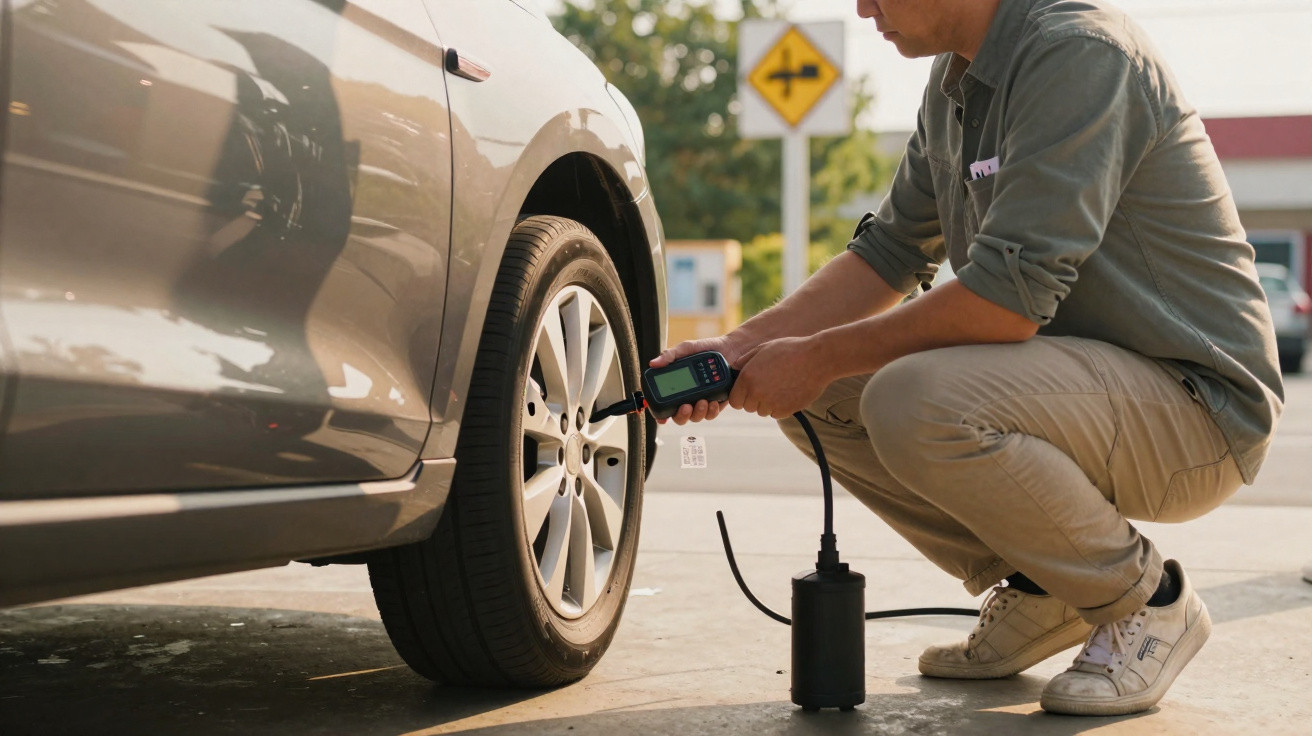
Same commute, same supermarket dash, same school run. Yet the price board at the pump keeps nudging up, and the car starts to feel a touch weightier through the wheel, a bit sluggish as you pull out of roundabouts. You pin it on congestion, on fuel prices, on the car simply ageing. Then, on a damp Sunday morning at a forecourt just off the A40, you crouch by the tyres and spot what’s really going on: the front-left is visibly drooping. Not punctured, not alarming. Just soft. A little tired. Left unchecked.
Five minutes later, after you’ve fed coins into a wheezing air machine, the drive home feels different. The car seems more alert, lighter on its feet, almost grateful. The fuel computer you normally ignore quietly shows a slightly better figure. And you start asking yourself how long you’ve been throwing away money, grip and braking performance on tyres nobody thinks about unless they look obviously wrong.
The reality is that most tyres don’t shout for attention. They murmur.
Why tyre pressure quietly eats your fuel and your safety
On a bright Tuesday at the edge of a retail park, stand near the air station and you’ll see the pattern play out. Drivers hop out, give the tyres a quick look from arm’s length, then shrug and climb back in. Those front tyres carry children, shopping, laptops, whole lives-yet tyre pressure is treated like a dull, optional task, somewhere on the scale of tidying the boot.
What makes it deceptive is that underinflation usually doesn’t look dramatic. A tyre can be 15% down and still appear “fine” at a glance. Meanwhile, the rubber is bending more than it should, the sidewalls are working harder, and the contact patch on the road is no longer what the engineers designed. That unseen space between “looks fine” and “is fine” is exactly where safety and efficiency start slipping away.
Once you put numbers on it, it gets more serious. The UK’s RAC reckons tyres underinflated by 15 psi can use up to 6% more fuel. For a typical family hatchback covering 10,000 miles a year, that isn’t pocket change-it can add up to hundreds of pounds over a few years, effectively burned as extra rolling resistance. Then there’s braking: safety-agency testing shows that severely underinflated tyres can add car lengths to stopping distances in the wet, precisely when you most need traction.
There are quieter consequences too. Tyres that are routinely run low tend to wear their shoulders faster, so you end up replacing them thousands of miles earlier than necessary. That’s not only an extra expense; it’s wasted rubber, wasted energy, wasted everything-because the air inside was subtly wrong for weeks at a time.
From a mechanical point of view, it’s straightforward. A tyre is engineered to keep a specific shape under load. As pressure drops, more rubber is pushed into the road, increasing friction. That friction is what your engine has to overcome every metre you travel. The sidewalls flex more, which generates heat and accelerates ageing. Steering becomes spongier, the car rolls more in bends, and modern systems such as ABS and stability control have to work harder because the tyre isn’t behaving as intended.
Overinflation causes the opposite problem. With too much pressure, the car rides on a narrower strip of rubber down the centre, which can reduce grip and make the car feel twitchy on wet or broken tarmac. You may claw back a tiny amount of fuel economy, but it’s paid for in comfort and control. The pressures listed on your door pillar or fuel flap aren’t a casual suggestion-they’re the balanced setting.
Turning tyre checks into a five‑minute habit, not a chore
The most effective approach is also the one many people avoid: a steady five-minute check using a decent pressure gauge. Not the one that’s been living under the passenger seat for three years collecting crumbs-use one that’s easy to read and doesn’t hiss air out of the sides. Keep it in the glovebox or door pocket, not buried in the boot under a folded pushchair and a football.
The ideal moment to check is when tyres are “cold”, meaning the car hasn’t gone much more than a couple of miles. Choose a level spot, apply the handbrake, and walk slowly around the car. Start with a visual check: bulges, cracks, or something metallic lodged in the tread is already a warning sign. Then measure each tyre and compare it with the figures on the driver’s door sticker or in the handbook-front and rear pressures can be different, particularly if the car is heavily loaded.
Let’s be honest: nobody truly does this every day.
What’s more realistic is attaching tyre pressure checks to a routine you already have. For many people, that’s filling up. Every second or third refuel, pull into the air station while the engine’s off and the tyres are still close to cold. You’ll probably end up waiting behind someone trying to remember their numbers, but that’s just forecourt life.
Dial in the target pressure, unscrew the valve cap, push on the hose and wait for the beep. It’s not glamorous and it won’t impress anyone online, but it quietly changes how your car drives for the next few hundred miles. If paying for air irritates you, a small plug‑in compressor for the 12V socket can be surprisingly satisfying. You park on the drive, put the kettle on, and inflate each tyre in turn while the tea cools.
Most of us have been the person who only reacts when a dashboard light demands attention. TPMS systems help, but they aren’t mind-readers. They’re designed to flag sudden drops, not the slow monthly loss of a couple of psi caused by time and temperature. That gentle drift is the one that steals fuel economy and composure without making a fuss.
“If you treat tyre pressure like brushing your teeth – quick, regular, boring – you’ll barely think about it. If you ignore it, the problems show up far more dramatically and at the worst possible moment,” says a London-based MOT tester who’s lost count of how many nearly-flat cars he sees each week.
A simple way to stop it slipping your mind is to build a small routine:
- Every payday weekend: check all four tyres plus the spare
- Before long trips or holidays: do a quick top-up and visual inspection
- With the first cold snap of autumn: check again, as pressure drops with temperature
The emotional element often outweighs the technical one. There’s genuine comfort in knowing the tyres gripping wet tarmac on a dark motorway have been checked by you, rather than assumed to be “fine”. That confidence comes from small, repeatable actions that take less time than scrolling on your phone at the pump.
When small numbers on a gauge change how you drive
Once you begin checking pressures routinely, your relationship with the car shifts in a subtle way. The slight resistance you used to blame on a headwind becomes something you recognise as a rear tyre running low. The vague steering you noticed on a gusty day now has a likely cause-and a straightforward fix. It’s a quiet kind of competence, built on habit and a £10 gauge.
Fuel economy talk can sound a bit clinical, but it points to a bigger question. How much of everyday driving happens on autopilot, assuming everything underneath you “just works”? How many school runs happen on tyres hovering near the legal limit? How many late-night journeys are taken on rubber that hasn’t been checked since the last MOT?
This isn’t about blame; it’s about noticing. A tyre pressure check is one of the few parts of modern driving that remains completely in your control. No app can do it for you, and no subscription quietly corrects it in the background. For all the technology in today’s cars, four small contact patches of rubber and air still decide how you brake, steer and stay on the road. Ignoring them doesn’t remove the risk; it simply conceals it behind a busy week and a long to‑do list.
| Key point | Detail | Why it matters to you |
|---|---|---|
| Correct pressure | Follow the values shown on the door pillar or in the handbook, with tyres “cold” | Lowers fuel use and keeps handling predictable |
| Consistency | Quick check every 3–4 weeks and before long trips | Prevents premature wear and reduces nasty motorway surprises |
| Practical habit | Link checks to filling up or a set weekend | Turns a chore into an easy reflex that protects both budget and safety |
FAQ:
- How often should I really check my tyre pressure? A check every three to four weeks is a sensible routine for everyday use, with an extra check before long motorway journeys or when the weather suddenly turns colder.
- Is the pressure listed on the tyre sidewall the one I should use? No. That figure is the maximum the tyre is rated to handle, not the recommended setting; use the numbers on the door pillar, fuel flap or in the handbook.
- Can wrong tyre pressure really affect fuel consumption that much? Yes. Underinflation increases rolling resistance, so the engine works harder and uses more fuel-most noticeable on longer trips and at higher speeds.
- Do I still need to check pressure if my car has a TPMS warning light? Yes. TPMS is a safety back‑up, not a complete solution; it may not flag mild but persistent underinflation that slowly wastes fuel and wears tyres.
- Are petrol station air machines accurate enough? Most are fine for everyday use, but checking against your own handheld gauge helps you catch poor readings and stay closer to the correct pressure.






Comments
No comments yet. Be the first to comment!
Leave a Comment