
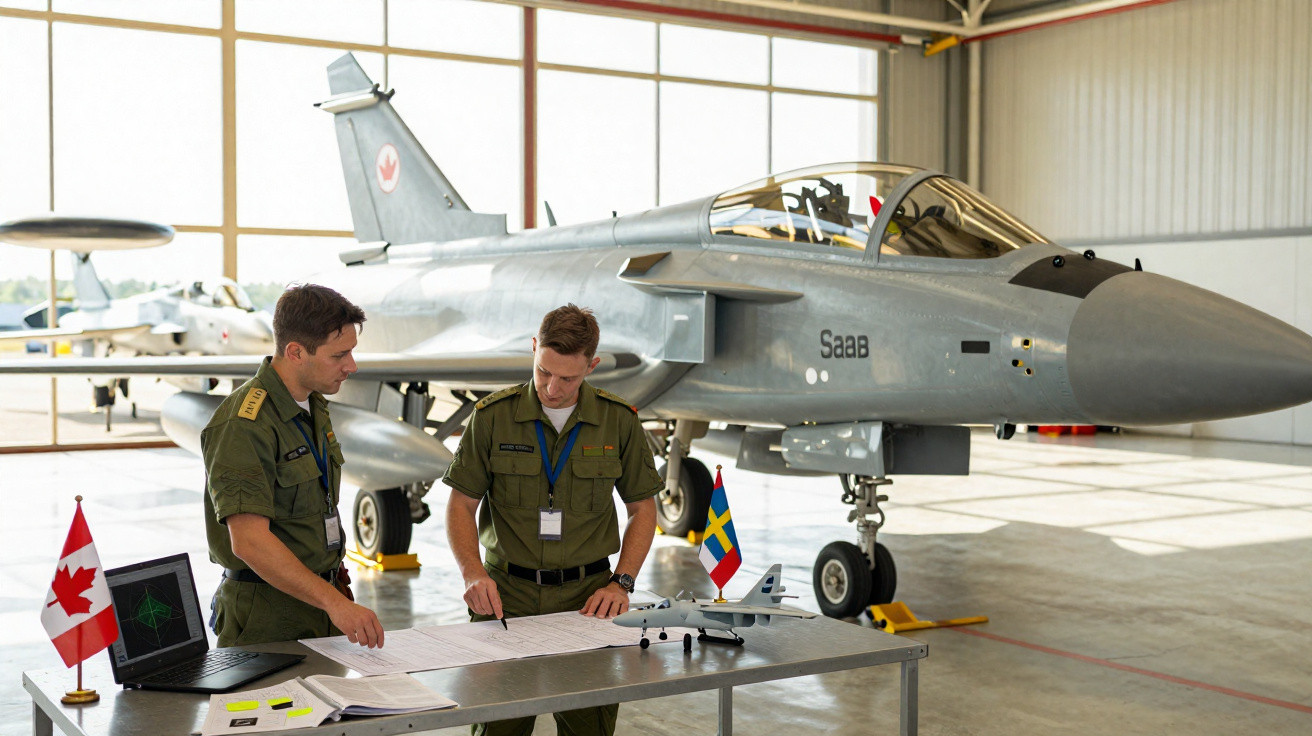
Sweden’s Saab is trying to capitalise on an unusual moment in North American defence politics, advancing a plan that would see Canada fly its Gripen E/F fighter in tandem with the US-built F-35, while moving a significant share of production to Canada.
Saab senses an opening amid US–Canada tensions
The Swedish firm is promoting what it describes as a “dual fleet” approach: Canada would continue with F-35 procurement, but also bring Gripens into service so that future combat airpower is not overly reliant on US equipment and political goodwill.
On an investor call, Saab chief executive Micael Johansson said Canadian decision-makers are considering how not “to be too dependent on the US” when it comes to fighter capability. In response, Saab says it has supplied extensive technical and industrial material to support its proposal.
Saab is feeding Ottawa detailed information on the Gripen’s technology transfer, production timelines and long-term export potential, betting that strategic autonomy now matters as much as raw performance.
This pitch arrives at a delicate time. Washington–Ottawa relations have been unsettled by public threats from former US President Donald Trump and a pointed caution from the US Ambassador to Canada, Pete Hoekstra, regarding Canada’s long-planned F-35 purchase.
What Saab is putting on the table
Saab’s bid is clearly shaped to resonate with both Canada’s defence establishment and its aerospace sector. The proposition centres not only on the aircraft themselves, but also on where they would be produced and how that work would be structured.
Local production and technology transfer
Johansson told investors Saab has given Canada concrete detail on how quickly a domestic Gripen production line could be established, and the extent of the technology transfer the company would be willing to provide.
- Creation of a Canadian final assembly and production facility
- Transfer of essential manufacturing and in-service support know-how
- Use of the Canadian line to produce Gripens for additional export customers
Saab is also setting out how Canada could benefit from future worldwide sales if Ottawa signs up to the aircraft.
Saab is framing the Gripen offer not just as a purchase, but as an entry ticket into the global fighter export business.
Saab already operates two Gripen production lines: one in Sweden and one in Brazil. Under the proposal, a Canadian site would become the third, and Saab argues it could serve as a production hub for selected international orders.
A growing export portfolio
Saab is highlighting that the Gripen E/F is steadily gaining customers, which it believes could reassure Canadian officials that they would be joining an expanding operator community.
| Country | Gripen deal | Approximate value |
|---|---|---|
| Brazil | Ongoing production and deliveries of Gripen E/F | Multi-billion dollar programme |
| Colombia | 17 aircraft ordered (2025 agreement) | €3.1 billion (around $3.7 billion) |
| Thailand | Four additional aircraft | 5.3 billion Swedish kronor |
| Ukraine | Letter of intent for 100–150 aircraft | Potentially one of Saab’s largest deals |
Alongside this, Saab is increasing manufacturing capacity. A company executive has recently said the aim is to reach 36 Gripens a year-an objective that would be easier to achieve with an additional production line in North America.
Canada rethinks its F-35-only plan
Canada is already signed up to the US-led F-35 programme and currently intends to buy 88 aircraft to replace its ageing CF-18 fleet. The 2023 budget set out 27.7 billion Canadian dollars (around $20.3 billion), although that total is now being reviewed.
Despite the political backdrop, Ottawa is still moving ahead with an initial tranche of 16 F-35s. Eight are scheduled for delivery to Luke Air Force Base in Arizona between 2026 and 2027 for pilot training.
Away from the public debate, however, the government is reconsidering how much of its future airpower should rest on a single aircraft type supplied by one ally. An Auditor General report said the F-35 plan is under review “to ensure” the aircraft remains the “best choice” for Canada’s requirements.
That change in emphasis appears to have energised Saab’s efforts. A senior Canadian official previously called the Swedish option “very interesting”, indicating that a mixed-fleet approach is now being discussed in a way it was not in recent years.
US pressure and industrial leverage
Analysts argue the US retains substantial leverage if Canada cuts back its F-35 numbers. Bryon Callan of Capital Alpha Partners told investors that any decision to “truncate” the 88-aircraft plan could bring repercussions for Canadian industry.
More than 30 Canadian aerospace companies are tied into F-35 production work, a powerful economic lever for the US if Ottawa shifts away from the programme.
Most of those firms supply parts and services throughout the F-35 supply chain, underpinning long-duration, high-value contracts. A reduced Canadian purchase could weaken the rationale for sustaining their participation.
Callan also flagged a further exposure within Saab’s proposal: the Gripen E uses the GE Aerospace F414G engine, which is manufactured in the United States. In a worst-case scenario, US export controls on that engine could become a pressure point-even if Canada opted to add Gripens.
Even so, Callan characterised Ottawa’s interest in diversifying defence suppliers as “prudent”, given Trump’s public threats that questioned Canada’s defence commitments and sovereignty choices.
High-stakes timing and political calculations
Johansson would not predict when Canada might decide on Gripen, emphasising that “high-level political decisions” will determine the outcome. He said Saab is in “intensive discussions” with Canada, but there is no defined timetable.
Any move to a dual fleet would have to weigh several competing factors:
- Canada’s commitments to NATO and NORAD
- Existing contractual and industrial links to the F-35 programme
- Potential domestic industrial gains from a Gripen production line
- The state of relations with Washington and wider US defence policy
For Ottawa, this is not solely a technical judgement. The F-35 brings stealth and tight integration with US forces; a second fighter type could, however, provide Canada with greater influence over upgrades, through-life support and export controls affecting its aircraft.
GlobalEye, NATO and Saab’s broader Canadian ambitions
Saab’s engagement with Canada extends beyond fighters. Johansson said he is closely tracking Ottawa’s work on a new surveillance aircraft requirement, which is widely expected to involve Saab’s GlobalEye airborne early warning and control platform.
GlobalEye pairs a Bombardier Global business jet airframe with advanced radar and sensors, many of which can be adapted to national needs. Canada’s extensive maritime approaches and Arctic surveillance demands make it a plausible candidate.
In parallel, Saab is awaiting a NATO decision on a possible GlobalEye contract as the alliance looks for a replacement for its ageing E-3 Sentry fleet. NATO had previously examined Boeing’s E-7A Wedgetail, but that option was set aside, opening the door for GlobalEye to compete again.
What a dual fleet would mean in practice
Operating both F-35s and Gripens would increase complexity for the Royal Canadian Air Force, yet it could also deliver added flexibility. Two fighter types entail two training systems, two logistics pipelines and separate simulators-while also offering more choices during a crisis.
In practice, Canada could reserve F-35s for tasks where stealth and penetrating defended airspace are crucial, such as the early stages of a NATO air campaign. Gripens could take on quick reaction alert duties at home, Arctic patrols, and numerous coalition roles where stealth is less decisive.
A mixed fleet could also provide resilience against fleet-wide grounding. If a technical issue forced one type to halt operations, the other could continue flying. For a country tasked with safeguarding vast northern airspace, that redundancy could translate into genuine operational advantage.
Key terms and risks worth understanding
Two ideas sit at the centre of the discussion: technology transfer and industrial participation. Technology transfer concerns how much design, engineering and production expertise a supplier will share, enabling domestic companies to build, maintain and modernise systems themselves. Industrial participation refers to the wider package of jobs, facilities and export work associated with a procurement decision.
Saab has traditionally presented itself as offering generously on both, whereas the US is typically more restrictive-particularly around sensitive stealth-related technologies. This contrast is one reason the Gripen proposal may appeal to Canadian industry, but it is not without risk. Even with transfer agreements, reliance on overseas technology can still be vulnerable to political change, export controls or sanctions in supplier countries.
For Canada, the decision is less about choosing a single “winner” and more about balancing sovereignty, alliance politics and value for money over decades. Saab’s Gripen offer adds a further variable-one that may strengthen Ottawa’s negotiating position, while also raising the stakes with its closest ally.






Comments
No comments yet. Be the first to comment!
Leave a Comment