
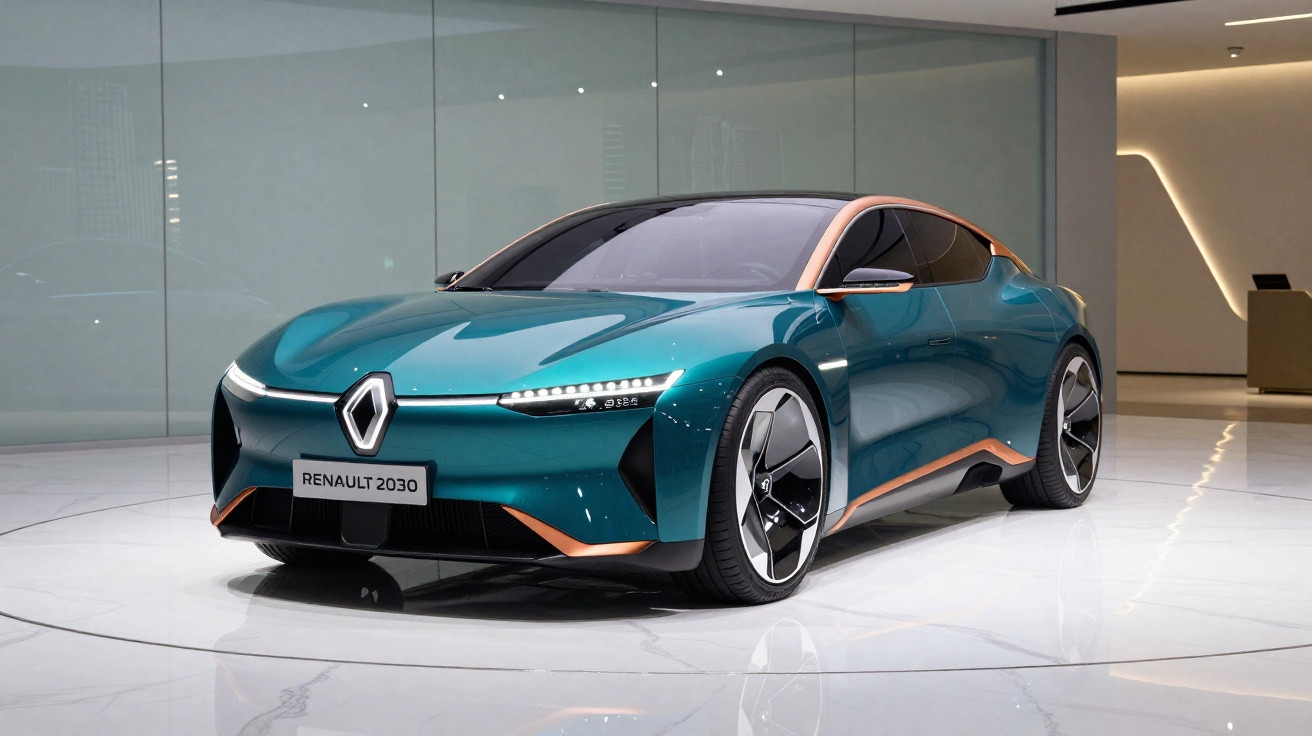
François Provost took over leadership of Renault Group in July last year, replacing Luca de Meo, and the business has already seen significant shifts since then.
The French executive has rolled back several decisions made under the previous management in a bid to cut costs and improve the group’s efficiency against rivals, particularly those from China. Among the steps taken are bringing Ampere (the electric-vehicle division) back into the group and ending certain mobility ventures under Mobilize.
He has now unveiled a new strategic plan called FutuREady. It builds on the direction set out in the Renaulution plan presented in 2021, but this time with bigger worldwide ambitions.
Where the earlier plan aimed to cement the group among Europe’s leading manufacturers, FutuREady is intended to position Renault Group as a global benchmark. The plan rests on four pillars: growth, technology, excellence and trust.
“Within Renault Group, we know where we came from. Today, we know where we want to go, how and with whom,” said François Provost.
Growth
Renault Group wants to speed up its international expansion through a fresh product push. The target is to introduce 22 new models in Europe, including 16 electric vehicles, plus 14 models for international markets. In total, that means 36 models launched by 2030.
For the Renault brand, the aim is to strengthen its European footprint with 12 new launches, while increasing electrification across the range and continuing to offer hybrid technology in Europe beyond 2030. At the same time, the brand is looking beyond Europe: the global goal is to sell two million vehicles per year, with half of those sales coming from outside the European continent.
Dacia will remain focused on a more affordable proposition, accelerating electrification so that 2/3 of its sales are electrified by 2030 - and it has announced the launch of four new electric models. In parallel, it wants to bolster its presence in the C-segment (Bigster and the new Striker), while keeping solutions such as LPG.
Alpine, meanwhile, will continue widening its line-up with new electric models, including the next generation of the A110, as part of a strategy designed to attract new customers and reinforce the brand’s sporting position. However, internal combustion has not been overlooked.
“Together, through FutuREady, we will show that we are here to stay and that we will become the reference for the European automotive industry on the global stage.”
François Provost, Chief Executive of Renault Group
Technology
On the technology side, Renault Group’s biggest announcement is the launch of a new electric platform called RGEV Medium 2.0. It will support multiple segments (B+ to D) and body styles (saloons, SUVs and MPVs), and it incorporates an 800 V architecture (enabling ultra-rapid charging). The group is claiming ranges of up to 750 km on the WLTP cycle, potentially reaching 1400 km with range-extender systems.
The platform will underpin a new generation of software-defined vehicles (SDV), with up to 90% of functions able to be updated remotely. The new architecture is being developed in partnership with Google and, in time, is expected to evolve towards Artificial Intelligence-defined vehicles (AIDV).
Higher-performance electric models will use batteries with high energy density, enabling very fast charging times - down to 10 minutes. Compact vehicles, by contrast, are expected to rely on more affordable batteries and 400 V systems, with charging times estimated at around 20 minutes.
Alongside this, the group will keep developing additional technologies, including a new generation of electric motor (Electrically Excited Synchronous Motor) that does not use rare earths. Efficiency of 93% on the motorway is being claimed, along with 25% more power. It will deliver 275 hp and will be offered in both front- and rear-wheel-drive versions, with costs 20% lower than current units. E-Tech hybrid technology will continue to be expanded beyond 2030 and will also include versions with under 150 hp.
Excellence
FutuREady’s ambition is also reflected in Renault Group’s intent to match Chinese manufacturers on both cost and development speed. The goal is a two-year development cycle, compared with today’s 3–4 years. Renault says it has already achieved this with the new Twingo, enabled by collaboration with a development centre in China.
In manufacturing, the plan is likewise to cut both cost and time. To achieve this, Renault Group intends to reduce the number of parts per vehicle by 30%, deploy 350 humanoid robots and use Artificial Intelligence (AI) to halve downtime. It therefore expects to reduce energy consumption by 25% and bring overall production costs down by 20%.
To protect quality levels, every stage of manufacturing will also be monitored by Artificial Intelligence (more than 1,000 control points). It will oversee all critical steps, enable remote updates and cut production incidents by 50%.
The target is to lower variable costs per vehicle by, on average, around €400 per year, and to reduce initial investment by up to 40%.
Trust
Renault Group employs nearly 100,000 people. Another part of the FutuREady plan is to invest in the workforce over the long term, through skills development and support, with particular emphasis on 9,000 managers. The aim is to lift productivity and reduce the network’s break-even point by 20%.
The company will also continue to strengthen strategic alliances, including those with Nissan and Mitsubishi. In Europe, the group says it will maintain industrial and technological independence, while keeping the option open to manufacture vehicles for other carmakers. Internationally, it will pursue further strategic agreements to accelerate growth, such as the deals struck with Geely in South Korea.
“Within Europe, the Group’s competitive technologies and industrial capabilities are already attracting Nissan, Mitsubishi Motors, Volvo Group (Renault Trucks) and now Ford. In total, the Group will build more than 300,000 vehicles for those five manufacturers by 2030, across its three main regions,” the statement reads.
Comments
No comments yet. Be the first to comment!
Leave a Comment