
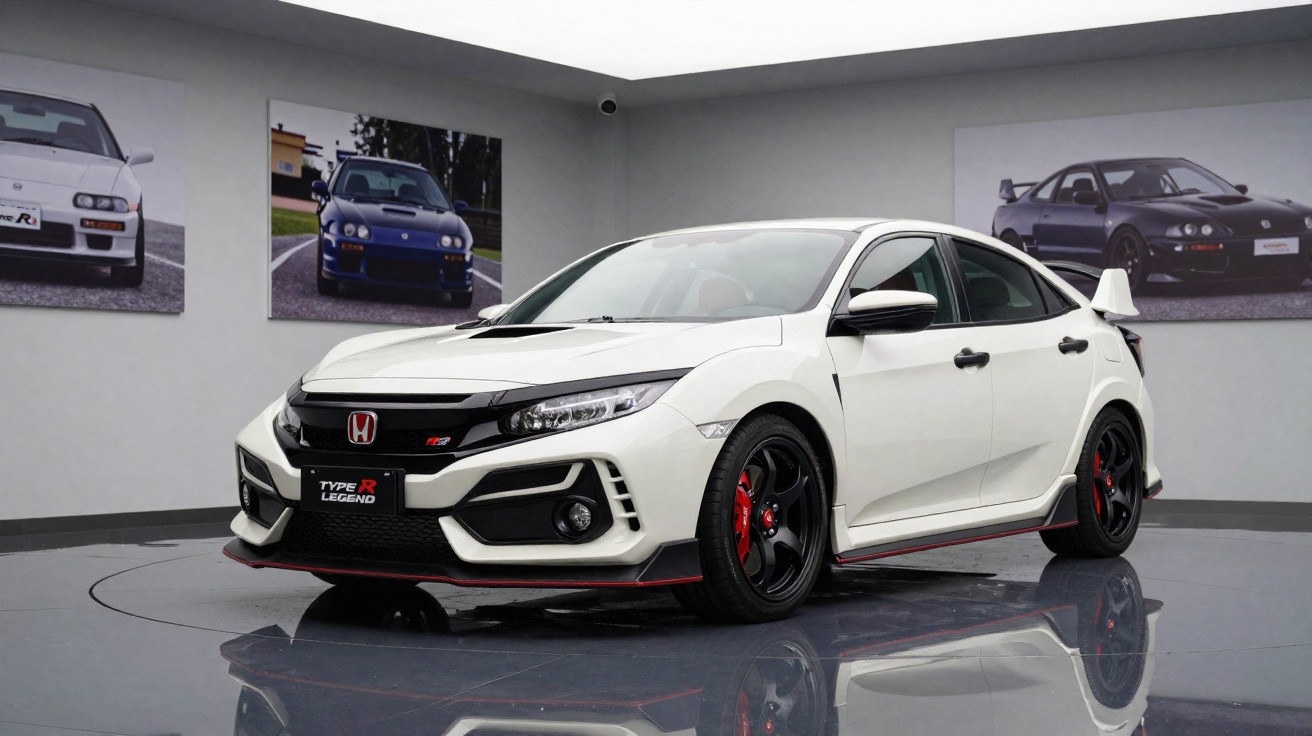
The Type R badge is one of the Honda designations most likely to stir strong feelings among performance-car enthusiasts. It first appeared in 1992 with the launch of the NSX Type R (NA1)-known in Japan as the NSX-R.
Honda’s aim was to create a car that was fast and effective on track-at the time powered by a 3.0-litre V6 producing 280 bhp-while still delivering genuine enjoyment on the road.
Honda Type R origins: NSX Type R (1992)
A dedicated weight-saving programme cut roughly 120 kg compared with the “standard” NSX, and it also brought in new, lighter Recaro seats instead of electrically adjustable leather chairs.
For the first time, red upholstery and Honda’s championship white were offered on a production model. This colour pairing honoured Honda’s Formula 1 history, echoing the look of the RA271-the first Japanese car to compete in Formula 1-and the RA272, which became the first to win the Japanese Grand Prix.
Both were finished in white with a red “sun mark”-inspired by Japan’s national flag-and this set the visual theme that would go on to define every Type R that followed.
Integra Type R expands the name (1995)
In 1995, Honda unveiled the first-generation Integra Type R, officially sold only in the Japanese market.
Its 1.8-litre, four-cylinder VTEC engine produced 200 bhp and wouldn’t stop pulling until 8000 rpm, helping introduce the Type R name to a far broader audience. It undercut the standard Integra on weight yet retained its stiffness, and it came with a five-speed manual gearbox plus upgraded suspension and brakes.
Civic Type R arrives, then Europe joins in
Two years later came the first Civic Type R, again built exclusively for Japan. The Civic Type R (EK9) used the already legendary B16-Honda’s first VTEC-specifically the B16B. Despite being a naturally aspirated 1.6-litre, it delivered 185 bhp at a frantic 8200 rpm, equating to 115 bhp per litre.
The Type R also featured a strengthened chassis, double-wishbone suspension front and rear, improved braking hardware, and a helical mechanical limited-slip differential (LSD).
In 1998, the Integra Type R reached the European market for the first time. That same year brought the first Type R with more than three doors: the Accord Type R.
As the 21st century began, Honda introduced the second-generation Integra Type R (for Japan) and launched the second generation of the Civic Type R (EP3)-marking the first time a Type R was built in Europe, at Honda of the UK Manufacturing in Swindon.
NSX-R (2002) and the later Civic Type R generations
In 2002, the second-generation NSX-R arrived, continuing the motorsport-led philosophy. Carbon fibre was used extensively to reduce mass, including on the large rear spoiler and the vented bonnet. The NSX Type R remains one of the rarest cars in the Type R lineage.
The third-generation Civic Type R went on sale in March 2007. In Japan, it took the form of a four-door sedan (FD2) with a 2.0-litre VTEC producing 225 bhp and an independent rear suspension-there is known to be at least one Civic Type R (FD2) in Portugal.
By contrast, the “European” Type R (FN2) was based on the three- and five-door hatchback. It used the same 2.0-litre VTEC as its predecessor, but with 1 bhp more-201 bhp in total-yet the “crime” was dropping the independent rear suspension in favour of a far simpler (and cheaper) torsion beam-even today it is the least-loved Type R…
The fourth generation (FK2) of the Civic Type R launched in 2015 with a host of technical changes, but the headline was the new 2.0-litre VTEC Turbo-the first turbocharged Type R. With its extreme styling and 310 bhp, it represented the first major step towards restoring the Civic Type R’s credibility.
When its successor, the FK8, was unveiled at the 2017 Geneva Motor Show, it used an evolved version of the same 2.0-litre VTEC Turbo, now with 320, and it established itself as the benchmark in its class-a status it still holds today. The Civic Type R FK8 also became the first truly global Type R, reaching the USA for the first time.
The Type R lineage is not over yet…

Comments
No comments yet. Be the first to comment!
Leave a Comment