
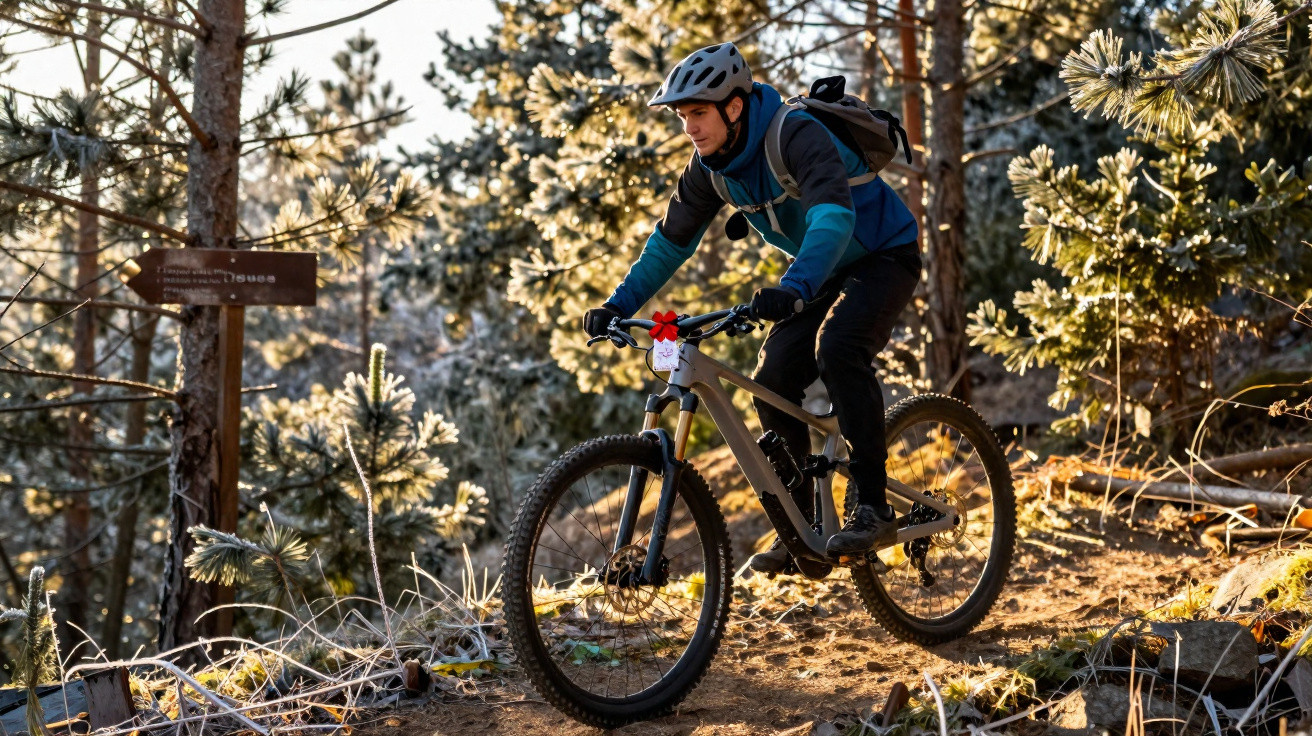
Amid the usual seasonal mayhem - to-do lists, parcels arriving, and late-night doomscrolling - the same thought keeps resurfacing: is this the year you stop buying more “stuff” and choose something that genuinely reshapes your weekends? Between a smartwatch you’ll barely put on and a games console destined to sit idle, a full-suspension Decathlon electric mountain bike is sitting there, quietly priced in a way that suddenly feels plausible.
Last week, in a Decathlon store, I saw a dad hovering with his phone out, pausing in front of an e-MTB he clearly wanted - while acting as though he was “just checking it for his son”. He left, returned, left again, then came back a second time. The moment the sales assistant mentioned the Christmas promotion and the option to spread the cost, his shoulders visibly relaxed. You could almost see the decision lock into place.
That small scene pointed to something much bigger.
The sweet spot: when an electric mountain bike finally feels “reachable”
For years, full-suspension electric mountain bikes felt like they belonged in a different world - nowhere near an everyday salary. €4,000, €5,000, €6,000: bikes you looked at the way you’d look at sports cars, with a mix of curiosity and distance. Decathlon has quietly shifted that landscape with bikes such as the Rockrider E-ST and its full-suspension relatives, pricing them below the mental threshold where your brain starts shouting “too expensive”.
This matters at Christmas. Tech pricing is unpredictable, and plenty of brands are happy to slap “Black Friday” labels on ageing stock with discounts that barely move the needle. Decathlon often lands in an unusual middle: not bargain-basement, no-name components - but also not the kind of purchase that wipes out your savings. It’s swapping the idea of one “big Christmas present” for something that delivers hundreds of smaller, better moments.
And those moments tend to begin on a wet trail, not under the tree.
On paper, the offer is straightforward: a full-suspension e-MTB with roughly 120–140 mm of travel, a mid-drive motor around the 250 W mark, a battery in the region of 500–630 Wh, and a price that usually sits in the €2,000–€2,800 band. That’s broadly where Decathlon has positioned its more capable Rockrider e-bikes, while competitors often sit about €1,000 higher. In day-to-day terms, that gap is the difference between “maybe in a few years” and “we could actually do this now”.
Speak to riders who’ve made the switch and the pattern repeats. On a forest loop north of Lyon, one rider told me he went from cycling twice a month to riding three times a week after picking up his Decathlon e-MTB in a Christmas deal. He didn’t suddenly turn into a “sporty” person; he simply stopped dreading savage climbs and heavy legs. The bike handled the hard work during the week - and he did the grinning.
Spread that across a full year and the cost per ride stops feeling intimidating. It starts to feel like paying rent on freedom.
The reasoning is simple: full suspension used to be a luxury, and electric assistance used to be another. Combine them and you had a toy reserved for well-heeled enthusiasts. What Decathlon has done is remove as much of the “luxury” packaging as possible while keeping the core of the experience intact. The suspension won’t win a World Cup. The motor badge may not be the most fashionable name in YouTube thumbnails. But the frame geometry is sensibly designed, the parts are sound, and the after-sales support is… local.
That final point is a game-changer. You don’t need to track down a specialist workshop to adjust a derailleur or swap brake pads. You can walk into the same place you’d pick up socks and inner tubes. For everyday riders - and for people who are simply curious - that kind of dependability can matter more than saving half a kilo or having a more glamorous motor logo.
There’s a reason these “gateway” e-MTBs are taking over trailhead car parks faster than high-end exotica.
How to pick the right Decathlon e-MTB before the Christmas rush eats them all
The sensible place to start is with how you truly ride, not how you imagine you might ride in an idealised version of yourself. Is your time spent mostly on woodland tracks and rolling fire roads, or are you planning steep alpine descents? For most people drawn to a Decathlon full-suspension e-MTB, the real sweet spot is “trail”, not “enduro”. In practice, that means sensible travel, a relaxed and comfortable position, and tyres that still roll efficiently across mixed surfaces.
Start by checking three essentials: battery capacity, suspension travel and braking. A 500–630 Wh battery can typically deliver around 35–70 km depending on your weight, how hilly the route is, and how much assistance you use. Suspension in the 120–140 mm range is ideal for technical singletrack without turning the bike into a sofa. And hydraulic disc brakes aren’t optional - especially when extra weight meets winter mud. Once those fundamentals are in place, it largely comes down to what feels right.
That “feel” is exactly why a quick in-store test - even ten minutes in the car park - is so valuable.
Christmas pressure can push anyone into grabbing the wrong frame size out of sheer urgency. This isn’t a jumper: an ill-fitting e-MTB makes every ride feel like a low-level struggle. If you’re between M and L, make a point of sitting on both. If your local Decathlon is out of stock, ask to try a similar non-electric bike to gauge the geometry. Your back, knees and shoulders will quietly thank you come March.
Then there’s the question of how much motor you actually need. Many people begin by riding in turbo mode, then gradually settle into eco or trail once the novelty wears off. It’s normal to overdo it at the beginning. So if you’re torn between two bikes mainly because of torque figures, remember most beginner and intermediate riders rarely spend their time right at the edge of that output.
Let’s be honest: almost nobody truly does those heroic all-day epics we promise ourselves when we click “order now”. Over time, what matters is everyday usability.
Psychologically, the words “Christmas deal” are more persuasive than most of us like to admit. You’re not only buying a bike; you’re also buying into a story - new year, new habits, new you, and all that. That’s why the best moment to cut through the noise is before the last-minute weekend panic, when sizes disappear and you end up compromising simply because you’re rushed.
A Decathlon salesperson I spoke to in early December put it like this:
“People think they’re coming for a gift. Most of them actually come to change how their Sunday feels. The bike is just the excuse.”
If that rings true, it helps to jot down what you genuinely want from the bike before you head in:
- Do you want to ride more often, or mainly ride further on occasional outings?
- Will you be riding solo, with children, or with much fitter friends?
- Are you comfortable with a slightly heavier bike if it comes with a bigger battery?
Small prompts like these keep you steady when flashy displays - or an impatient crowd - try to steer you off course.
A Christmas present that keeps nudging you outside, even when the couch calls
The odd thing about e-MTBs is that the “electric” aspect gradually stops dominating your thoughts after a few weeks. At the start, it’s everything: the motor’s hum, the assistance modes, the percentage tick-down on the display. Then winter Sundays arrive, the sofa looks irresistible, and that same motor turns into your private advantage against inertia. Just knowing the worst climbs will be “smoothed out” can be enough to tip you towards getting dressed, charging up, and heading out.
On a freezing January morning, that tiny push can be the difference between another day lost to scrolling and a ride that leaves your cheeks burning and your legs remembering they exist. One ride won’t transform your life. Fifty rides might. That’s where a sensibly priced Decathlon full-suspension bike earns its value: not as a trophy purchase, but as a habit machine with very little friction.
On a human level, that may be the real “perfect price”: low enough to say yes, and high enough that you actually use it.
| Key point | Detail | Benefit for the reader |
|---|---|---|
| “Accessible” price | Decathlon full-suspension e-MTB around €2,000–€2,800 | Lets you aim for a serious bike without a pro-level budget |
| Sensible specification | Battery ~500–630 Wh, hydraulic braking, trail geometry | Comfort and safety on real tracks, not just on paper |
| Store network | Servicing and repairs available close to home | Less stress, more riding time, better long-term bike lifespan |
FAQ:
- Is a Decathlon full-suspension e-MTB enough for real mountain trails? For most amateur riders, yes. The suspension travel, brakes and geometry are designed for serious trail use, as long as you stay within reasonable limits and maintain the bike regularly.
- How long does the battery last on typical winter rides? On mixed terrain with moderate assistance, you can expect roughly 35–60 km, depending on your weight, elevation gain and temperature. Using “eco” mode extends that range quite a bit.
- Is it worth paying more for a higher-torque motor? If you ride very steep climbs or tow a child trailer, extra torque helps. For most riders on forest and trail networks, mid-range motors already feel very powerful.
- Can I use a full-suspension e-MTB for commuting as well? Yes, many riders do. You might want to add mudguards, lights and maybe slightly faster-rolling tyres, but the comfort on potholes and kerbs is a nice daily bonus.
- When is the best time to buy around Christmas? Stock and sizes tend to vanish in the last two weeks before Christmas. Early December, or even late November deals, usually offer the best mix of availability and interesting prices.
Comments
No comments yet. Be the first to comment!
Leave a Comment