
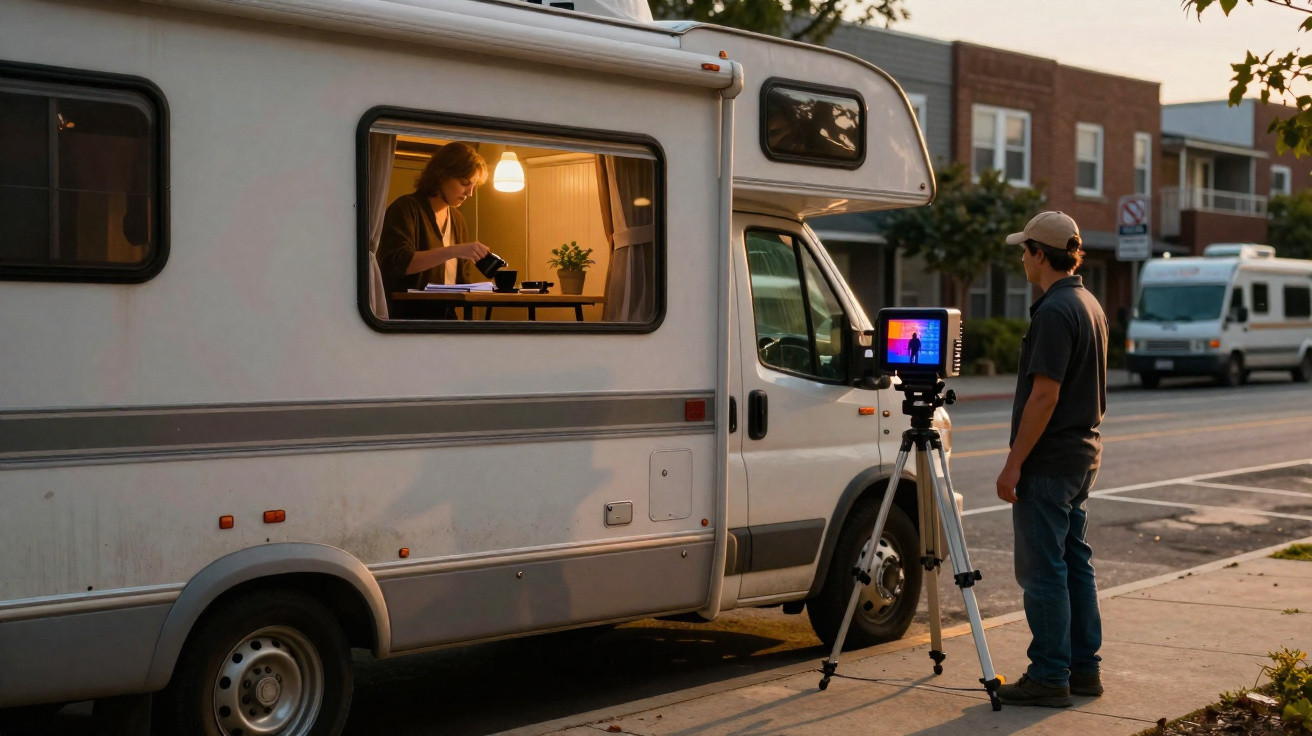
One after another, tiny blooms of heat appeared on the laptop balanced on the bonnet of a city SUV. The outline of a person on a mattress. The faint residual warmth of a computer. A neat little square where a dog had been curled up moments earlier. Two streets away, the RV still looked blank and unremarkable, parked between SUVs on a quiet side road. On the thermal view, though, it shone like an admission. The officer didn’t knock. He simply tapped a marker icon on the screen and carried on to the next block.
By this autumn, that kind of scene won’t be confined to a pilot in a seaside city. It’s set to become standard practice in more and more places where people living in RVs have, quietly, turned parking bays into makeshift lifelines. New thermal radars are being introduced to identify “lived-in” RVs that breach local rules. The technology is marketed as impartial. The lives behind those glowing shapes are anything but.
Thermal radars meet the housing crunch on the curb
On a cold late-October evening, older RVs sit nose-to-tail along an industrial road at the edge of town. Curtains closed. Solar panels angled like weary wings. From the pavement it seems calm, even dull. Then a council vehicle inches by, topped with what looks like an oversized roof box, connected by cables to a tablet resting on the passenger’s lap. It’s a mobile thermal radar unit, adjusted to pick up the kinds of heat traces that imply someone is spending the night inside an RV.
It doesn’t ping or strobe. Instead, it translates parked vehicles into a different vocabulary: cold exteriors, warm interiors, leftover heat. Where a normal patrol might see tired campers and white vans, the radar reads signs of occupancy. A saucepan that’s still warm, an engine that hasn’t fully cooled, the steady output of bodies asleep a few centimetres from thin metal walls. For teams being pushed to “clear the streets”, that shift turns uncertainty into a dataset.
If you ask officials why they want thermal radars, they usually begin with complaints. Residents frustrated by lines of deteriorating RVs. Shop owners anxious about blocked loading bays and litter. Fire services warning about propane-related explosions. The figures aren’t invented: in some West Coast cities, the number of people living in vehicles has risen by double digits within just a few years. One city recorded more than 2,000 vehicle dwellers in a single annual count, many in RVs described as “inoperable”.
In time, those statistics harden into demands for action. “We need tools,” a city councillor in one mid-sized metro area told me. “We can’t just send three officers to knock on doors and guess who’s actually living there.” That’s the pitch for these thermal systems: more accurate identification, quicker enforcement, and fewer arguments about whether an RV is unlawfully occupied. But once you start quantifying heat, you are also quantifying life.
The hardware isn’t futuristic. These are adapted thermal cameras and radar systems, akin to equipment used in search and rescue or border surveillance. On top of that, software adds pattern recognition: human-sized heat clusters, repeat overnight occupancy, and the characteristic glow of cooking or heaters at certain times. The interface looks neat, almost clinical-dashboards, coloured maps, risk scores. The complication comes afterwards. What changes when a council can pinpoint how many people are living in which RVs, on which streets, and at what hour of the night?
How cities will actually use RV thermal detection
In most of the areas trialling these systems, the process is deceptively straightforward. Radar units-fitted to patrol cars, council trucks, or even mounted on fixed poles-scan chosen routes where RVs routinely park. The software flags vehicles that appear “likely occupied” based on heat patterns. Number plates or GPS points are then placed into an enforcement queue. After that, usually the following morning, teams attend: parking enforcement, sometimes police, sometimes outreach staff.
A West Coast pilot, outlined in a council briefing, illustrates how it plays out. Overnight scans picked out 63 “potentially inhabited” RVs along two industrial arterial roads. By 8 a.m., a combined team had the list. Eight RVs had already left, seeking somewhere safer before daylight. Twenty-one were issued warnings. Eleven were towed that week as “hazards” or due to unresolved breaches. A small number of people were placed in short-term shelters. The rest largely relocated-another street, another industrial fringe.
On paper, the aims are easy to defend: protect pavements, keep fire lanes clear, maintain neighbourhood “quality of life”. Thermal radars are sold as a way to “target enforcement efficiently” rather than carry out broad sweeps. But speak to people living in RVs and a different term comes up: hunted. When your home is on wheels, invisibility is often your first protection. Blackout curtains. Parking where nobody pays attention. Staying just out of sight-until the radar is designed to find you.
That is where the moral questions sharpen. A tool that can tell an occupied vehicle from an empty one doesn’t only shape ticketing. It can also be used to create lists of known RV households, monitor routines across weeks, or link records with social-service databases. Civil liberties organisations are already asking whether thermal scans that reveal human presence edge into constitutional protections against unreasonable searches. Councils often argue that anything observable from a public road is permissible. Yet what’s being revealed here isn’t a number plate or a broken light. It’s the simple reality that you’re inside, trying to sleep.
What RV dwellers and neighbours can realistically do
Among people living in RVs, advice shared in online forums is already shifting. It used to focus on parking regulations and “blending in”. Now, some discussions treat heat signatures like a new kind of forecast. A few try to outsmart the system-parking beside large lorries to muddy the signal, hanging reflective insulation, moving sleeping positions within the vehicle. The more brutal reality is that once a council commits to this technology, long-term stealth becomes far more difficult.
In practice, the most workable steps come down to three. Learn the precise overnight parking rules street by street. Create a rotation of lawful or tolerated locations rather than relying on one spot. And connect with outreach workers before you end up on the enforcement list. That could mean speaking with a charity van doing rounds, or visiting a day centre so your details enter the systems that manage access to safer parking sites. None of it is glamorous. It’s administrative survival.
For neighbours in permanent housing, the decisions are just as concrete, even if the personal risk feels smaller. You can demand faster clearances and tougher tech-or you can push your council to match enforcement with real options: more safe-parking locations, repair support for broken-down vehicles, and credible routes into stable housing. Let’s be honest: hardly anyone does that day in, day out. Most people complain, send one angry email, and move on. Meanwhile, policy keeps gathering speed.
When I spoke to a long-term RV resident whose home had just been towed from a tech-patrolled area, he summed it up plainly:
“They say it’s about safety, but the only thing that changed was how fast they could find us.”
His line turns up in council hearings, more often through absence than presence. The people most affected rarely get time at the microphone.
- Ask your council how thermal data on RVs is stored, how long it’s kept, and who is allowed to access it.
- Push for public dashboards that report not only tows and fines, but also placements into safe parking or housing.
- Back local organisations offering mechanical repairs and legal support for people living in vehicles.
- Pay attention to budget decisions: technology contracts often advance quicker than funding for alternatives.
- Talk-properly talk-with the person living in the RV on your street before the radar arrives.
Living with being seen by machines
Thermal imagery carries an odd kind of intimacy. It bypasses faces and skin tone, ignores clothing and social cues, and reduces everything to warmth. A person becomes a glow. A shared duvet becomes a brighter patch. A space heater, a pan on a hob, a dog curled near someone’s feet. These new RV radars are designed to strip that intimacy of any softness and turn it into something to manage. The glow becomes a breach code, a pin on a digital map, an item on a morning task list.
From a control-room screen, it all appears tidier than what’s happening at the kerb. No condensation streaking windows. No smell of reheated leftovers. No child quietly asking whether the vehicle outside means they have to move again. An officer sees occupancy rates rising and falling. A councillor sees before-and-after slides for a press event. A vendor sees a case study and, perhaps, the next client in the neighbouring city.
Most of us know the feeling of a private habit suddenly becoming visible-captured on CCTV, logged by an app, noticed by a stranger. Multiply that discomfort across a thousand nights and imagine that what’s exposed isn’t a habit, but your last thin layer of home. Being “detected” isn’t only technical; it lands emotionally. Some readers will view thermal RV radars as long-overdue tools to regain control of streets. Others will see them as another way of pushing the housing crisis out of view rather than addressing it.
The vehicles will still be out this autumn. The radars will sit quietly above the traffic. Somewhere, a heat signature will brighten and then disappear as an RV pulls away in the dark. What follows-whether councils treat those blips as people to shift on or neighbours to help off the kerb-will reveal a great deal about who we are when the screens light up.
| Key point | Detail | Why it matters to you |
|---|---|---|
| Thermal radar rollout | Systems will scan RVs for human heat signatures to flag “lived-in” vehicles in breach of local rules. | Understand what’s actually coming to your streets and how it works. |
| Impact on RV dwellers | Faster detection means less ability to stay unseen and a higher risk of fines, tows and displacement. | Anticipate how life in a vehicle could change, or how it’s changing for people around you. |
| Room for local action | Councils can pair tech with safe parking, outreach and housing-or rely only on enforcement. | Identify where your voice and choices can still shape how this technology is used. |
FAQ:
- Are thermal RV radars already in use, or is this just a proposal? Several cities in North America and Europe have already run pilots using thermal detection on RVs and other vehicles, and a broader rollout is planned for this autumn across multiple jurisdictions that have recently tightened parking and encampment rules.
- Can these systems see inside an RV like an x‑ray? No. Thermal sensors don’t show faces or objects in detail; they read heat patterns. However, those patterns can still reveal that people are inside, when they’re inside, and sometimes roughly how many-raising serious privacy and legal questions.
- Will this only affect “abandoned” or unsafe RVs? Not necessarily. The purpose is to separate occupied from empty vehicles, so even tidy, well-maintained RV homes can be flagged if they’re parked where overnight habitation is prohibited.
- Is there anything RV residents can legally do to avoid detection? You can park in lawful zones, move more frequently, and connect with safe-parking schemes or outreach teams, but attempts to mask heat signatures are often unreliable and, in some cases, may attract additional attention.
- How can local residents influence how these radars are used? Attend council meetings when contracts and enforcement policies are being decided, ask detailed questions about data use and non-enforcement alternatives, and support community groups that argue for safe parking and housing rather than tech-only crackdowns.





Comments
No comments yet. Be the first to comment!
Leave a Comment