
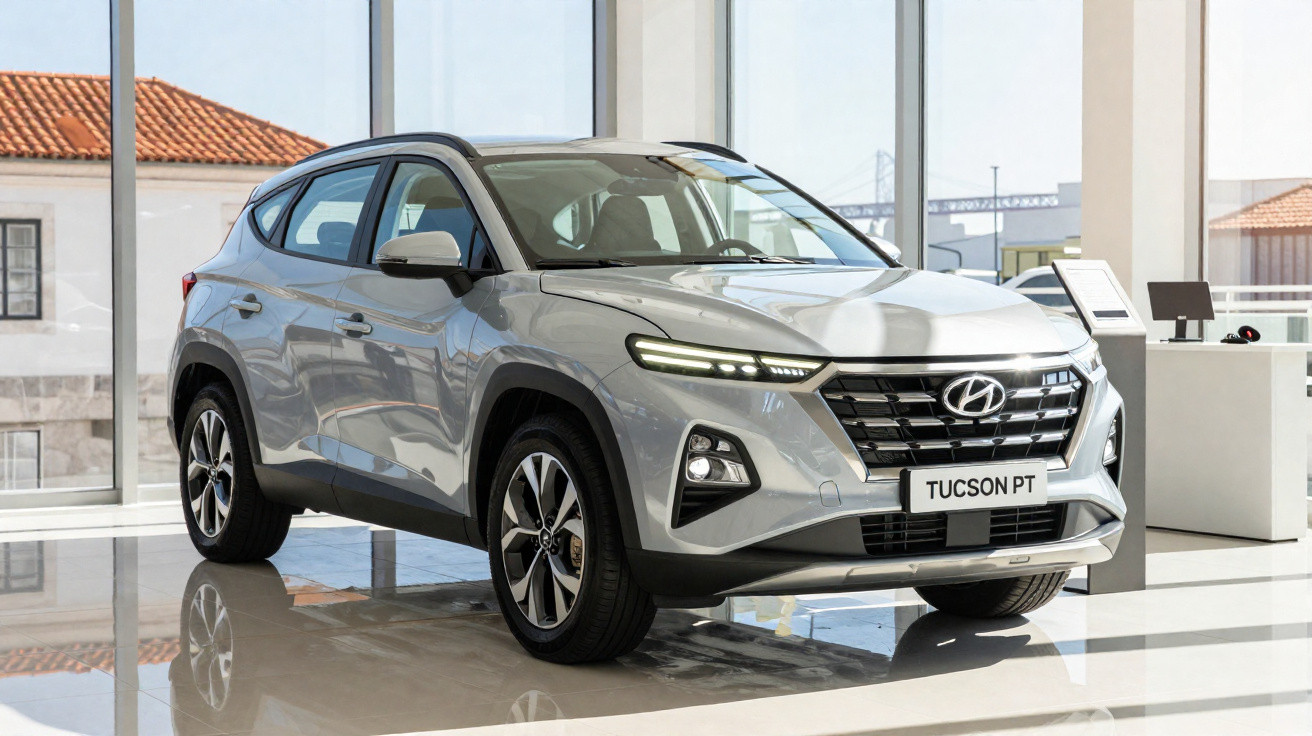
The Hyundai Tucson is one of the strongest SUVs in its class. The drawback is that availability on the used market is limited.
The third-generation Hyundai Tucson (2015–2020) was a pivotal model for the South Korean brand in Europe. It played a major role in Hyundai finally moving beyond the image of a purely “rational” choice, helping it establish itself as a manufacturer that also delivers technology, quality and brand appeal.
Hyundai backed this shift with substantial investment across Europe-development and design centres, people and skills, and manufacturing capacity-and the Tucson made it clear just how important the European market had become to the company.
In today’s used-car market, the Tucson still makes a great deal of sense. We found more than 80 examples for sale on Piscapisca.pt, with most of them certified and sold with a warranty.
It is well worth considering if you want a straightforward SUV with space, comfort and predictable day-to-day use. What’s more, most versions come with a generous equipment list. The car we found priced at under €21,000 even includes heated rear seats-something that remains uncommon in this segment.
Hyundai Tucson: simple, clean exterior design
The exterior styling of the Hyundai Tucson (2015–2020) shows how to keep a car looking fresh over time without resorting to gimmicks. The proportions are well judged, and the bodywork communicates sturdiness without leaning into the kind of aggressive design that tends to date quickly.
That said, the third-generation Tucson arguably looks its best after the 2018 facelift, which sharpened the overall package: a redesigned grille, slimmer headlamps, and a more contemporary look that matched the identity Hyundai was aiming to cement at the time.
It is not an SUV that grabs attention from afar, but it also does not look old-fashioned-an obvious plus when you are buying used. Just as importantly, the body assembly feels robust (trim plastics, lamps and other components), which should make long-term ageing less stressful.
A Korean SUV that ages like a Japanese one
Inside is where the Tucson most clearly earns its popularity. Space is one of its most widely agreed strengths: there’s plenty of shoulder room, enough rear-seat space for adults, and a boot that fits typical family demands-whether that’s holidays, prams, or light professional use.
Perceived quality is strong, and the build precision made many rivals from German brands raise an eyebrow (including premium badges). The standard Hyundai set with this Tucson feels like a blend of the best of the German and Japanese approaches.
On later cars-especially from 2018 onwards-the infotainment system took a noticeable step forward, with quicker responses, larger screens, and support for Apple CarPlay and Android Auto.
Even mid-range trims often include a very comprehensive specification, which makes it important to read each advert carefully: some exceptionally well-equipped used Tucsons are easy to miss if you skim the listings-there are several examples available via the referenced listings page.
Very easy-going on the road
The Tucson’s driving experience matches its brief. It is not an SUV designed to excite; it is designed to be pleasant in everyday use. The suspension is tuned for comfort, doing a good job of smoothing out rough surfaces-particularly relevant on Portuguese roads. The steering is accurate and works well in town, when parking and manoeuvring, without undermining motorway stability.
When it comes to diesel engines, it is worth being precise. Up to the facelift, the main option was the 1.7 CRDi (115 hp), a well-known, durable unit with modest fuel consumption. From 2018, the 1.6 CRDi also arrived, offered with either 116 hp or 136 hp depending on version and gearbox.
On the road, both do the job properly: capable performance at moderate speeds, enough torque for the car’s weight, and realistic consumption for higher-mileage drivers. There are no big surprises-good or bad-and, once again, that predictability works in the Tucson’s favour as a used buy.
Stable pricing, but limited supply
Portugal’s market is not especially helpful if you are looking for a used Tucson. Supply is relatively thin, although prices have settled.
On PiscaPisca, older diesel examples (2015–2016) with the 1.7 CRDi and average mileages are typically listed between €16,000 and €18,000. As model years and equipment levels improve, pricing rises in the expected way.
A chart provided by MotorCV / Piscapisca.pt helps illustrate how the Hyundai Tucson behaves in Portugal’s used-car market.
Post-facelift cars, now with the 1.6 CRDi, generally sit between €20,000 and €30,000 depending on year, kilometres, manual or DCT (dual-clutch) transmission, and equipment level.
Costs
The Tucson benefits from a broadly positive reliability reputation, in line with Hyundai’s brand image-Hyundai regularly appears near the top of reliability rankings. It is not a model known for serious structural issues, which goes some way to explaining its strong acceptance in the used market.
Even so, there are areas to watch. On higher-mileage cars, some owners report early wear of the clutch and dual-mass flywheel, particularly with heavy urban use. Versions fitted with the DCT automatic can feel less smooth at low speeds or during manoeuvres, so it is something to test carefully before buying.
As with any modern diesel, how the car has been used matters greatly. Vehicles driven almost entirely on short trips require extra care during inspection, especially for components linked to the emissions system. Overall, servicing costs are manageable and broadly in line with the segment, without the financial burden often associated with premium alternatives.
The Hyundai Tucson we would choose
In Portugal, the most balanced choice tends to be a post-facelift Hyundai Tucson (from 2018 onwards) with the 1.6 CRDi engine-ideally with a manual gearbox, or a DCT that has been properly tested and comes with a complete maintenance history.
This is the version that best combines modernity, efficiency, comfort and residual value, without straying into the higher prices of the newest cars or accepting the compromises of older, entry-level variants.
A report provided by the consultancy MotorCV / Piscapisca.pt gives access to the most relevant information about this model in the Portuguese market:

Comments
No comments yet. Be the first to comment!
Leave a Comment