
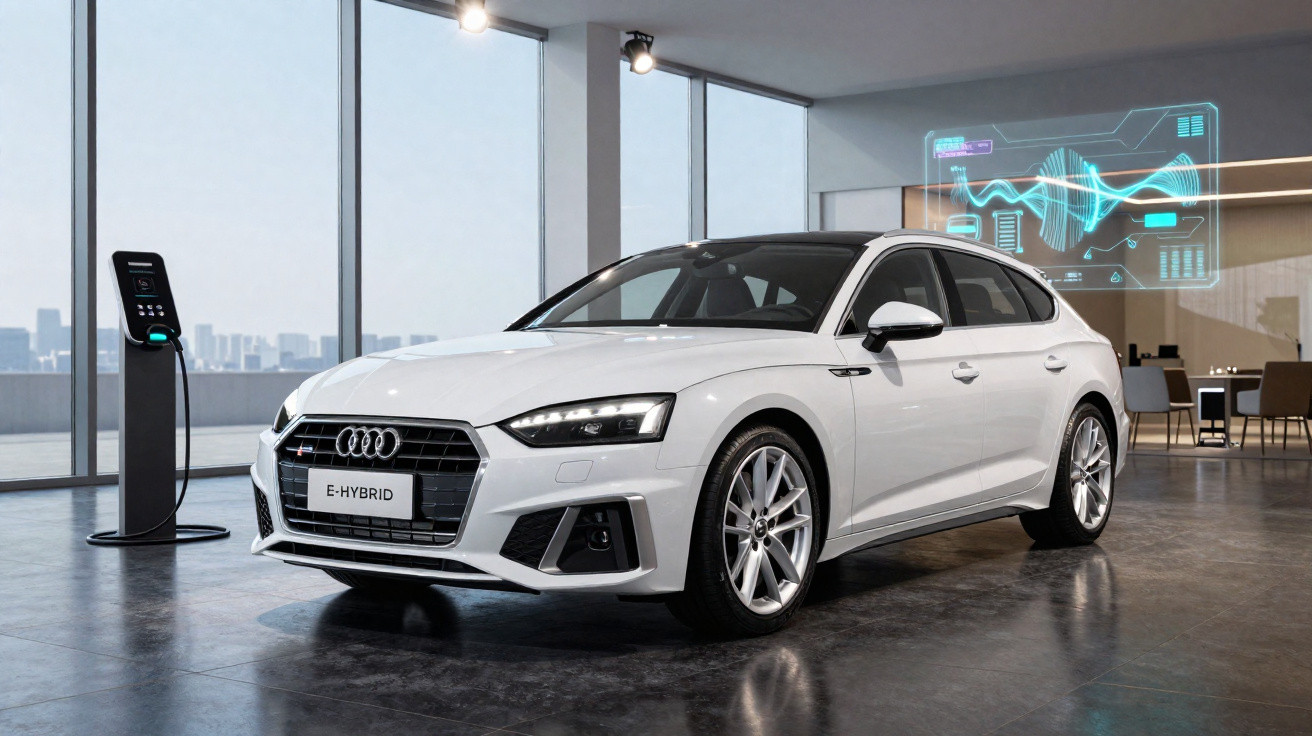
In Portugal, choosing a car is not simply about styling, equipment, performance or price. For businesses, it is also a tax-led decision and part of a wider strategy.
That is where Audi’s latest generation of e-hybrid (PHEV) models comes in. The A5 Avant, A6 Avant and Q5 Sportback are very different cars, yet they share the same starting point: deliver roughly 100 kilometres of WLTP electric range, while keeping the performance and day-to-day flexibility associated with the German brand.
Audi Portugal has positioned the full e-hybrid range for fleets and for private drivers who want electrification without the anxiety of limited range, but with running costs kept under control.
More than 100 km on electricity changes everything
With a 25,9 kWh battery (20,7 kWh usable) that supports AC charging of up to 11 kW - around two and a half hours for a full charge - the new Audi e-hybrid models claim up to 107 km of electric range in the A5 Avant, about 101 km in the A6 Avant and up to 100 km in the Q5 Sportback.
In everyday terms, that means many companies - and many private owners too - can cover most routine journeys in fully electric mode. Home to office. Meetings in town. Family life during the week. All without using a single drop of fuel.
The 2.0 TFSI engine is there for when it genuinely makes sense: longer trips, motorway driving and more demanding use, when you want to benefit from the dynamic strengths these cars can also deliver.
It’s not just a bigger battery - it’s intelligent energy management
Across the new e-hybrid models, Audi has added a predictive management system that combines navigation data, road profile and traffic conditions to decide when to run on the electric motor and when to call on the combustion engine.
The aim is straightforward: extend electric driving as much as possible and improve energy recuperation during braking and deceleration.
For the driver, it operates seamlessly in the background. For anyone tracking operating costs closely, the effect is easy to see: more time spent driving in 100% electric mode day to day and reduced fuel consumption, particularly for those able to charge at home or at work.
This is not simply another plug-in hybrid with a large battery, like so many others. It is a system engineered from the ground up to make meaningful use of that battery, without the driver needing to manage anything manually.
A5 Avant e-hybrid: the most compelling balance
Within Audi’s line-up, the A5 Avant e-hybrid sits at the heart of the range, positioned as a tailored choice for drivers seeking a dynamic, elegant estate.
It pairs the 2.0 TFSI with a 105 kW (143 cv) electric motor, producing a combined output of 299 cv and 450 Nm. There is also a higher-output version that delivers 367 cv and 500 Nm. The 0 to 100 km/h sprint takes 5,9s in the 299 cv model and 5,1s in the more powerful variant.
All of that comes in a package offering 361 litres of boot space (expandable to 1306 litres), intended to meet the demands of family use.
In Portugal, pricing starts at 62 500 euros for the 299 cv quattro version - a figure that even undercuts the equivalent Diesel model. That positioning matters, especially for business customers. The 367 cv version begins at 73 650 euros.
Same technical foundation, different profiles
The A6 Avant e-hybrid uses the same technical approach, but strengthens the offer for those who value more space and higher-segment comfort, with electric ranges close to around 100 km and two power outputs (299 cv and 367 cv), from 71 150 euros.
The Q5 Sportback e-hybrid applies the same idea to the SUV category, retaining quattro all-wheel drive while adding a stronger road presence and a higher driving position, with prices starting at 77 898 euros.
Tax considerations carry real weight
For Portuguese companies (and sole traders), assessing a new vehicle goes far beyond the spec sheet.
Under the tax framework currently in place in Portugal, plug-in hybrids benefit from more favourable treatment than purely combustion models, notably in terms of Autonomous Taxation and the significant (75%) reduction in Vehicle Registration Tax (ISV). There is also the option to deduct VAT within the applicable legal limits.
Against comparable Diesel alternatives, this tax advantage can directly reduce the total cost of use - particularly when it is paired with regular electric driving in daily routines.
For private buyers, the logic is different but still important: less fuel spent on everyday journeys, with the same freedom to travel without complex charging plans.
Configuration and leasing solutions
The e-hybrid range is also offered with various finance and leasing solutions, tailored to both professional and private profiles.
Detailed terms, configurations and simulations can be checked directly via the brand’s official configurator.

Comments
No comments yet. Be the first to comment!
Leave a Comment