
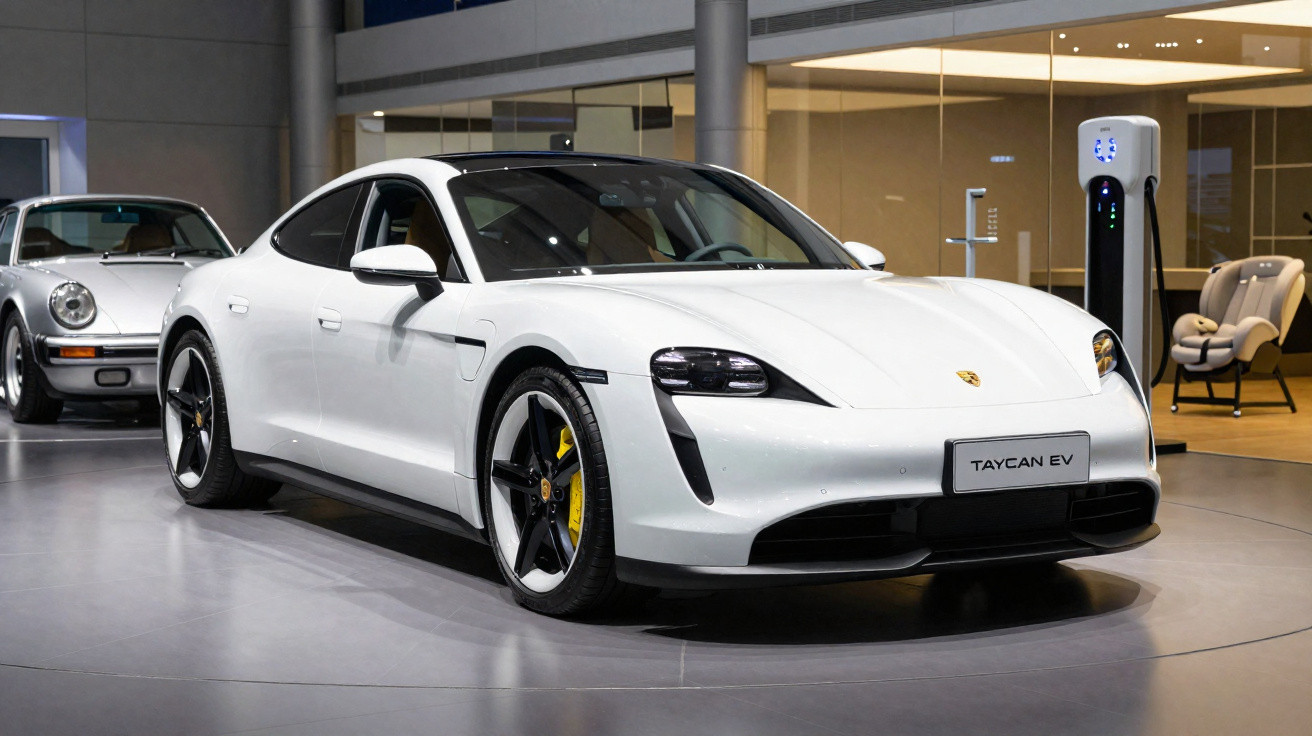
We have already said almost everything there is to say about the Porsche Taycan Turbo - just think back to some of our previous pieces on the Taycan, Porsche’s first electric car.
So if I tell you it’s the most thrilling electric car to drive on the market and that, despite its dynamic focus, it still works brilliantly as a family car, that won’t come as news to anyone.
This time, however, I had the good fortune to drive the Porsche Taycan almost at the same time as another missile: the Porsche 911 Turbo S. That back-to-back experience gave me a different perspective on things - and on where the Taycan Turbo really sits.
Testing the Porsche Taycan Turbo in Portugal
It was also our first Taycan test in Portugal, after having driven it in Los Angeles and in Finland (videos). Shall we get on with it?
The Porsche Taycan isn’t just good “for an electric”
The Porsche Taycan Turbo isn’t only “good” by electric-vehicle standards. It’s simply good, regardless of what you park next to it.
On the days I tested the Porsche Taycan Turbo, my benchmark was just one car: the best car I’ve ever driven, the Porsche 911 Turbo S - the first car ever to receive a full score from Razão Automóvel.
I had to dig deep to remember a car as visceral yet as easy to live with day to day as the Porsche 911 Turbo S. And the more I searched my memory, the clearer it became: there isn’t one. That’s exactly where the Porsche Taycan Turbo enters the picture.
Its acceleration isn’t quite as astonishing, its cornering speed isn’t as high, and its braking isn’t as ferocious - but believe me… the Porsche Taycan Turbo is absurdly close to a car that, for decades, has been regarded as one of the best in the world.
With four-wheel drive, up to 680 hp and 850 Nm (in Launch Control mode), it delivers a brutal shove that pins you into the seat.
The 0–100 km/h sprint takes just 3.2s (the 911 Turbo S needs 0.5s less), and 0–160 km/h arrives in 6.9s. It’s so quick that passengers with more sensitive stomachs may feel queasy. The top speed matches the intent: 260 km/h (limited).
After tackling the demanding Serra da Arrábida twice (in opposite directions) in the Porsche Taycan Turbo, and then living with it on Lisbon’s streets for five days, I have no doubts about its capability. The Taycan is a fully fledged member of the Porsche bloodline.
The Porsche Taycan Turbo in family mode
Anyone shopping for a Porsche Taycan enjoys driving. Otherwise, they would buy a Tesla Model S, which costs less and has batteries that allow a longer distance between charges. On that point, I have no doubt.
Everyday comfort and Porsche build quality
Fortunately, even though it’s genuinely exciting to drive, the Porsche Taycan Turbo also makes an excellent family car. The suspension deals impressively well with every imperfection in the tarmac, and the build quality is… Porsche.
Range and charging in the real world
As for range, the brand quotes between 381–450 km of autonomy (WLTP cycle). In real-world use, with plenty of city driving in the mix, I managed to exceed 400 km between charges.
When it comes to charging speed, don’t worry. With 83.7 kWh of usable capacity, the Porsche Taycan Turbo’s battery can charge at up to 270 kW. In other words, it will charge as quickly as the charger itself allows.
For now, it won’t be easy to find a place to charge at that rate. So, on a home wallbox (7.7 kW) you’ll need 10 hours for a full charge, and under 1h30 to reach 80% on a fast-charging station.
In terms of dynamic ability and build quality, Porsche doesn’t take lessons from Tesla; when it comes to the charging network… well, that’s a different conversation. Even so, my time with the Porsche Taycan Turbo couldn’t have been more rewarding. Perhaps if I had a track like this all to myself:
Comments
No comments yet. Be the first to comment!
Leave a Comment