
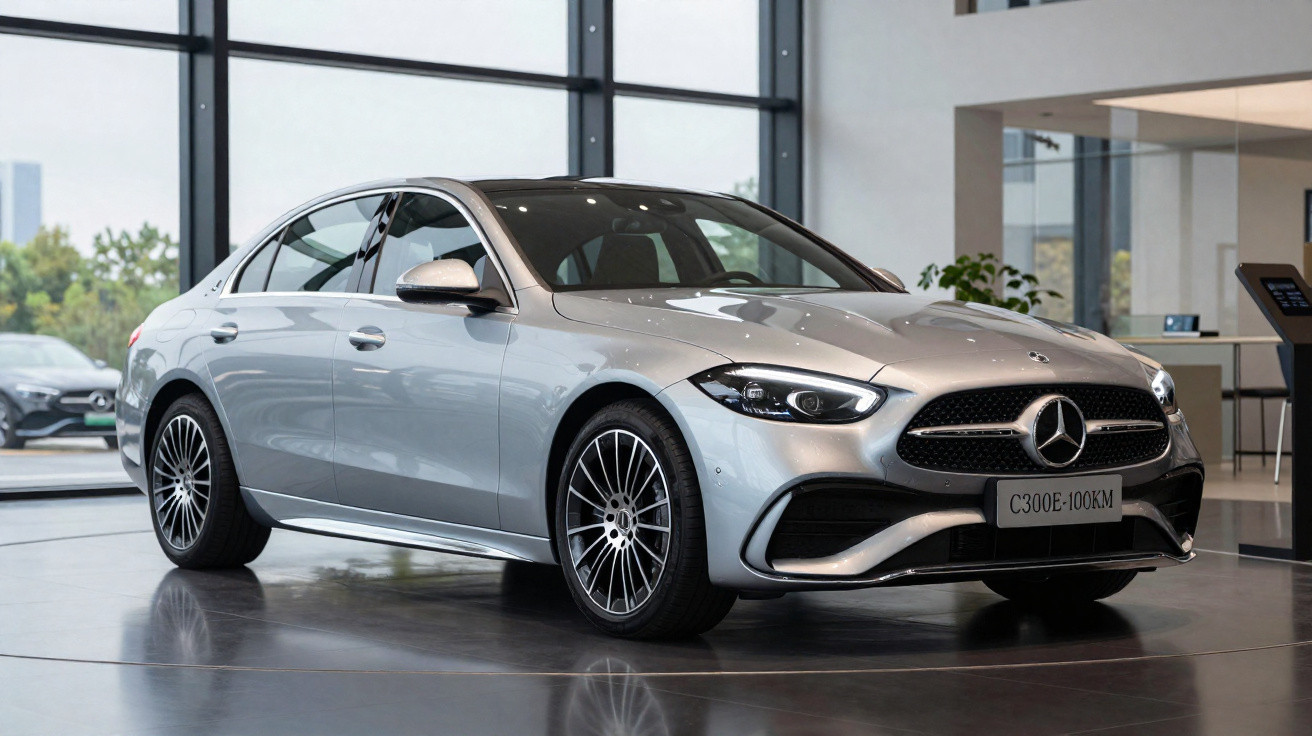
“With this level of electric range we want the C plug-in hybrid to be, above all else, an electric car - and that’s exactly what we engineered the drivetrain to achieve.” That is how Matthias Koepfler, chief engineer for the Mercedes-Benz C 300 e, describes what is billed as the first saloon in the world able to cover more than 100 km in fully electric mode.
That claim has the potential to transform everyday driving. Most motorists do not routinely travel more than a hundred kilometres a day, which means that, from Monday to Friday, this C 300 e can effectively be used as an EV. Even the occasional motorway run can be completed at speeds of up to 140 km/h without waking the petrol engine. Then, at the end of the day, it simply needs plugging in - almost like charging a mobile phone - to restore the battery to full.
And, naturally, when you do need to head further afield, its plug-in hybrid set-up should allow around 800 km (or more) of range from a tank of fuel plus a full battery.
I’ll explain in detail how the German engineers achieved that result (800 km or more of range). First, though, here is a snapshot of the most important changes in the new generation of the C, which has now surpassed 10.5 million units since its origins (initially as the Mercedes 190, only becoming the C-Class in 1993 with the second generation) back in 1982.
The platform (MRA II) has been developed further, a new electronic architecture has been introduced (with a user-experience concept closely aligned with what was recently launched in the new S-Class), the chassis has been revised, and the exterior styling is entirely new. The bonnet is shorter because engines with more than four cylinders have been dropped - even on AMG models - the rear pillars are broader, and the bodywork features cleaner surfacing with fewer creases.
Brand-new exterior design
Across the range, the Mercedes star sits within the radiator grille (with small differences depending on trim level). At the rear, the slimmer, more horizontal light units extend further into the boot lid than on the previous model, and - for the first time on a C - each lamp is split into two separate pieces.
Sticking with the lighting theme, LED headlamps are standard. Buyers can pay extra for the Digital Light system (first seen on the new S-Class), which adds advanced features such as projecting guidance lines or warning symbols onto the road. It delivers exceptionally bright illumination while avoiding glare for other road users, and it can also identify pedestrians in dark areas ahead of the car.
The changes in proportions are modest in width and height (up 1 cm in the first case, down 1 cm in the second). Length, however, grows by 6.5 cm, while the wheelbase is stretched by 2.5 cm.
Track width (the distance between wheels on each axle) increases by 2 cm at the front and 5 cm at the rear. In the latter case, that is also linked to the introduction of rear-axle steering (the only car in the segment to offer it), although it is not available on this plug-in version. This variant also cannot be specified with electronic dampers - “lack of space and excessive technological complexity are the reasons,” Koepfler told me.
The Mercedes-Benz C 300 e chief engineer also underlines that “plug-ins always have rear air suspension to prioritise ride comfort, which would otherwise be compromised by the significant weight of the battery,” positioned directly over the rear axle.
Boot space without intrusion
Inside, overall space is much the same. In practice, four adults can travel comfortably with good room, while a fifth passenger in the rear centre seat will always be affected by the transmission tunnel running along the floor.
The boot continues to provide 455 litres in the saloon (and increases by 30 litres, from 460 to 490, in the estate). The key improvement, however, is found specifically on this C 300 e plug-in hybrid. It still offers less luggage space than the “regular” versions (315 litres in the saloon and 360 in the Estate), yet the big step forward is that the huge intrusion in the boot floor has been eliminated. Previously, that raised section stole volume and, more importantly, reduced usability by making it difficult to exploit a flat load area when the rear seatbacks were folded.
This is despite the high-voltage battery - which powers the hybrid drivetrain and is installed beneath the boot - having doubled in capacity.
Infotainment derived from the S-Class
There is a stronger driver focus, because the central infotainment display is now slightly angled towards the person behind the wheel - a solution more commonly associated with brands that trade on a sportier image.
The screen is 9.5” (or 11.9”), and its format, placement and operating system closely mirror those in the new S-Class. As Maxi Vogel, the electronics engineer who led the rollout of this user interface, explained: “I’d say 80% of the systems are the same, but in the C-Class we don’t have the 3D module or the Augmented Reality (AR) projection in the instrument display, as you do in the S-Class.”
Even so, paired with the new instrument cluster - a 10.25” (or 12.3”) digital LCD that is fully configurable - the aim is to take the whole user experience forward, in the same way that driver-assistance systems have advanced.
There are three dial themes (Discreet, Sport and Classic) and three modes (Navigation, Assistance, Service) to choose from. Voice control is available in several languages, and buyers can opt for a head-up display that projects information “floating” 4.5 m ahead of the vehicle.
Simplified driving
Five air vents are fitted (three in the centre and two at the outer ends of the neatly finished dashboard). There is also a new steering wheel with a smaller diameter, a thicker rim and a flattened lower section, giving it a noticeably sportier look.
Behind the C 300 e’s steering wheel you’ll find paddles that, in Sport mode, can be used for manual gear changes. They can also be used to increase or decrease the strength of regenerative braking. At maximum deceleration, you can drive largely using only the right-hand pedal, making it possible to all but ignore the brake pedal in most traffic situations (energy recuperation is now possible at more than 100 kW).
However, there is one fewer regeneration step than before. Koepfler explains: “Today we have D+ with no recuperation, D with weak recuperation and D- with strong recuperation, and we dropped D– because customers of the previous C 300 e told us it was too much deceleration and they wanted the car to be less complicated to drive.”
There are four drive modes: B (to conserve battery charge), EL (electric), H (hybrid) and Sport. Various settings can then be mixed and matched in the I (individual) programme. By contrast, Battery Charge mode - which used the petrol engine to charge the battery - has been removed because it was highly inefficient from an energy standpoint.
As usual, it is possible to manage the powertrain strategy by linking it to the navigation system, which helps reduce consumption and maximise electric range.
In addition, plug-in hybrids get a haptic accelerator pedal module with a pressure point (at an angle of 9.7º). Up to that point, acceleration remains purely electric (up to the same 140 km/h), and beyond it the petrol engine “wakes up”, adding its extra power and torque.
Almost double the electric range
Like the plug-in hybrid system itself, the high-voltage battery is now in its fourth generation. Energy density has been improved to reach a capacity of 25.4 kWh (larger, for example, than the first all-electric Nissan Leaf), which is almost double what was previously available. That, in turn, explains why the maximum electric driving range rises to 110 km - roughly twice what it managed before and also around double what direct rivals from BMW and Volvo offer.
The battery now features an internal temperature management system, improving performance in extreme climates (hot or cold). It also enables DC (direct current) charging, which can dramatically speed things up. With the optional 55 kW on-board charger, a full charge takes just half an hour. Even with the standard 11 kW charger (three-phase on a Wallbox), the same job can be done in about three hours.
Priority to… environmental performance
The system combines a 2.0-litre engine producing 204 cv (seven fewer than before) with a more powerful electric motor (permanent-magnet synchronous) rated at 129 cv (seven more than before) and 440 Nm, for a total system output of 313 cv and 550 Nm.
It is worth recalling that the previous generation delivered 320 cv and 700 Nm. In the case of torque, those 700 Nm were only available “in a very brief peak, whereas now the 550 Nm are at the driver’s disposal over a much longer plateau,” Matthias Koepfler clarified.
Fuel consumption figures are still provisional, averaging around 1.0 l/100 km - clearly lower than the predecessor’s 1.6 l/100 km - although the earlier car was quicker in acceleration and top speed.
Even so, reaching 100 km/h in about six seconds (the previous model did it in 5.6s) and a top speed of 245 km/h (versus 250 km/h before) show that, despite weighing around two tonnes (some 150 kg more than before), the C 300 e is anything but slow.
More “connected to the road”
The new C 300 e always pulls away in full electric mode. Only if you are heavy-handed with the accelerator, push through the pedal resistance, or exceed 140 km/h do you “wake” the petrol engine.
It is clear the updated suspension - independent front and rear, with multi-link layouts in both cases and a rear subframe - has been tuned to make the new C more agile and sporting. The reduced steering lock-to-lock reinforces that objective, dropping from 2.35 turns to 2.1 turns in this generation.
It can also be genuinely enjoyable to use the steering-wheel paddles either to shift gears (always through the 9-speed automatic) - only in Sport mode - or to adjust the level of energy recuperation via deceleration.
Smoothness remains the defining characteristic of the C 300 e’s driving experience, thanks to its ride quality, the strong level of cabin sound insulation and, naturally, the fully or partially electric nature of its propulsion.
And when instant performance is required, a firmer push of the right-hand pedal makes the C 300 e capable of swift launches and strong in-gear acceleration.
On the most varied section of the test route - 51 km, mainly on secondary roads, through small towns and with a short motorway stretch - I recorded an average of 0.4 l/100 km (and 22.6 kWh/100 km). That is clearly below Mercedes-Benz’s provisional figure, and it will rise the more distance is covered at higher speeds while urban sections decrease.
Either way, it clearly indicates that the emphasis on electric driving has been successfully delivered, and that anyone whose daily trips are under 100 km can reduce the energy bill associated with using the car quite significantly.
Too much information?
To finish, the less positive points. This is an issue across the entire automotive industry, but the rise in screens and projections in modern cars creates challenges and makes it advisable to be selective.
Here, there is the central infotainment display, the instrument cluster and, in many cases, a head-up display as well - frequently repeating the same information twice or even three times. I’m not convinced the head-up display is a worthwhile option unless the information shown on each screen is very carefully curated to avoid eye fatigue and driver distraction.
That is especially true because Augmented Reality navigation prompts do not appear in the head-up display (as they do in the S-Class or the EQS). Instead, they are shown on the central screen, forcing the driver to look too far away from the road to see them.
On another note, the C 300 e’s transmission selector stalk looks and feels rather basic, falling short of the otherwise high perceived quality (materials and build) in this cabin.
Finally, the lack of progressive response from the brake pedal still has not been resolved. In the first third of its travel it generates almost no speed reduction (a problem common to Mercedes-Benz mild hybrids and plug-in hybrids). That takes away smoothness and can make the driver feel less secure.
Technical specifications
| Mercedes-Benz C 300 e | |
|---|---|
| Combustion engine | |
| Position | Front longitudinal |
| Architecture | Inline 4-cylinder |
| Capacity | 1999 cm³ |
| Valvetrain | 2 a.c.c.; 4 valves/cyl. (16 valves) |
| Fuel system | Direct inj., Turbo and Intercooler |
| Power | 204 cv at 6100 rpm |
| Torque | 320 Nm (rpm N.A.) |
| Electric motor | |
| Power | 95 kW (129 cv) |
| Torque | 440 Nm |
| Maximum combined output | |
| Maximum combined power | 230 kW (313 cv) |
| Torque | 550 Nm |
| Battery | |
| Type | Lithium-ion |
| Capacity | 25.4 kWh |
| Charging | |
| Chargers | AC (alternating current): 11 kW; DC (direct current): 55 kW |
| Charging times | 2.3 kW (AC): 10 hours; 11 kW (AC, three-phase): 3 hours; 55 kW (DC): 30 minutes. |
| Transmission | |
| Drive | Rear-wheel drive |
| Gearbox | Automatic (torque converter) 9-speed |
| Chassis | |
| Suspension | FR: Independent multi-link; TR: Independent multi-link |
| Brakes | FR: Ventilated discs; TR: Discs; |
| Steering/No. of turns lock-to-lock | Electric assistance/2.1 |
| Dimensions and capacities | |
| Length x Width x Height | 4751 mm x 1828 mm x 1437 mm |
| Wheelbase | 2865 mm |
| Boot capacity | 315 l |
| Fuel tank capacity | 50 l |
| Wheels | FR: 225/50 R17; TR: 245/45 R17 |
| Weight | 1990 kg |
| Performance and consumption | |
| Top speed | 245 km/h; Electric mode: 140 km/h |
| 0-100 km/h | 6.0s |
| Combined consumption | 0.7-1.1 l/100 km |
| Combined electric consumption | 20-23.5 kWh/100 km |
| Electric range | 90-110 km; |
| CO₂ emissions | 14-24 g/km |
Note: Estimated final price of 59 000 euros
Comments
No comments yet. Be the first to comment!
Leave a Comment