
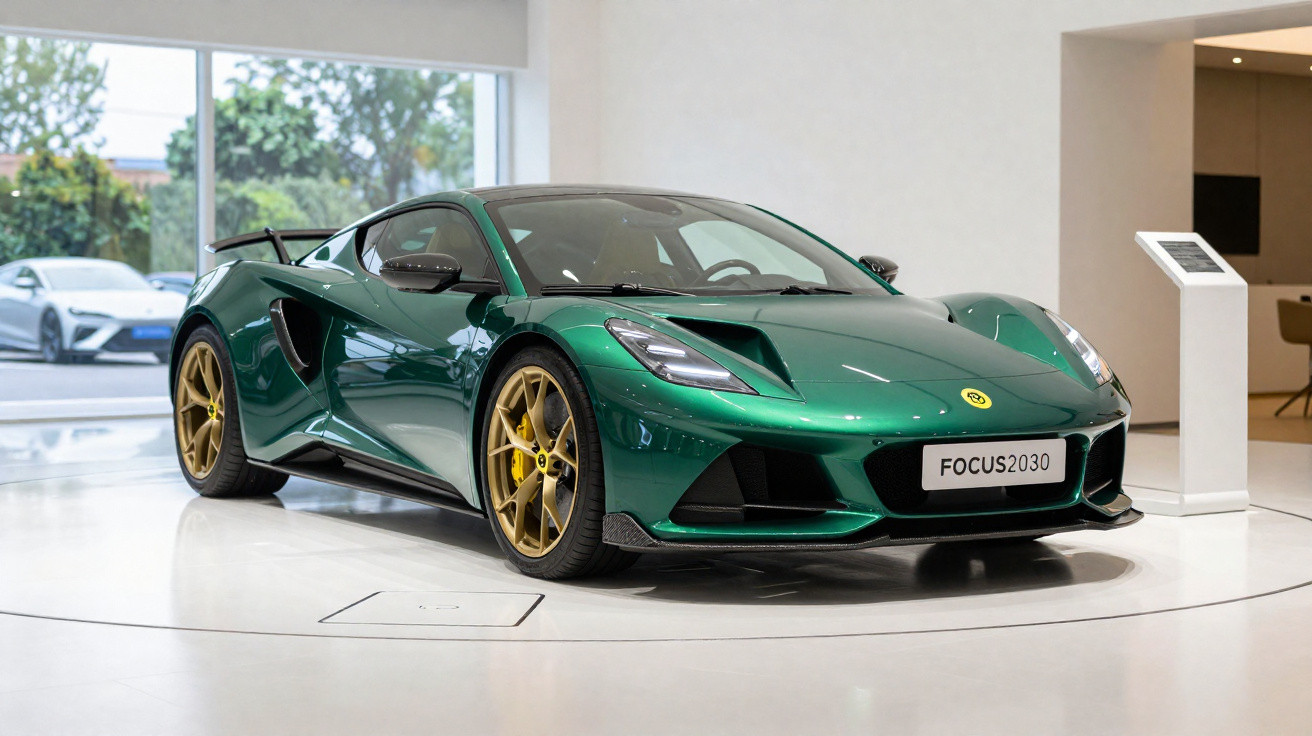
In 2021, Lotus said it would stop launching new internal-combustion models and that, by 2028, its line-up would be fully electric.
Five years on, that roadmap has been scrapped.
The new strategy is called Focus 2030 and it marks a major change in direction. Battery-electric cars remain part of Lotus’s future, but they are no longer the only answer. The plan now includes plug-in hybrids, combustion engines, and room to extend the life of models such as the Emira.
Lotus believes hybrids could account for around 60% of sales across its electrified range, with the remaining 40% coming from 100% electric models. That is a notable shift for a brand that, until recently, presented the Eletre, Emeya and Evija as the start of an irreversible transformation.
This pivot is largely explained by results that have fallen well short of ambitions. In 2025, Lotus delivered 6520 cars, down 46% on the previous year, and slipped back into the red, reporting losses of 464 million dollars (404 million euros).
The original target of 150,000 annual sales was plainly detached from reality. Even after being cut to a more plausible 30,000 units under the new plan, it still requires Lotus to increase the just-over-6,500 deliveries recorded in 2025 by almost fivefold.
With demand for electric cars rising more slowly than expected, incentives being reduced, and tariffs punishing models built in China, sticking to an EV-only strategy would have made a turnaround even harder.
Becoming Lotus again
Focus 2030 is also framed as an attempt to reclaim Lotus’s identity. The company says it will once again place lightness, aerodynamics, engineering and driver involvement at the heart of its cars-qualities that can be difficult to see in the heavy Eletre, Emeya and even the Evija.
Chief executive Qingfeng Feng acknowledged the tension, arguing that a sports car weighing more than 1,800 kg can hardly be truly good-and every electric Lotus sits above that threshold. The goal now is to bring what Lotus builds closer to what its name is meant to stand for.
The first hybrid has already arrived
It may take several years for the renewed focus to show its full results, but the retreat from an all-electric ambition has already begun with the Eletre X, the plug-in hybrid version of the brand’s SUV.
It pairs a combustion engine with electric motors and a 900 V architecture. Lotus claims up to 952 cv (metric horsepower), 0–100 km/h in 3.3s, and more than 1,200 km of combined range.
In China, where it is sold under the unusual name For Me, it attracted more than a thousand orders in its first month. European deliveries are expected to start in the final quarter of 2026.
Lotus plans to roll this long-range hybrid technology out to other models, likely including the Emeya. The electric versions of the Eletre and Emeya will remain on sale.
Emira continues and gets more power
The Emira-intended to be the last Lotus with a combustion engine-has effectively been granted a reprieve. It will keep being built in Hethel and has already gained a more powerful variant, the 420 Sport.
Its Mercedes-AMG-sourced, turbocharged 2.0-litre four-cylinder now produces 420 cv and 500 Nm. With the Lightweight Handling pack, the Emira sheds 25 kg thanks to parts such as a titanium exhaust, a lithium-ion battery and adjustable Multimatic dampers. At 1,430 kg (DIN), it becomes the lightest Emira so far.
More substantial changes may also be on the way for the sports car. The current Toyota- and Mercedes-AMG-derived engines could be replaced by a 3.0-litre twin-turbo V6 developed by Horse Powertrain, a company created by Geely and Renault.
Designed from the outset for electrified drivetrains, this engine would allow Lotus to retain a compact combustion-engined sports car while still meeting future environmental requirements.
A hybrid V8 supercar in 2028
However, it is the Type 135-also known internally as Vision X-that most clearly illustrates the shift. Initially conceived as the Emira’s 100% electric successor, it is now set to be a V8 hybrid supercar with more than 1,000 cv and production planned for Europe (cover image).
First deliveries are scheduled for 2028. Little else is known about the supercar, and it has not been confirmed whether the Esprit name will return. Even so, it will be the first road-going Lotus with a V8 since the Esprit was discontinued in 2004.
It will also be the first major test of Focus 2030. Lotus will need to deliver more than 1,000 cv of “electrified” performance without repeating the issue it now recognises in its high-performance EVs: excessive weight.
Comments
No comments yet. Be the first to comment!
Leave a Comment