
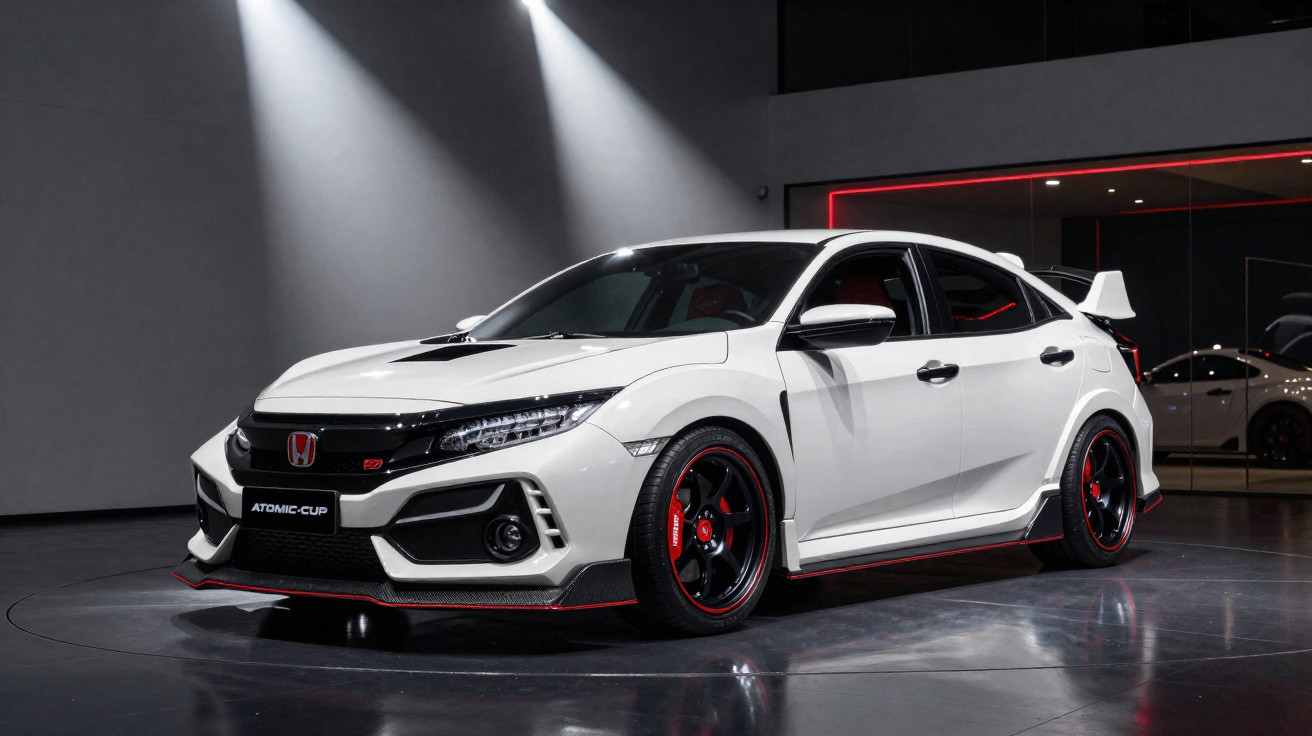
The recipe is straightforward, but pulling it off is anything but. Step one is the easy bit: bring a cult car back from the past, strip away everything unnecessary, let it speak properly (read: a freer-flowing exhaust), sharpen the suspension, and raise the safety bar.
Next, you add a professional organisation, mix proven names with rising young talent, keep costs under control, and turn the fun and competitiveness up to the maximum. In short, that is what Motor Sponsor is preparing for 2022. A «proper feast» with a name: Civic Atomic Cup.
We headed to Estoril to sample the first «starter» from this menu, put together by the «Chefs» André Marques and Ricardo Leitão of Motor Sponsor, with technical backing from TRS – Touge Racing Service. That tasting is what I’ll describe in the lines that follow.
If I can pass on what I felt from behind the wheel of the Civic Atomic Cup at Estoril, I’m sure you’ll finish this wanting to take part-and to start looking for sponsors for a season. Visit the website here; Motor Sponsor can help with any questions.
Life goes on after 8,000 rpm…
Before I get into my time driving the Civic Atomic Cup at Estoril, it is worth revisiting the model it is built on. Anyone born before the new millennium will remember exactly when the Honda Civic Type R EP3 arrived. It was the first Type R officially sold in Europe. Even if its body shape looked like a cross between an MPV and a hatchback, it was a genuinely brilliant hot hatch.
The chassis was expertly dialled in by Honda’s Japanese engineers and, while it did not deliver quite the same experience as the essential Honda Integra Type R, it was by no means worlds apart from that Japanese «monster». True, the EP3’s steering could have offered a little more feedback, but not to a degree that seriously undermined the drive.
Then there was the engine: the famous K20A2. Full of character and seemingly addicted to revs, this naturally aspirated 2.0-litre four-cylinder produced 200 bhp and 196 Nm of peak torque, and «sang» all the way to 8,100 rpm with real determination. Those figures may sound ordinary today, but there is nothing ordinary about an old-school VTEC engine-thank you, Honda.
Better still… in every way
As you can tell, the Honda Civic Type R EP3 has everything needed to be a strong base for racing. It is light, fundamentally well engineered, and powered by an engine that can take serious punishment. In fact, at the time it launched, many one-make trophies across Europe were built around this Japanese model-Portugal included.
Nearly 20 years later, the EP3 is back on track thanks to the Civic Atomic Cup. By focusing only on what matters, Motor Sponsor has created something genuinely impressive.
So what has been changed? The cars receive a Quaife limited-slip differential, Bilstein competition dampers, brakes fitted with race pads, a performance exhaust system, and the mandatory FIA-homologated roll cage plus the corresponding fire-extinguishing system. Inside, anything non-essential has been removed.
On circuit, the differences are obvious-and the stopwatch confirms it. A lap of the Estoril Circuit takes around 2min04s.
The engine’s «howl» fills the cabin like never before-thanks to the lack of sound-deadening and the new exhaust-and the 200 bhp feels freshly energised because of the weight reduction.
Braking is another clear winner from these updates. Even though the system remains standard, it held up stoically (with no sign of fade!) during an intense run of 10 laps «flat out» at Estoril-though the ABS deserves a less flattering mention, as it became too intrusive under heavy braking combined with downshifts.
Beyond that, it is simply a matter of driving it as a «front-wheel drive» car should be driven: not too much steering lock, clean lines, and the rear end helping during weight transfer. Now add a grid packed with established drivers and promising newcomers, all on equal terms. In a word: magnificent.
Costs won’t keep anyone awake at night
Compared with similar championships, the Civic Atomic Cup costs less than half as much. The biggest slice of the investment is, without question, buying the Honda Civic Type R (€15 000). As for running costs, fuel comes to €200 per round; entry is €750 per round; and tyres are €480 per round (Toyo R888R in 205/40/R17), supplied by Dispnal.
Front and rear brakes, supplied by Atomic Shop, last two rounds and cost €106.50 and €60.98 respectively. Finally, the FPAK licence (National B) costs €200/year and the technical passport comes in at €120.
If there is contact and minor knocks (or even bigger ones…)-sometimes unavoidable in racing-the cost of replacement parts is also very competitive. Parts availability for this model is broad, and prices after an incident won’t keep anyone awake at night.
For all these reasons, the Civic Atomic Cup grid is starting to take shape. More than 12 teams have already confirmed for the 2022 season-a figure that continues to rise. As for me, I’m off to find a Type R and I’ll be back-there are a few here.
Comments
No comments yet. Be the first to comment!
Leave a Comment