
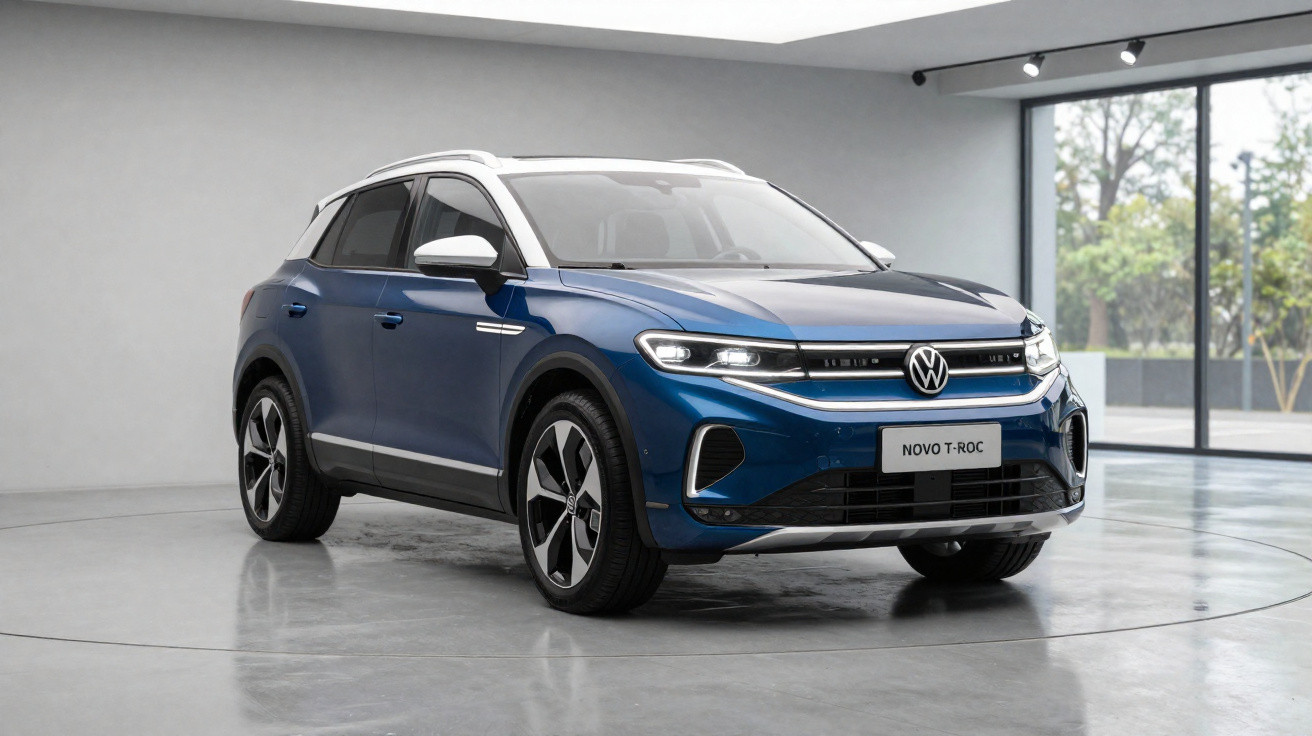
Although it may carry a German passport, the Volkswagen T-Roc is also Portuguese - and its track record is a success story.
Built at Autoeuropa in Palmela, it has shifted more than two million units since its 2017 launch and even managed to unseat the Golf as Volkswagen’s best-selling model in Europe. In Portugal it is not simply “another SUV”; it is something closer to a homegrown flagship for the national car industry.
That is why the newly unveiled second generation arrives with big expectations. Even at this early stage, it is clear the new Volkswagen T-Roc represents a positive step forward on several fronts - and anything less would have been a surprise.
Bigger, more aerodynamic and more expressive
The T-Roc 2026 has grown in every direction, creating more separation from the T-Cross and moving it closer to the Tiguan. Length increases by 122 mm (4,373 m), width by 9 mm (1,828 m) and height by 9 mm (1,562 m), while the wheelbase stretches by 28 mm (2,631 m).
That extra size pays off inside, with added room for elbows and legs, plus more luggage space. Boot capacity rises to 465 litres (+20 litres), which should make family holidays possible without having to play “Tetris” with suitcases.
The second-generation silhouette still feels familiar - with a more coupé-like profile, a redesigned “hockey stick” feature and a new rear spoiler - yet it is also aerodynamically improved. The Cx (drag coefficient) is now 0,29, around 10% lower than before, which should help both fuel consumption and refinement.
Even so, Volkswagen has not taken major styling risks - the logic of “don’t change a winning team” clearly applies here. Instead, the brand has aligned the T-Roc with its newer models by adding more expressive details, including new front and rear light clusters connected by illuminated light bars. Another first for the T-Roc: an illuminated Volkswagen badge, both at the front and the rear.
Fewer buttons and more technology
Inside, Volkswagen is promising a step up in perceived quality, with the dashboard trimmed in padded fabric and ambient lighting shining through perforated leatherette.
The interior design continues the move towards minimalism, with fewer buttons and fewer traditional decorative elements. It is also positioned as more sustainable: the Volkswagen T-Roc 2026 uses up to 40 kg of recycled plastics inside, accounting for 20% of the total. There are also several easter eggs tucked away in different storage areas - small German cultural nods such as pretzels and coffee.
The transmission selector - now DSG only (dual-clutch), with the manual gearbox dropped - has been relocated to the steering column. This has helped to “clean up” the cabin and make better use of the centre console, which now offers more storage. Wireless smartphone charging also gains active cooling.
The infotainment system is the latest-generation MIB4, accessed via either a 10,4” screen (without navigation) or a 12,9” screen (with navigation that can also be activated later by download). Volkswagen says the interface is more intuitive thanks to fixed shortcuts, a redesigned home screen and a top bar.
The 10” Digital Cockpit Pro keeps its customisable information layout, while a head-up display makes its debut on the Volkswagen T-Roc. For those who are not keen on touchscreens, voice control is available via the IDA assistant, which integrates ChatGPT.
Even with fewer physical controls overall, there is a new multifunction controller on the centre console that lets you switch between volume, driving profiles and even the cabin ambience.
The first full-hybrid from Volkswagen
One of the headline changes for the second-generation Volkswagen T-Roc is the introduction of a (full hybrid) powertrain that does not require external charging - the same type of solution already offered by brands such as Toyota, Renault and Hyundai.
It will only arrive in 2026, but the starting point is already known: the familiar 1.5 TSI petrol engine paired with an electric motor, offered with two power levels - 136 cv and 170 cv (both with 306 Nm of torque). It is expected to deliver short-distance 100% electric driving and fuel consumption 15% lower than 48 V mild-hybrid versions.
Until the T-Roc Hybrid appears, the launch line-up will be petrol mild-hybrid only. These are familiar Volkswagen units: the 1.5 eTSI with 116 cv and 150 cv, always paired with a seven-speed DSG. Efficiency measures include ACTplus cylinder deactivation and coasting (freewheeling) with the engine switched off.
At the top of the range will sit the 2.0 TSI 4MOTION with all-wheel drive, although specifications for this version have not yet been released. Volkswagen Chief Executive Officer Thomas Schäfer has also confirmed that the T-Roc R will return.
Finally, the Volkswagen T-Roc 2026 will be equipped with a broad set of driver-assistance systems. Standard kit includes Front Assist, Lane Assist, Cruise Control, a fatigue alert, and emergency braking with pedestrian and cyclist detection.
Options raise the bar further: Travel Assist with assisted lane changes, predictive road adaptation, and even an automatic stop if the driver falls asleep at the wheel. There is also Park Assist Pro, which can memorise manoeuvres of up to 50 m and allows parking via smartphone. All of this is supported by 360° vision and door-opening alerts (Exit Warning).
When does it arrive?
The new Volkswagen T-Roc does not reinvent the wheel, but it develops the model in the areas that matter, building on a remarkably strong sales record. And it will continue to leave Palmela for the world, carrying not only the weight of Portuguese production but also the responsibility of being one of Europe’s best-selling models.
It will be publicly unveiled at the Munich Motor Show (IAA Mobility 2025) on 9 September, which also marks the start of pre-orders, but the second-generation T-Roc is due to reach the market in November 2025.
Prices have not been announced yet, but with the 1.0 TSI removed from the range - and with our outdated taxation that penalises engine displacement - the new T-Roc’s entry price is likely to sit above the current model’s 32 342 euros.
Comments
No comments yet. Be the first to comment!
Leave a Comment