
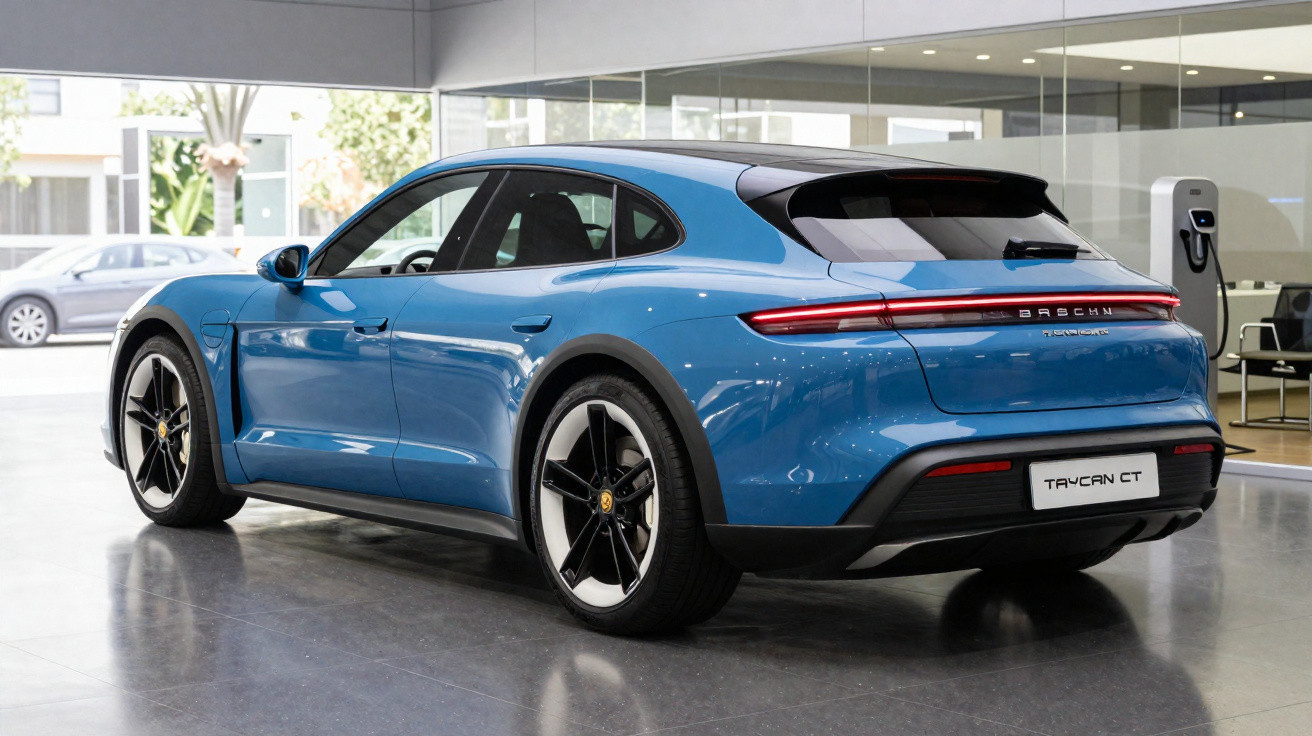
Porsche can barely keep up. The Porsche Taycan has turned into a major sales hit, and the arrival of the new Porsche Taycan Cross Turismo looks set to pile even more strain onto the German brand’s production line. In Portugal, Porsche expects the new Taycan Cross Turismo to account for 60% of the sales mix.
That confidence makes sense. This new take on Porsche’s fully electric model seems to tick every box for Portuguese drivers: the estate-style shape that has long appealed locally, the crossover-like stance thanks to increased ground clearance (+20 mm), and the extra cladding and protective elements that create a more adventurous look for this derivative of the German EV.
Looks aren’t everything, though, so we covered around 300 km behind the wheel of the new Porsche Taycan Cross Turismo to understand what you gain - and what you give up - compared with the “standard” version.
What we gain with the Porsche Taycan Cross Turismo
One of the biggest advantages of the Porsche Taycan Cross Turismo is the styling - already mentioned - but choosing the Cross Turismo over the saloon brings other benefits too.
Because the rear section has been comprehensively redesigned, boot space increases to 446 litres - 39 litres more than the conventional Taycan - and rear passengers also get an extra 47mm of headroom. In practice, the Porsche Taycan Cross Turismo is a genuinely pleasant, comfortable place to sit - more so than its silhouette might suggest.
As well as being roomier, the Cross Turismo is simply more usable. With the extra 20 mm of ground clearance, it’s easier to attempt the occasional more ambitious detour away from tarmac - for instance, reaching a more secluded beach, or getting to that trailhead with a little more peace of mind for a mountain-bike ride.
To make those outings feel more natural, the Taycan Cross Turismo introduces a new “gravel” driving mode, which adapts power delivery, the ABS system and stability control to suit lower-grip surfaces (dirt, snow or mud). For drivers who really will “use and abuse” rough tracks, there’s an “off road” package that strengthens the underbody protection and lifts ride height by a further 10 mm.
What we lose with the Porsche Taycan Cross Turismo
In truth, we lose plenty. To start with, there’s the extra 6 000 euros Porsche asks for this Cross Turismo 4S versus the saloon - which, in my view, is entirely justified.
You also sacrifice a small amount of sharpness on corner entry, a consequence of the higher ride height - but the difference is so minor it’s barely worth flagging, unless your off-road “excursions” include track afternoons at the Circuito do Estoril or Portimão. If that’s not on the agenda, the Porsche Taycan Cross Turismo remains a brilliant companion for tackling a mountain road.
Porsche knows exactly what it’s doing, and few manufacturers build sports cars for the “real world” as capable as Porsche does. Every component in the Taycan Cross Turismo communicates with the driver and delivers extremely high performance.
Even with the extra ground clearance, it’s still hugely rewarding to explore this model’s limits. And as your eyes pick out the exit of a bend, you can rely on the shove from the two electric motors; in the 4S we tested, output sits at a healthy 490 cv - rising to 571 cv in “overboost” or when you activate “launch control”.
If that doesn’t sound like enough, there’s the Turbo with 625 cv (680 cv in “overboost”) for 160 435 euros, and the Turbo S with 625 cv (761 cv in “overboost”) for 194 875 euros. For the more restrained, the 4 is available with 380 cv (476cv in “overboost”) for 99 418 euros.
What to expect in everyday use
We’ve been talking about the “real world”. And in the “real world”, you’re not constantly calling on everything the Porsche Taycan Cross Turismo can do dynamically.
Instead, you live with other priorities: comfort, space and, of course, battery capacity. With a 93,4 kWh battery pack, Porsche quotes a 452 km combined-range figure (WLTP) for the 4S. Our drive was too short for definitive conclusions, but real-world range in a 50/50 mix of road and motorway driving should be around 360 km.
That isn’t a jaw-dropping number, but it doesn’t undermine daily use either - provided, naturally, that the future owner of this Taycan Cross Turismo has a home wallbox charger. A requirement that applies to pretty much all electric cars.
Comments
No comments yet. Be the first to comment!
Leave a Comment