
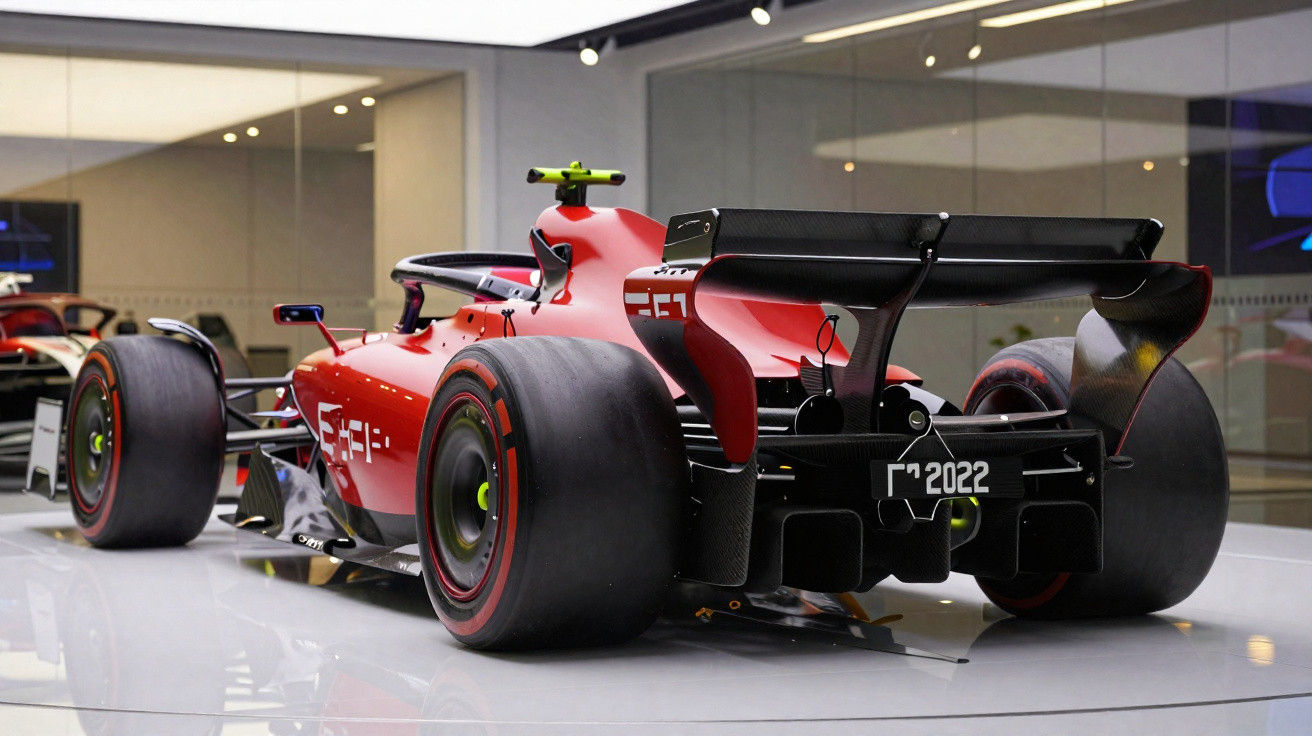
The Formula 1 single-seaters being introduced for the 2022 season - of which we saw the first prototype at this year’s British Grand Prix - will look and behave quite differently from the cars racing in 2021, and there is near-universal agreement that they will be far more visually appealing.
2022 Formula 1 cars: what changes compared with 2021?
The contrast between the 2021 and 2022 cars is immediately obvious. One of the quickest details to spot is the move to larger-diameter wheels: 18-inch rims replace the current 13-inch set-up.
Aerodynamics in 2022: the push to make overtaking easier
Where the biggest shift is expected, however, is aerodynamics - aimed (as always) at making overtaking simpler and race-to-race competition more intense.
At a glance, the 2022 car appears much more “clean” than a 2021 Formula 1 car. That comes from “cleaning up” aerodynamic surfaces: there are fewer of them, and the ones that remain are drawn in a simpler, less cluttered way.
A direct consequence is that the new cars will not be able to produce as much downforce (negative lift) as the 2021 cars. Even so, the key goal of the new aerodynamic rules was not to cut downforce, but instead to create less “dirty air”.
“Dirty air”? What does that mean?
This is not air that is… polluted. Rather, it is the name (in English, dirty air) given to the turbulent airflow that forms behind a car as it forces its way through the atmosphere. For the single-seater following behind, the driver quickly feels the impact of that turbulence disrupting the airflow around their car.
With the airflow disturbed, the aerodynamic surfaces become less efficient. That reduces the amount of downforce the car can generate, and as a result grip falls and cornering speeds drop.
When one car runs close behind another, it loses between 35% (20 m of separation) and 46% (10 m of separation) of its downforce. This goes a long way towards explaining why it is so difficult for a driver to remain tucked up behind the car they are chasing.
Reducing the volume of “dirty air” is therefore essential - and this is precisely where the new car’s aerodynamics are designed to make the difference.
Curved rear wing
The aerodynamic component prompting the most curiosity and debate on the new single-seater is the rear wing, whose design could hardly be more different from what Formula 1 uses today.
Curved rear wing
On current F1 cars, the rear wing looks a bit like a box: there are two uniform wing profiles (the wing itself), “enclosed” by two flat vertical plates known as endplates.
This arrangement is highly effective at creating huge amounts of downforce, but it also leaves a great deal of turbulence in its wake - largely because of those endplates.
They help guide airflow over the wing profiles, strengthening the high-pressure area formed on the upper surface of the wing, which in turn boosts downforce. At the same time, they generate vortices that create significant turbulence behind the car, damaging the quality of the airflow available to the car that follows.
Venturi tunnels, ground effect and the new floor
With the 2022 rear wing, the approach changes dramatically: straight, flat elements disappear in favour of fully curved surfaces, and endplates are removed. Without the endplates “fence” effect, some of the high-pressure air created above this curved wing is allowed to spill out at the sides. That reduces not only downforce, but also the amount of “dirty air” produced.
To make up for the loss of downforce, the 2022 Formula 1 cars will adopt a new floor. Instead of being flat, it runs Venturi tunnels along its full length to create ground effect. In other words, as air is accelerated through these tunnels it produces a suction effect, effectively “sticking” the car to the tarmac. The floor - rather than the aerodynamic surfaces on top of the car, such as the rear wing - becomes the main source of downforce.
It is an efficient solution, and it also supports the wider objective of reducing “dirty air” in the car’s wake.
Even so, “dirty air” will still be produced (there is no way to eliminate it completely, because it is a natural result of an object “punching a hole” through the air). But the new curved rear wing has one more “trick”…
Counter to what you might expect, it is shaped to steer the “dirty air” towards the centre and directly behind the rear diffuser - when it might seem more logical to push that turbulent, undesirable air away from the car.
The explanation, once again, lies with the new floor. As noted, the floor is now the primary generator of downforce, speeding up the airflow through its Venturi tunnels towards the rear diffuser.
That accelerated flow coming from underneath and exiting via the diffuser picks up the “dirty air” that the curved rear wing has concentrated in that zone, then throws it upwards and away from the following car. This also explains the presence of a second wing element positioned lower down, but immediately above the diffuser.
That lower element creates a low-pressure region that helps intensify the effect, drawing in the turbulent air so it can be carried away by the diffuser’s airflow. Clever, isn’t it?
The end result? The car behind now loses only 18% of its downforce (10 m of separation), rather than the 46% we saw earlier!
For more detail on the new curved rear wing, watch the video published by driver Scott Mansell (not related to Nigel Mansell) from the Driver61 channel (in English, with no subtitles):
Comments
No comments yet. Be the first to comment!
Leave a Comment