
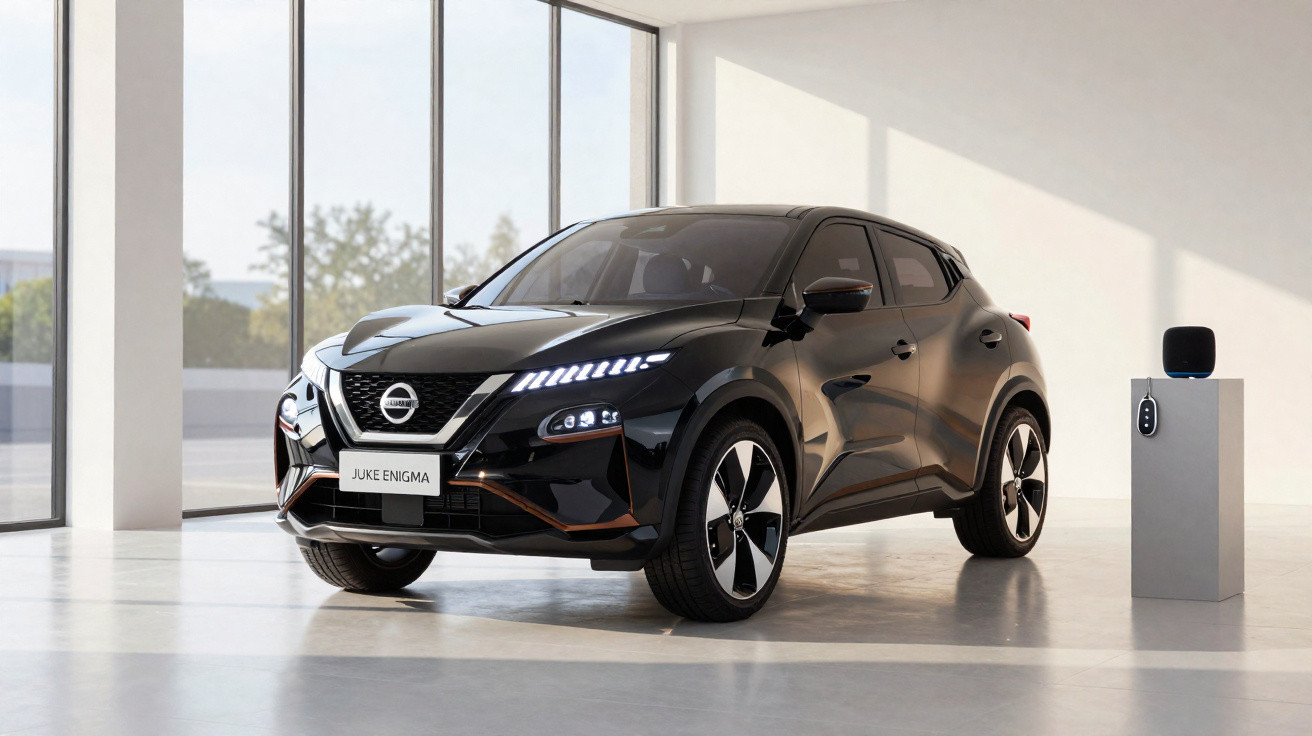
Nearly two years on, I’m back behind the wheel of the second-generation Nissan Juke, this time in Enigma trim. Despite the name, there’s very little that’s mysterious about it. Beyond a handful of distinctive styling touches and a set of 19-inch alloy wheels (standard), the standout change is that it’s Nissan’s first model in Europe to arrive with the Amazon Alexa assistant.
This addition makes it possible to link the Juke Enigma to an Alexa device at home, so you can check on and control a range of functions remotely. Among other things, you can send an address to the sat-nav or find out where the car is parked. Connectivity was already one of the Juke’s selling points, and it’s now even stronger.
Aside from that, the Nissan Juke is still very much the car I remember from our first encounter, with this second generation feeling notably more grown-up than its striking predecessor.
More mature, but less playful
That sense of growth (both literal and figurative) has brought plenty of upsides for the Juke, but I have to admit I miss the more playful character you got from the first generation when you’re at the wheel.
From the driver’s seat, the Juke comes across as a more comfortable and capable B-SUV - even in this Enigma guise, fitted with the largest wheels available on the Juke at 19 inches. Its motorway manners are improved, yet it doesn’t entertain or charm in quite the same way as the earlier model.
It’s still agile, helped by a compliant, incisive front axle that responds sharply, but the emphasis now leans more towards effectiveness. You also feel a little more “removed from the action”. Part of that comes down to the controls, which are slightly more filtered than before, reinforcing that impression.
In some respects, this more mature mindset contrasts with its exterior styling, which remains among the boldest and most distinctive (and also most divisive) in the segment. It’s worth highlighting, though, the clear step forward in proportions and overall cohesion.
A bigger appetite than expected
The engine suits the car’s more adult personality. The 1.0 DIG-T now produces 114 cv rather than 117 cv (to comply with the latest Euro 6D emissions standard). It has enough muscle (200 Nm) to move the Juke along with confidence, but although it delivers on what it promises, it lacks a bit of the “fizz” you find, for instance, in the Ford Puma’s 1.0 EcoBoost.
Here it’s paired with a precise six-speed manual gearbox, though the shift action feels more plastic than metallic. Performance is perfectly acceptable, but it ended up proving a little thirsty.
Even at modest speeds (90 km/h on an A-road), consumption never dropped below five litres per 100 km (as rivals manage), and on the motorway it even climbed to eight litres per 100 km - slightly odd, given that its appetite was a touch more restrained in the past, on other visits to Razão Automóvel’s garage.
Is it the right car for me?
This class moves so quickly that, despite not yet being two years old, you can almost accuse the Nissan Juke of being a veteran already. It remains a competitive option, with the Juke Enigma standing out for its very strong price-to-equipment balance.
What’s more, for anyone looking for a B-SUV with convincing credentials as a family car, the Nissan Juke is a very solid choice. Rear-seat space is at a good level, close to the most generous rivals, and the boot is among the largest in the segment. The main drawback is rearward visibility, which affects both the driver and passengers in the second row.

Comments
No comments yet. Be the first to comment!
Leave a Comment