
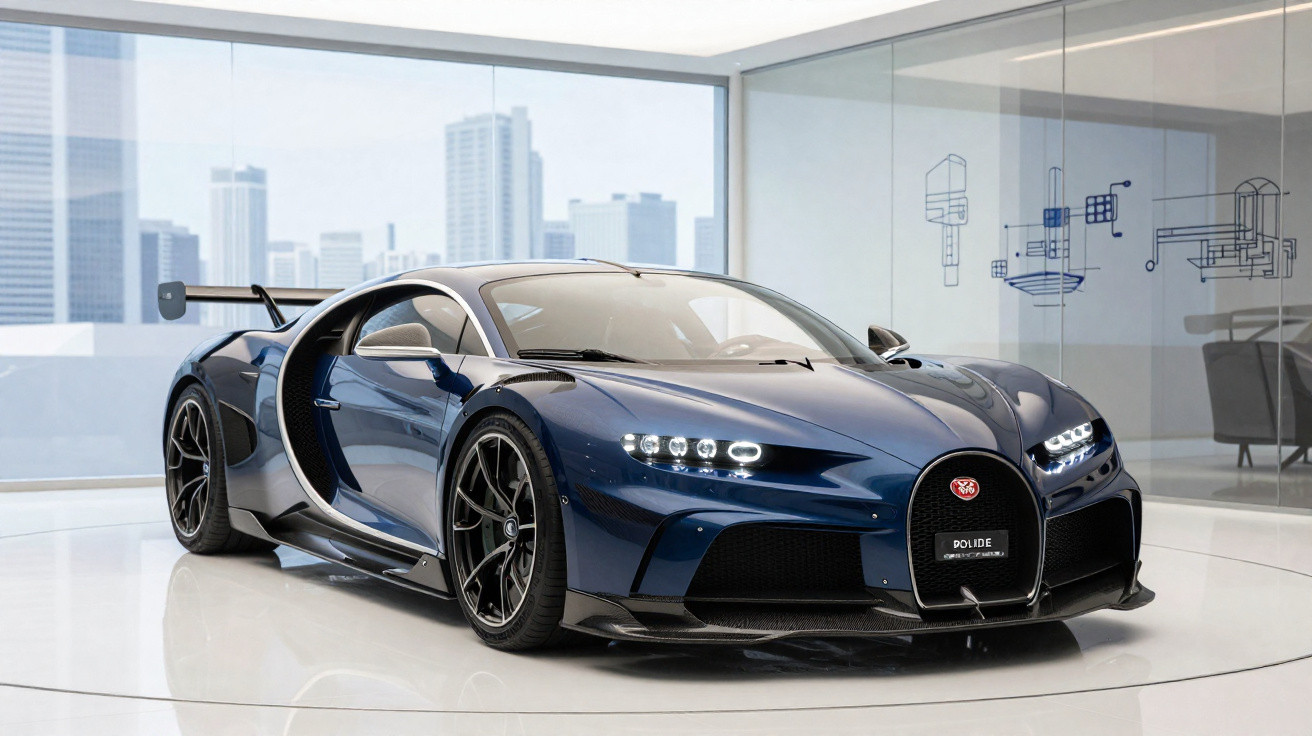
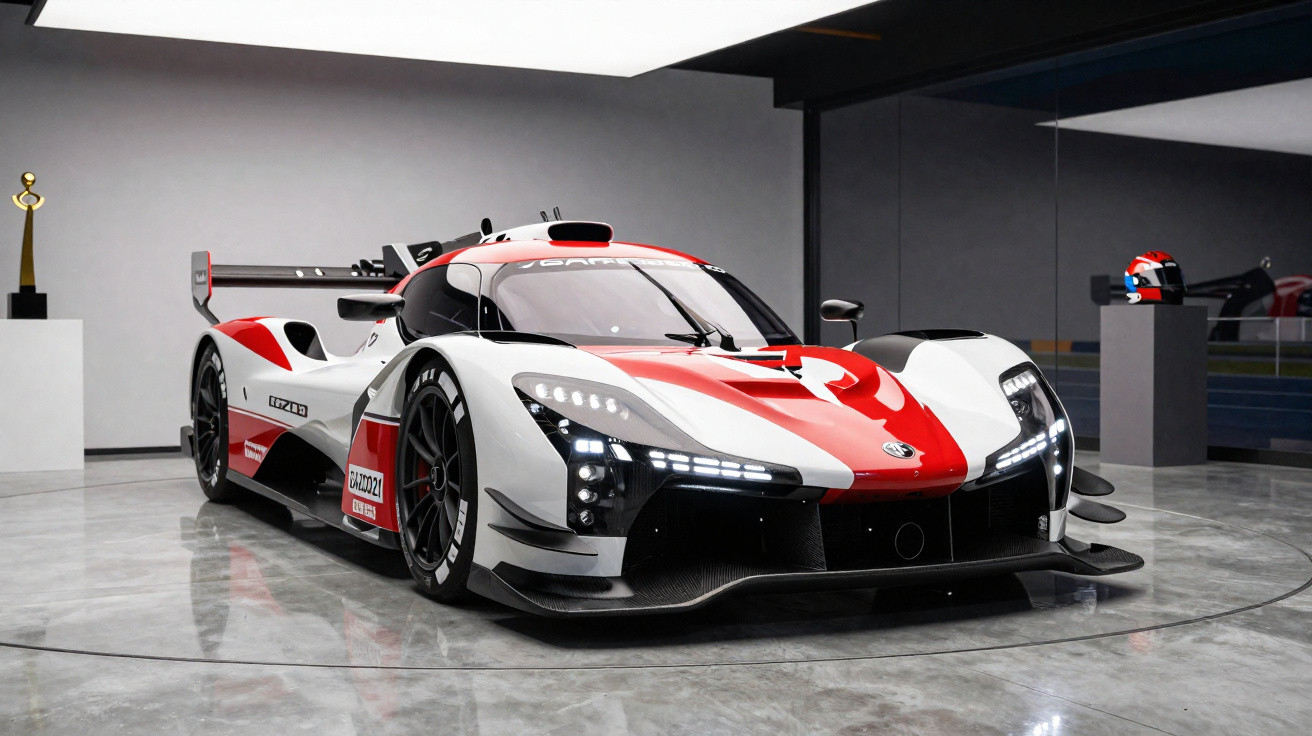
Even a Veyron - or the more dramatic Chiron variants - feels almost normal once you look at the machine now carrying the perfectly chosen name Bugatti Bolide.
For this bold Bugatti project, the people in charge set out to remove anything that did not absolutely need to be on a one-off car measuring 4.76 m in length. Within that brief, Achim Anscheidt’s design team was given the freedom to follow its own ambitions.
The end result is a spectacular “hyper-athlete”. With 1850 cv and a mass of under 1.3 tonnes (1240 kg dry), it achieves a power-to-weight figure of 0.67 kg/cv. In this stripped-back form, the claimed top speed is above 500 km/h (!), while peak torque reaches 1850 Nm - already at 2000 rpm - figures that promise acceleration on an entirely different level.
Track pace: Bugatti Bolide simulated lap times
Bugatti’s engineers also pushed their calculations further than usual, looking at the question in a more imaginative way: just how quickly could the Bugatti Bolide lap the world’s best-known high-speed circuits? In simulation, a lap of La Sarthe at Le Mans would take 3min07,1s, and a Nürburgring Nordschleife lap would be no more than 5min23,1s.
“The Bolide is the ultimate answer to the question of whether Bugatti could build a hyper sports car suited to the racetrack and meeting all safety requirements of the Fédération Internationale de l’Automobile (FIA). Developed around the W16 powertrain, with minimal bodywork around it and unbelievable performance,” explains Technical Development Director Stefan Ellrott, who adds that the programme “also acts as an innovative knowledge carrier for future technologies”.
What a… Bugatti Bolide!
Despite being a thought experiment both on and off the circuit - and for all its technical subtlety - the coupé’s styling is anything but abstract. With all-wheel drive, an eight-litre W16 turbo engine paired with a seven-speed dual-clutch automatic gearbox, and two racing bucket seats, Bugatti has created an exclusive carbon monocoque of extremely high stiffness.
The stiffness of the fibres used is 6750 N/mm² (Newtons per square millimetre), while the individual fibre reaches 350 000 N/mm² - figures more commonly associated with… spacecraft.
Active roof skin and aero figures
One particularly striking feature is the change in the roof’s outer skin, which uses active flow optimisation. At low speeds the roof surface remains smooth; but under full acceleration, a field of bubbles forms to cut air resistance by 10% and deliver 17% less lift, while also improving the airflow reaching the rear wing.
At 320 km/h, downforce on the rear wing is 1800 kg, with 800 kg on the front wing. Compared with what is typical for Bugatti, the proportion of visible carbon has risen by around 60%, and only 40% of the surfaces are painted - in French Racing Blue, naturally.
The Bugatti Bolide stands just one metre tall, matching the historic Bugatti Type 35, and it is 30 centimetres lower than the current Chiron. Getting in and out is like climbing into an LMP1 race car: open the doors and slide over the sill into, or out of, the bucket seat.
Le Mans-compliant equipment and the hybrid question
Hardware such as the fire-extinguishing system, towing provision, pressure refuelling with a fuel bladder, centre-lock wheels, polycarbonate windows, and a six-point seat-belt system is in line with Le Mans regulations. Is Bugatti hinting at a potential Le Mans car with the Bolide? Probably not, because 2022 marks the debut of hybrid models in the world’s best-known endurance race - and, unfortunately, with a giant eight-litre displacement and 16 cylinders there is no room left for any hybrid drive system.
Still, now and then we should be allowed to dream.
Technical specifications
Bugatti Bolide
| Item | Value |
|---|---|
| ENGINE | |
| Architecture | 16-cylinder W |
| Positioning | Longitudinal mid-rear |
| Capacity | 7993 cm³ |
| Valvetrain | 4 valves/cyl., 64 valves |
| Induction | 4 turbochargers |
| Power* | 1850 cv at 7000 rpm* |
| Torque | 1850 Nm between 2000-7025 rpm |
| TRANSMISSION | |
| Drive | Four wheels: longitudinal self-locking front differential; transverse self-locking rear differential |
| Gearbox | 7-speed automatic, dual-clutch |
| CHASSIS | |
| Suspension | Front: Double wishbones, pushrod linkage with horizontal spring/damper unit; Rear: Double wishbones, pushrod linkage with vertical spring/damper unit |
| Brakes | Carbon-ceramic, with 6 pistons per wheel. Front: 380 mm diameter; Rear: 370 mm diameter. |
| Tyres | Front: Michelin slicks 30/68 R18; Rear: Michelin slicks 37/71 R18. |
| Wheels | 18″ forged magnesium |
| DIMENSIONS AND CAPACITIES | |
| L x W x H | 4,756 m x 1,998 m x 0,995 m |
| Wheelbase | 2,75 m |
| Ground clearance | 75 mm |
| Weight | 1240 kg (dry) |
| Power-to-weight ratio | 0,67 kg/cv |
| PERFORMANCE (simulated) | |
| Top speed | +500 km/h |
| 0-100 km/h | 2,17s |
| 0-200 km/h | 4,36s |
| 0-300 km/h | 7,37s |
| 0-400 km/h | 12,08s |
| 0-500 km/h | 20,16s |
| 0-400-0 km/h | 24,14s |
| 0-500-0 km/h | 33,62s |
| Lateral acceleration | Max. 2,8g |
| Le Mans lap | 3min07,1s |
| Nürburgring lap | 5min23,1s |
| Aerodynamics Cd.A** | Max. downforce config.: 1,31; Max. speed config.: 0,54. |
- Power achieved with 110 octane fuel. With 98 octane fuel, power is 1600 cv.
** Aerodynamic drag coefficient multiplied by frontal area.
Authors: Joaquim Oliveira/Press-Inform.


Comments
No comments yet. Be the first to comment!
Leave a Comment