
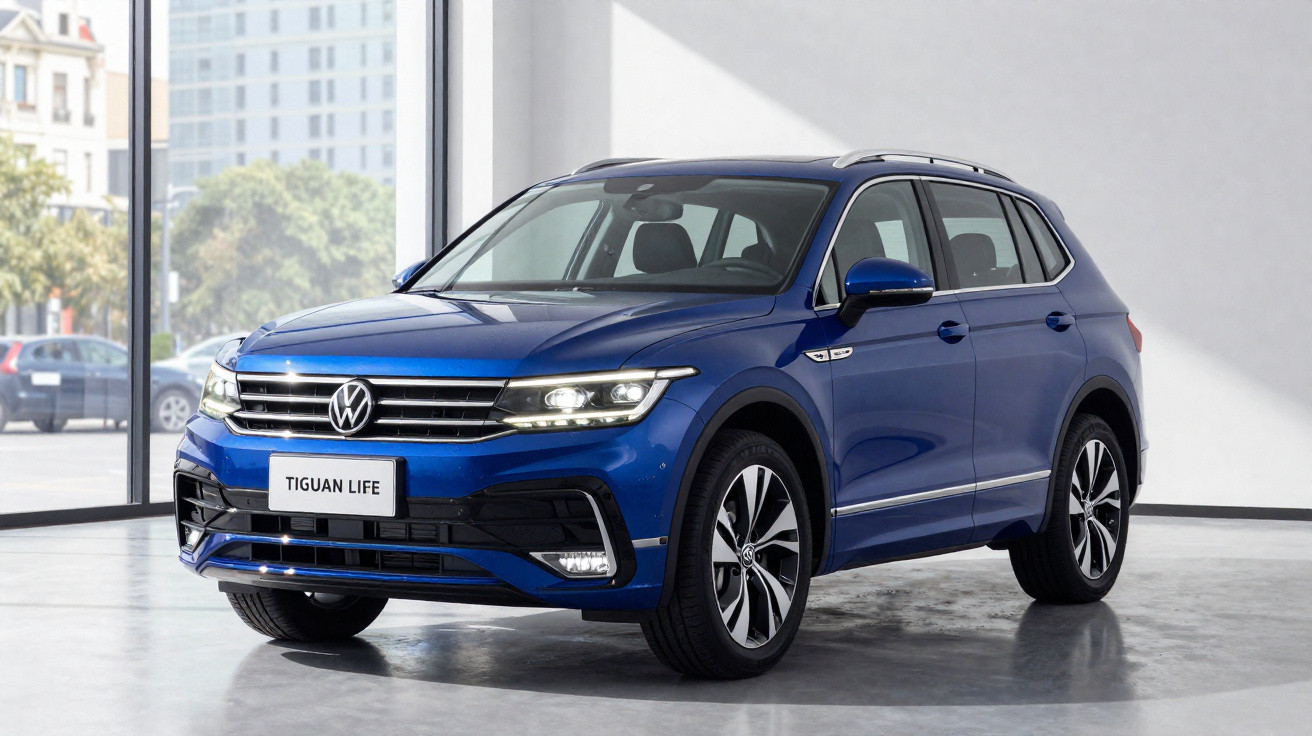
With buyers typically steering clear of entry-level trims, the Life version takes on particular significance within the successful Volkswagen Tiguan range.
Positioned between the most basic “Tiguan” trim and the range-topping “R-Line”, the Life specification - when paired with the 2.0 TDI in 122 hp form and a six-speed manual gearbox - comes across as a notably well-judged middle ground.
Still, given the size of this German SUV and its family-friendly brief, isn’t the quoted 122 hp a touch on the modest side? To find out, we put it to the test.
Simply Tiguan
Whether you’re looking at the exterior or sitting inside, the Tiguan sticks to the restrained, no-nonsense style that defines it - and, in my view, that approach is likely to work in its favour over time.
More traditional, understated shapes generally date better, and that can ultimately help residual values for the German SUV. It’s a pattern we’ve seen with other Volkswagen models.
As for space, build solidity and material quality, I’m happy to echo Fernando’s verdict from his test of the most affordable Tiguan you can buy: despite first appearing in 2016, the Tiguan remains one of the segment benchmarks in this area.
Is this the right engine?
On paper - and when stationary - Fernando’s Tiguan and the one I drove look almost identical. The moment you turn the key, though, the differences become obvious.
First up, the noise. Even with good cabin insulation, that familiar Diesel clatter (which I don’t actually mind, as you’ll know if you read that article) still filters through, reminding you there’s a 2.0 TDI up front rather than a 1.5 TSI.
Once on the move, it’s the way the engines deliver their performance that really separates these two Tiguans. With the petrol version, 130 hp felt slightly “tight”; with the Diesel, intriguingly, the lower 122 hp figure seems to do the job.
Of course, it’s not outright fast (and it was never meant to be). But thanks to the stronger torque - 320 Nm versus 220 Nm - available from 1600 rpm through to 2500 rpm, you can drive in a calm, unhurried way without constantly working the nicely spaced, smooth-shifting six-speed manual.
Even carrying four occupants and (a lot of) luggage, the 2.0 TDI never protested, consistently delivering solid real-world pace (bearing in mind the car’s weight and the engine’s output) and, above all, sensible fuel use.
In normal driving it stayed around 5 to 5.5 l/100 km, and when I pointed the Tiguan towards “Guilherme’s neck of the woods” (a.k.a, Alentejo) and focused on economy (without crawling along, but keeping to the speed limits on our national roads), I managed an average of… 3.8 l/100 km!
It’s German, but it feels French
Dynamically, this Tiguan shows that smaller wheels and higher-profile tyres have their own appeal.
Just as Fernando noted when he tested the other Tiguan on 17-inch alloys, in this configuration the German SUV rides with a suppleness and comfort level that feels… French. Even so, its roots show up as soon as the road starts to twist. It may not be thrilling, but the Tiguan is consistently capable, predictable and safe.
In corners it keeps body movements nicely in check, and the steering is accurate and quick. Less impressive in the same situations is the lack of extra lateral support from the Life trim’s simple (though comfortable) seats.
Is it the right car for me?
Solidly built, roomy and deliberately understated in appearance, the Volkswagen Tiguan in Life specification - with the 2.0 TDI producing 122 hp and a manual gearbox - stands out as one of the most balanced choices in its class.
The equipment list is already thoroughly decent (everything you typically need is present, including all the electronic “guardian angels”), and the engine suits relaxed use while remaining, above all, economical.
Are there Diesel SUVs with stronger performance? Yes - and the Tiguan itself offers 150 hp and 200 hp versions of this engine.
What’s more, thanks to our tax rules, this Diesel option is now facing a new kind of rival, namely the Tiguan eHybrid (plug-in hybrid). Although it’s still roughly €1500-2000 more expensive, it delivers more than double the power (245 hp) and 50 km of electric range - the scope for even lower consumption than the Diesel is very real… as long as you charge the battery often.
Even so, for anyone who racks up miles easily without wanting it to turn into an “assault” on their wallet, this Volkswagen Tiguan Life 2.0 TDI with 122 hp could be the ideal pick.
Comments
No comments yet. Be the first to comment!
Leave a Comment