
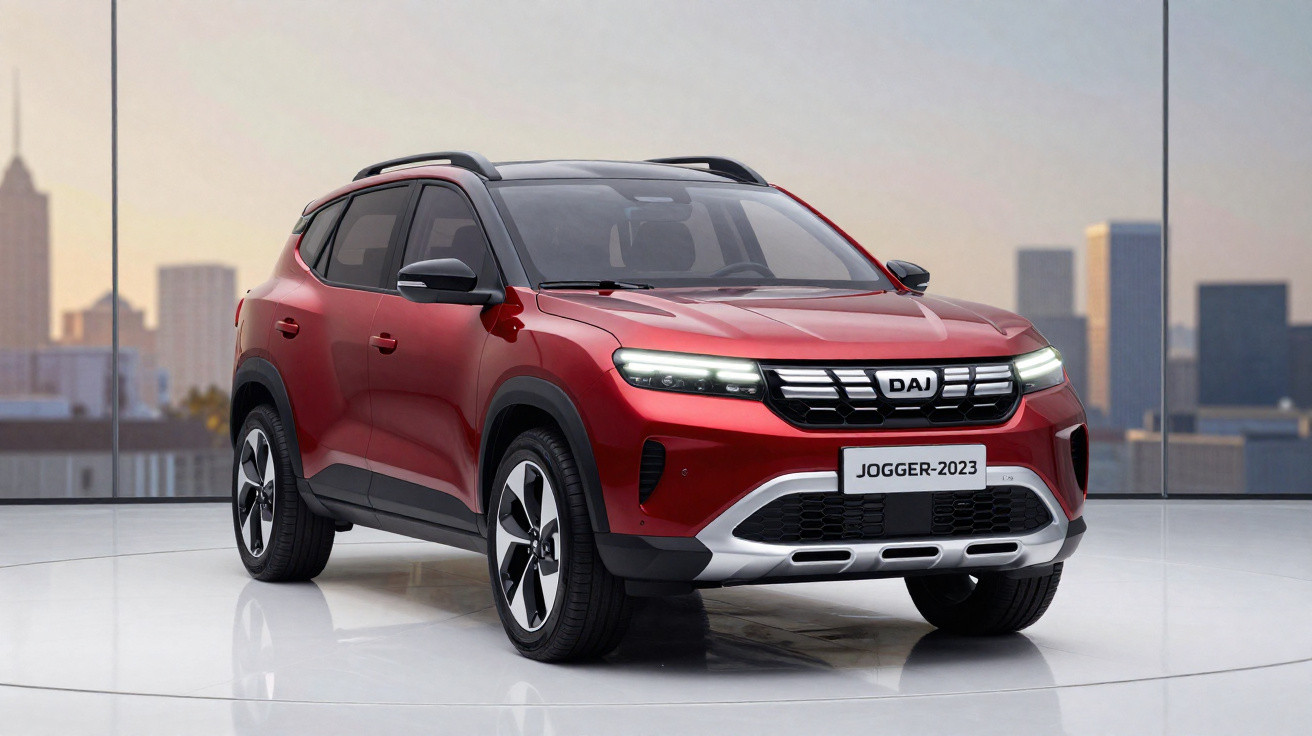
“The Jogger takes the best from every class: the length of an estate, the room of an MPV and the look of an SUV.” That is how Dacia’s team introduced the Jogger to us: a family-focused crossover offered with five or seven seats.
This is the fourth cornerstone model in the Romanian brand’s plan within the Renault Group, following the Sandero, the Duster and the Spring, Dacia’s first 100% electric car. By 2025, the brand has already confirmed it intends to add two more new models.
Until then, however, the next big arrival is this Jogger. Dacia says it was given a name meant to call to mind “sport, the outdoors and positive energy”, while also expressing “robustness and versatility”.
Jogger, the crossover
And robustness and versatility are exactly what this Dacia Jogger seems to deliver. Having now seen it in the flesh, we were struck by its proportions-this is the model brought in to replace the Logan MCV and the Lodgy.
Sitting between a rugged, raised estate and a full SUV, this crossover uses the Renault-Nissan-Mitsubishi Alliance’s CMF-B platform (the same one found under the Dacia Sandero). It measures 4,55 m long, making it the largest vehicle in Dacia’s line-up (at least until the production version of the even bigger Bigster arrives).
Up front, the family resemblance to the Sandero is clear: a very wide grille stretching towards the headlamps, which use LED technology and feature a “Y” light signature. The bonnet also has two strongly defined creases, helping to underline the tough stance Dacia is aiming for.
At the rear, the headline feature is the set of vertical tail-lamps (we’re not the only ones seeing hints of the Volvo XC90, right?). According to Dacia, this layout allowed for a notably wide tailgate and helped emphasise the Jogger’s sense of width.
From the side, and to ensure the Jogger wasn’t simply a “stretched Sandero”, the brand’s designers and engineers introduced two key touches: widened panels over the rear wheel arches, which give it a more muscular shoulder line, and a step in the upper window frame above the B-pillar, creating a (positive) height change of 40 mm.
That decision not only makes the silhouette more distinctive, but also improves rear passengers’ headroom. But we’ll come back to that…
Still in profile, it’s worth noting the wheels-on the version we saw they were 16’’ and filled the arches fairly well-along with the plastic cladding that reinforces the model’s adventurous character. And, of course, there are the modular roof bars, rated to carry up to 80 kg.
Space to spare
Step inside and it’s not easy to spot major differences from the Sandero-and that’s hardly a drawback, given that the Sandero is one of the areas where the model made its biggest leap forward.
On better-equipped versions there’s a fabric strip running across the dashboard that looks and feels pleasing, and-just like the Sandero-the Jogger offers three multimedia choices: Media Control, where your smartphone becomes the Jogger’s multimedia hub via a Dacia-developed app with a particularly appealing interface; Media Display, with an 8’’ central touchscreen and wired smartphone integration through Android Auto and Apple CarPlay; and Media Nav, which keeps the 8’’ screen but enables wireless smartphone connectivity (Android Auto and Apple CarPlay).
Even so, what really stands out in the Jogger’s cabin is sheer roominess. In the second row-where you also get two aeroplane-style trays with cupholders-I was impressed by the headroom and the ease of entry. Remarkably, those same compliments also apply to the third row.
The two rearmost seats in the third row (the car we saw was set up as a seven-seater) are a long way from being “kids only” chairs. I’m 1,83 m tall and I was able to sit comfortably in the back. And unlike many vehicles in this class, my knees weren’t pushed uncomfortably high.
There are no USB outlets in either the second or third rows. However, since both areas do provide 12 V sockets, it’s a gap that can be very easily addressed with an adaptor. On the plus side, you do get two small windows that can open slightly on a hinge, plus two cupholders.
With all seven seats in place, the Dacia Jogger offers 160 litres of boot capacity. With two rows of seats, that rises to 708 litres, and it can be expanded to 1819 litres with the second row folded and the third row removed.
And whenever those last two seats aren’t needed, removing them is genuinely simple (and quick). During this first in-person look at the Jogger, I did the process twice and can confirm it took no more than 15 seconds to lift out each seat.
On top of that, there are 24 litres of storage spaces spread around the cabin, enough to stash almost anything. Each front door bin can take a bottle of up to one litre, the centre console holds 1,3 l, and there are six cupholders in the cabin. The glovebox, meanwhile, offers seven litres.
Jogger ‘Extreme’, even more adventure
The Jogger will also be sold in a limited series called “Extreme”, with an even stronger off road influence.
This version uniquely features the “Terracotta Brown” finish-the model’s launch colour-and adds several gloss-black accents, from the wheels to the roof bars. The details continue with the fin-style aerial, the door mirrors and the side decals.
Inside, the highlights are red stitching, version-specific floor mats and a rear parking camera.
What about the engines?
The new Dacia Jogger comes “at your service” with a 1.0 l, three-cylinder TCe petrol engine producing 110 cv and 200 Nm, paired with a six-speed manual gearbox. It will also be offered with a bi-fuel (petrol and LPG) version that we have already praised in the Sandero.
In that bi-fuel ECO-G variant, the Jogger gives up 10 cv compared with the TCe 110-dropping to 100 cv and 170 Nm-but Dacia promises average consumption around 10% lower than the equivalent petrol version. Thanks to the two fuel tanks, maximum range is said to be close to 1000 km.
Hybrid only in 2023
As expected, the Jogger will later gain the hybrid system already familiar from models such as the Renault Clio E-Tech, combining a 1.6 l naturally aspirated petrol engine with two electric motors and a 1,2 kWh battery.
The end result will be a maximum combined output of 140 cv, which will make it the most powerful Jogger in the range. Transmission duties will be handled-just as in the Clio E-Tech-by an advanced multi-speed automatic gearbox featuring technology derived from Formula 1.
When will it arrive and how much will it cost?
The new Dacia Jogger will only reach the Portuguese market in 2022, specifically in March, so prices for Portugal have not yet been announced.
Even so, Dacia has confirmed that the entry price in central Europe (in France, for example) will be around 15 000 euros, and that the seven-seat version is expected to account for roughly 50% of the model’s total sales.

Comments
No comments yet. Be the first to comment!
Leave a Comment