
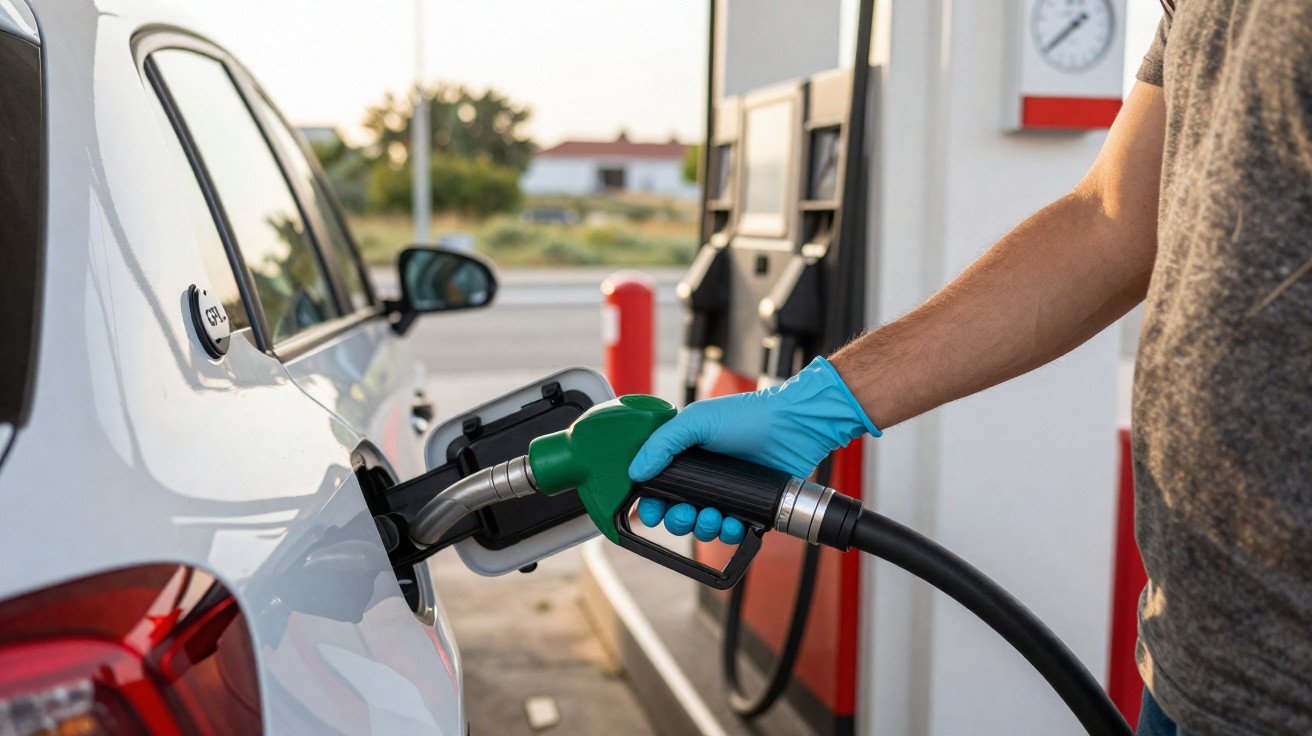
With prices far below petrol and diesel, GPL - Liquefied Petroleum Gas - remains an appealing choice for drivers in Portugal.
If you have bought a car that runs on this fuel, or you are considering doing so, you will quickly notice that refuelling works slightly differently and calls for a few extra precautions.
You have probably also seen that many filling stations leave gloves next to the GPL pump. But do you have to use them?
Are gloves compulsory when refuelling with GPL?
The answer is straightforward: no. In Portugal, there is no specific legal requirement that forces drivers to wear gloves while refuelling with GPL. Even so, using them is strongly advised for safety reasons.
Why is it advisable to wear gloves?
Unlike petrol or diesel, which are stored at atmospheric pressure, GPL is kept under pressure and in liquid form.
When you disconnect the nozzle, a small amount of GPL can be released. As it rapidly changes from liquid to gas, it causes a sharp cooling effect on the nozzle, the adapter and nearby surfaces.
If your skin comes into direct contact with GPL itself, or with those very cold parts, you can suffer cold burns. Gloves reduce that risk, which is why many stations provide them for customers.
Direct contact with these chilled surfaces can lead to cold burns, particularly if there is a minor release of GPL at the moment you disconnect the hose. Wearing gloves helps prevent this, and that is why many filling stations offer them free of charge.
What should you do before refuelling?
Refuelling with GPL is straightforward, but it does require a few basic precautions. As with petrol or diesel, begin by stopping the vehicle, switching off the engine and applying the parking brake.
Before you start, check that the nozzle is correctly seated on the filler neck or the vehicle’s adapter. Do not force the connection, and always follow the instructions shown on the pump. When you finish, stop the flow and release the nozzle’s locking mechanism before removing it.
When disconnecting, you may hear a brief sound caused by pressure being released from the connection. This small discharge is normal and does not, on its own, mean the vehicle has a leak.
However, if you notice a strong smell of gas or an ongoing leak, move away from the area and notify a member of staff immediately.
Why the GPL tank stops at around 80%
Another feature of this system is that, for safety, the GPL tank is not filled completely. A valve automatically cuts off refuelling once roughly 80% of its capacity is reached.
The remaining empty space allows the fuel to expand as temperatures rise, preventing excessive pressure building up inside the tank.





Comments
No comments yet. Be the first to comment!
Leave a Comment