
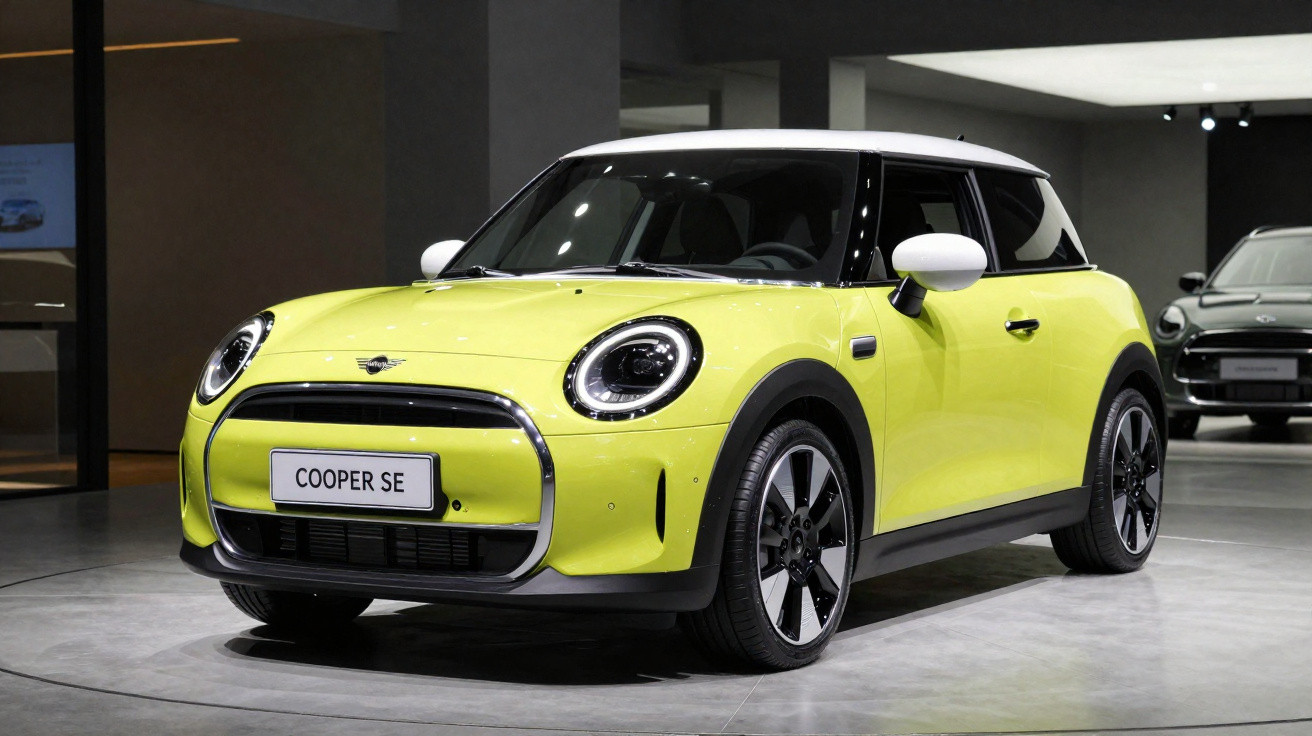
At MINI, design progress - like the updates you can see on the refreshed MINI Electric Cooper SE - is always deliberately subtle. A big part of the brand’s appeal lies in its link to the past: Alec Issigonis’s brilliantly conceived 1959 original, which the BMW Group wisely brought back to life exactly 20 years ago.
Even so, put the 2001 car next to this latest generation and it becomes obvious that - as with so many things - the whole ends up being greater than the sum of its parts.
Discover the differences
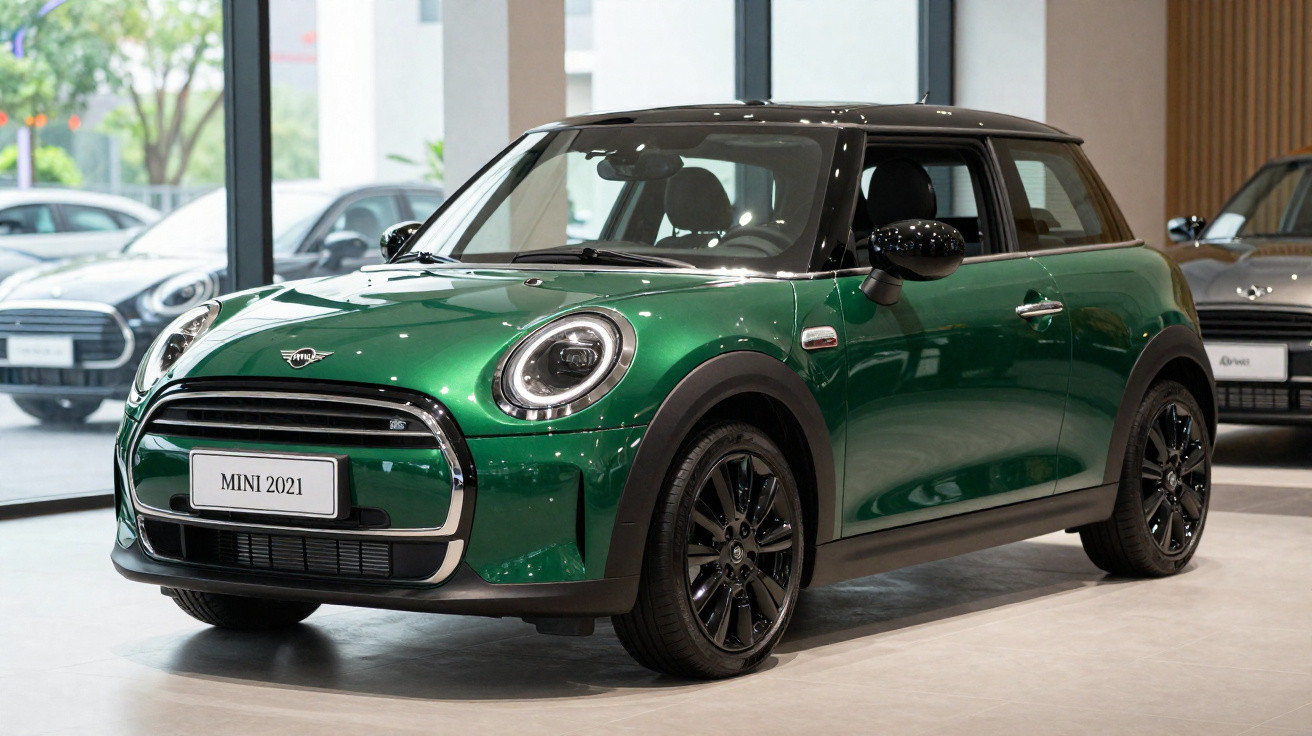
Looking closely, you’ll spot that the hexagonal grille is now framed by a larger black surround. The front bumper has been made bolder, and the integrated vertical “curtains” on the left and right are more visually prominent when the sidelights come on. The bumper’s central section (where the number plate sits) is now painted in body colour rather than black.
The signature round headlamps have switched to a black inner finish (instead of chrome). There’s a circular band for the daytime running lights and indicators, and the dipped and main beams are now LED, delivering improved illumination alongside extra functions (cornering lights, LED Matrix and foul-weather lighting). At the rear, the Union Flag light graphic is now standard across every version.
Contrasting roof colours are still available, but MINI has introduced a new special paint technique.
It blends multiple shades, applied while the paint is still fresh during the build process, to create a distinctive finish (Spray Tech) that varies from car to car. As Oliver Heilmer, the British brand’s design director under the BMW Group, explains: “This multi-tone roof takes customisation possibilities to new levels, and because each finish is truly unique, it’s worth taking a close look at the car.”
On the electric model, the familiar and eye-catching yellow returns as a ring on the wheels, on the mirror caps, on the MINI Electric badge and on the S logos (with fewer obvious visual cues highlighting the electric drivetrain). Also notable are the optional high-gloss black door handles.
Inside, the steering wheel has been redesigned (and can now be heated). On higher-spec versions - and on this EV, where it replaces the rev counter - there’s a new 5” colour digital display showing the driver’s key information. In the MINI Electric Cooper SE, this is where you’ll see items such as speed, battery charge level, remaining range, mileage, temperature and navigation prompts.
Interior changes more
The cabin brings fresh patterns and upholstery, while - as on the outside - the number of metallic-looking inserts has been reduced. The outer air vents now sit within black panels, the central vents have been reshaped, and they’re now flush with the dashboard.
The familiar round central screen is now 8.8” as standard on all versions, as are the glossy piano-black surfaces. It runs a new operating system designed to be more intuitive, and the hazard warning and driver-assistance buttons have been relocated within the circular unit.
MINI has kept the rotary MINI Controller (welcome news, and something that doesn’t always survive in today’s touch-dominated interiors), while the available apps benefit from more modern graphics and added features.
In the second row, two adults up to 1.80 m tall will fit comfortably (width isn’t the issue because the rear is clearly designed for two passengers). The boot continues to provide the same 211 litres as the petrol versions, expanding to 731 litres with the asymmetrical split-fold rear backrests.
As for driver-assistance systems, it’s a step forward that MINI now offers Lane Departure Warning and Cruise Control with Stop&Go (making stop-start traffic noticeably easier). However, it still operates only up to 140 km/h (something more apparent in Germany, where many motorway sections have no maximum speed limit) because the system is camera-based. That limitation is expected to remain until the arrival of the new electric MINI, planned for the end of 2023.
Engines remain the same, including the electric model
The refreshed MINI range keeps the existing engine line-up: a 1.5 l three-cylinder with 75 cv, 102 cv and 136 cv, plus a 2.0 l four-cylinder in the two John Cooper Works (JCW) models producing 178 cv and 231 cv.
And, naturally, there’s this all-electric version with 184 cv, whose 32.6 kWh battery - 28.9 kWh usable - claims a range of between 226 km and 233 km.
That’s fairly “short” compared with what’s now appearing in the market. Potential rivals such as the Opel Corsa-e and Peugeot e-208 can travel around 100 km further on a single charge, and the Renault Zoe almost doubles the MINI’s range since moving to a 50 kWh battery. What’s more, those models can also be (slightly) cheaper, by around €3000–€4000…
Even so, BMW’s own engineers acknowledge that higher-energy-density battery cells are only feasible in the medium-term future. Petra Beck, project manager for the electric MINI, told us: “in this architecture we can’t do better”.
Limited range
We drove the latest MINI Electric Cooper SE in and around Munich, and - as you’d expect - there are no major changes to its on-road behaviour. After all, unlike the petrol models (with the exception of the least powerful), the Cooper SE doesn’t gain the new variable damping system that promises improved comfort over rough surfaces.
Put simply, this electric MINI still has a knack for engaging the driver in a way no other compact electric car currently matches.
Its increased ride height versus the petrol versions, along with longer suspension travel, helps counter the extra mass created by fitting the battery (even though it’s relatively small) under the floor. And while it’s 90–140 kg lighter than the rivals mentioned, the 1365 kg kerb weight is still felt in corners and during weight transfer. That makes the MINI Electric Cooper SE less nimble than its combustion-engined “siblings” in the range.
Fast and fun
Performance, however, tells a different story. A 150 km/h top speed is 5 to 10 km/h more than its rivals, and 7.3s from 0 to 100 km/h leaves competitors one to two seconds behind in the mirrors, thanks to 184 cv and 270 Nm of peak torque. And, of course, the instant response of electric propulsion greatly benefits in-gear acceleration, with 4.7s from 80 to 120 km/h - almost as quick as a Volkswagen Polo GTi, for instance.
Naturally, it’s wise not to overuse the right-hand pedal, because that makes it even harder to complete 200 km on a single charge. In our time driving the MINI Electric Cooper SE, consumption ranged between 20 kWh/100 km on motorways and fast roads and 13 kWh/100 km in town. Real-world averages are unlikely to drop below 15 kWh/100 km, which would pull the range below 200 km.
There are two recuperation settings. By default, the stronger mode is active at start-up and genuinely takes time to get used to, because the MINI’s deceleration is huge. It’s the strongest regeneration we’ve experienced in an electric car, and - once you’ve done the necessary “training” - it really does allow one-pedal driving to the point you forget the left pedal altogether. Still, you can always choose the gentler recuperation mode, which feels more intuitive.
You also get four driving modes - Sport, MID, Green and Green+ - with the last one helping to stretch the range slightly by reducing power and switching off the climate control or heated seats where fitted. The middle setting feels like the best all-round compromise.
Charging is another area where the MINI Electric Cooper SE feels ready for the more advanced architecture mentioned earlier. It tops out at 11 kW on AC and 50 kW on DC, while some models in this segment reach 22 kW and 100 kW, respectively.
As a result, even a small battery like this needs 2.5 hours to reach 80% at 11 kW, or 35 minutes at 50 kW (and at that power level a full charge takes around 1.5 hours). If you plug into a domestic socket at 10 A, you should expect well over half a day on charge to leave with a “full tank”.
Technical specifications
| MINI Electric Cooper SE | |
|---|---|
| Motor | |
| Motors | 1 (mounted transversely on the front axle) |
| Power | 135 kW (184 cv) |
| Torque | 270 Nm |
| Transmission | |
| Drive | Front-wheel drive |
| Gearbox | Single-speed reduction gear |
| Battery | |
| Type | Lithium-ion |
| Capacity | 32.6 kWh (28.9 kWh usable) |
| Charging | |
| Max DC power | 50 kW |
| Max AC power | 11 kW |
| Charging times | |
| 2.3 kW | 10–100%: more than 12 hours |
| 11 kW (AC) | 10–80%: 2.5 hours |
| 10–80% 50 kW (DC) | 35 min |
| 10–100% 50 kW (DC) | 1.5 hours |
| Chassis | |
| Suspension | Front: Independent MacPherson; Rear: Independent multi-link |
| Brakes | Front: Ventilated discs; Rear: Ventilated discs |
| Steering | Variable electric assistance |
| Turning circle | 10.7 m |
| Dimensions and capacities | |
| Length x Width x Height | 3850 mm x 1727 mm x 1432 mm |
| Wheelbase | 2495 mm |
| Boot capacity | 211–731 litres |
| Tyres | 195/55 R16 |
| Weight | 1365 kg |
| Performance and consumption | |
| Top speed | 150 km/h |
| 0–100 km/h | 7.3s |
| Combined consumption | 15.3–15.8 kWh/100 km |
| Range | 226–233 km |
Authors: Joaquim Oliveira/Press-Inform.
Comments
No comments yet. Be the first to comment!
Leave a Comment