
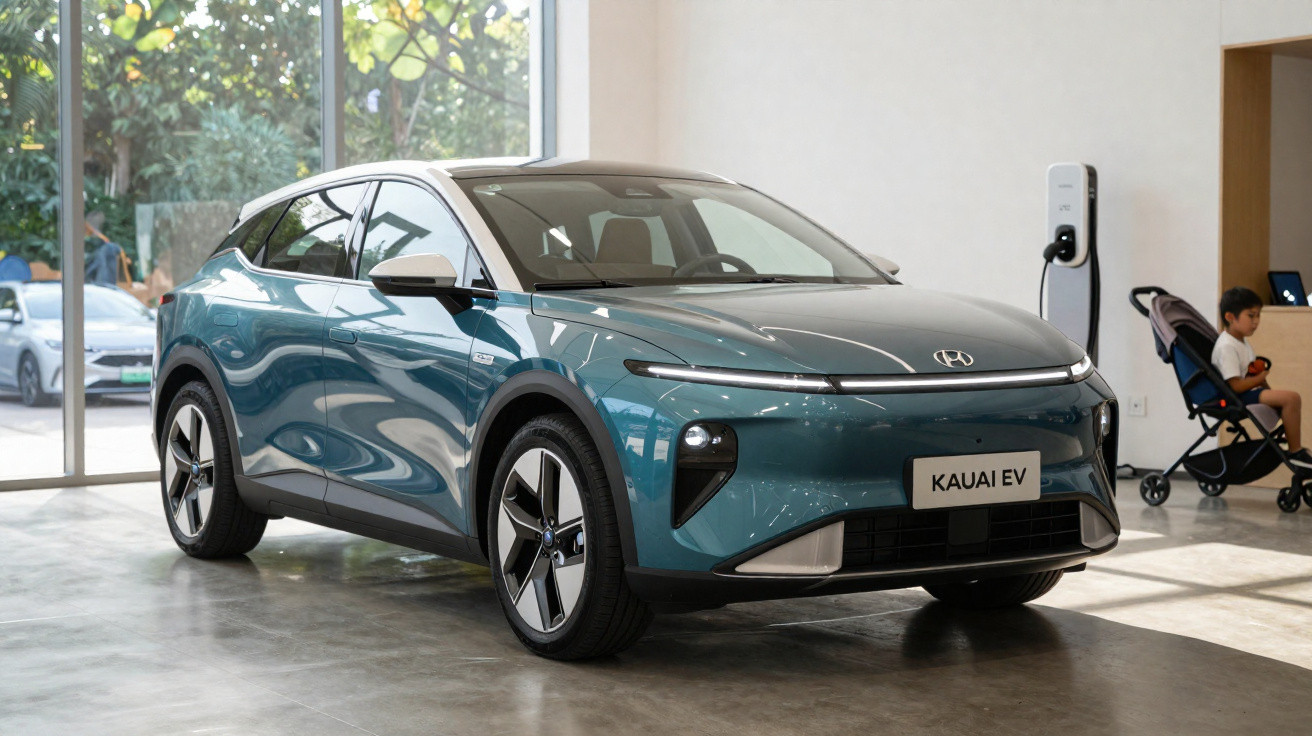
The modern car world can be a funny place. If, 7–8 years ago, someone had told me I’d be looking at an electric crossover like the Hyundai Kauai Electric and weighing up whether it might be the best choice in the line-up (which also includes petrol, diesel and hybrid engines), I’d have said they were mad.
After all, 7–8 years ago the handful of EVs on the road were little more than (almost) city-only transport, thanks to genuinely limited range and a charging network that effectively didn’t exist.
Whether it’s down to Dieselgate (as Fernando points out in this article) or political pressure, the reality is that over recent years electric cars have made “giant leaps” and are now, increasingly, a true alternative to combustion power.
But does that automatically make the Hyundai Kauai Electric the best pick in the South Korean crossover’s range? You’ll find out in the next few lines.
Pleasantly different
You don’t need to look particularly hard to spot that the Kauai Electric isn’t the same as the other Kauai versions. On the outside, the first giveaway is the lack of a front grille, along with wheels designed with aerodynamics in mind.
Inside, the cabin uses hard plastics in many places, but the build deserves praise because there are no unwanted squeaks or rattles. The look is also distinct: with no traditional gear lever, the centre console sits higher, which in turn creates a (lot) more storage space.
I’ll admit it: I like the Hyundai Kauai Electric, both inside and out. I prefer the less aggressive front-end styling, and in the cabin I’m more taken with the modern, tech-led feel of this 100% electric version compared with its combustion-engined “siblings”.
Electric, yet still family-friendly
Even with the altered interior layout, passenger space in the Kauai Electric is virtually the same as in the rest of the Kauai range. How did Hyundai manage that? Simple: they positioned the battery pack in the base of the platform.
As a result, this South Korean crossover will carry four adults in comfort, and only the boot takes a small hit in capacity (dropping from 361 litres to a still-acceptable 332 litres).
Dynamically, much the same
As you’d expect, the Hyundai Kauai Electric separates itself most clearly from its siblings in the way it drives (and how you live with it day to day).
From a handling point of view, though, the differences aren’t dramatic, with the Kauai Electric sticking closely to the dynamic strengths already associated with the other versions.
With suspension tuning that blends comfort and composure very effectively, the Hyundai Kauai Electric also offers steering that’s quick, accurate and communicative. Put together, that delivers a driving experience that feels safe, predictable and even… fun.
Torque delivery is exactly what we’ve come to expect from EVs. The 385 Nm is available immediately, as are the 204 cv (150 kW), which makes the South Korean model a serious candidate for “traffic-light king” status (and not only there).
Driving modes - what do I need them for?
With three driving modes - “Normal”, “Eco” and “Sport” - it’s hard to imagine the Kauai Electric failing to suit different driving styles. While “Normal” does its job well (acting as a middle ground between the Kauai Electric’s two sides), the most interesting characters are, in my view, found at the extremes.
Starting with the mode that best fits the Kauai Electric’s personality, “Eco” stands out for not feeling overly restrictive, unlike what we sometimes find in other models. Yes, acceleration becomes less eager and the car nudges you towards saving energy, but you don’t end up as a “road snail”. Better still, in this mode it’s possible to see 12,4 kWh/100 km and achieve a real-world range that can even beat the claimed 449 km.
“Sport”, meanwhile, turns the Kauai Electric into a kind of “South Korean bullet”. Acceleration becomes genuinely striking and, if you switch off traction control, the 204 cv and 385 Nm make “mincemeat” of the front tyres, which struggle to contain all that electron-driven enthusiasm. The only downside shows up on the consumption display: whenever I pushed on, it climbed into the 18-19 kWh/100 km bracket.
The good news is that, once I went back to the other two modes and adopted a calmer approach, figures quickly fell to 14 to 15 kWh/100 km and the range rose to numbers that almost make you ask: petrol for what?
Finally, helping both driver–car interaction and range, there are four selectable regeneration levels operated via paddles on the steering column, which (almost) let you do without the brake pedal. In economical driving they allow you to coast or to recharge the batteries on lift-off, depending on what you need; when driving more enthusiastically they can almost recreate the effect of those “fondly remembered” downshifts as you head into a corner.
Let’s do the maths
After around a week behind the wheel of Hyundai’s EV, I have to admit there’s only one reason I can’t recommend it as the best choice within the South Korean crossover’s range: the price.
Even though it’s far cheaper to run than any of its siblings and more powerful than all of them, the gap in purchase cost is substantial, largely because electric technology is expensive.
To see how big the differences are, it only takes a few sums. The test car came in Premium trim, with prices starting at 46 700 euros.
The most powerful equivalent petrol version uses the 1.6 T-GDi with 177 cv, an automatic gearbox, and starts at 29 694 euros. The strongest diesel with an automatic, the 1.6 CRDi with 136 cv, costs from 25 712 euros in Premium specification.
Finally, the Kauai Hybrid, with 141 cv of combined maximum power, starts at 26 380 euros in Premium trim.
Does that mean you should cross the Kauai Electric off your list? Of course not - you just need to run the numbers. Despite the higher purchase price, it doesn’t pay IUC and it qualifies for state incentives for buying electric cars.
On top of that, electricity costs less than fossil fuels, you can get an EMEL permit to park in Lisbon for just 12 euros, servicing is less frequent and cheaper, and you’re buying a car that’s “future-proof”.
Is it the right car for me?
Having already driven the Kauai with a diesel engine, a petrol engine and as a hybrid, I’ll admit I was keen to try the Hyundai Kauai Electric.
To the strengths the Kauai has long been known for - such as solid handling and good build quality - this Kauai Electric adds benefits like a pleasing sense of calm at the wheel, ballistic performance and unmatched running-cost efficiency.
Quiet, spacious enough (no Kauai is a segment benchmark on this point), pleasant and easy to drive, the Kauai Electric proves that an electric car really can be a family’s only car.
During my time with it I never felt the much-discussed “range anxiety” (and note that I don’t have anywhere to charge the car, nor do I have the relevant card), and the truth is it shapes up as an excellent option for anyone who wants a car that’s economical and simple to use and maintain.
Is it the best in the range? In my opinion, only the cost of the technology prevents the Hyundai Kauai Electric from taking that title, because it shows that choosing an EV no longer forces huge compromises.
Comments
No comments yet. Be the first to comment!
Leave a Comment