
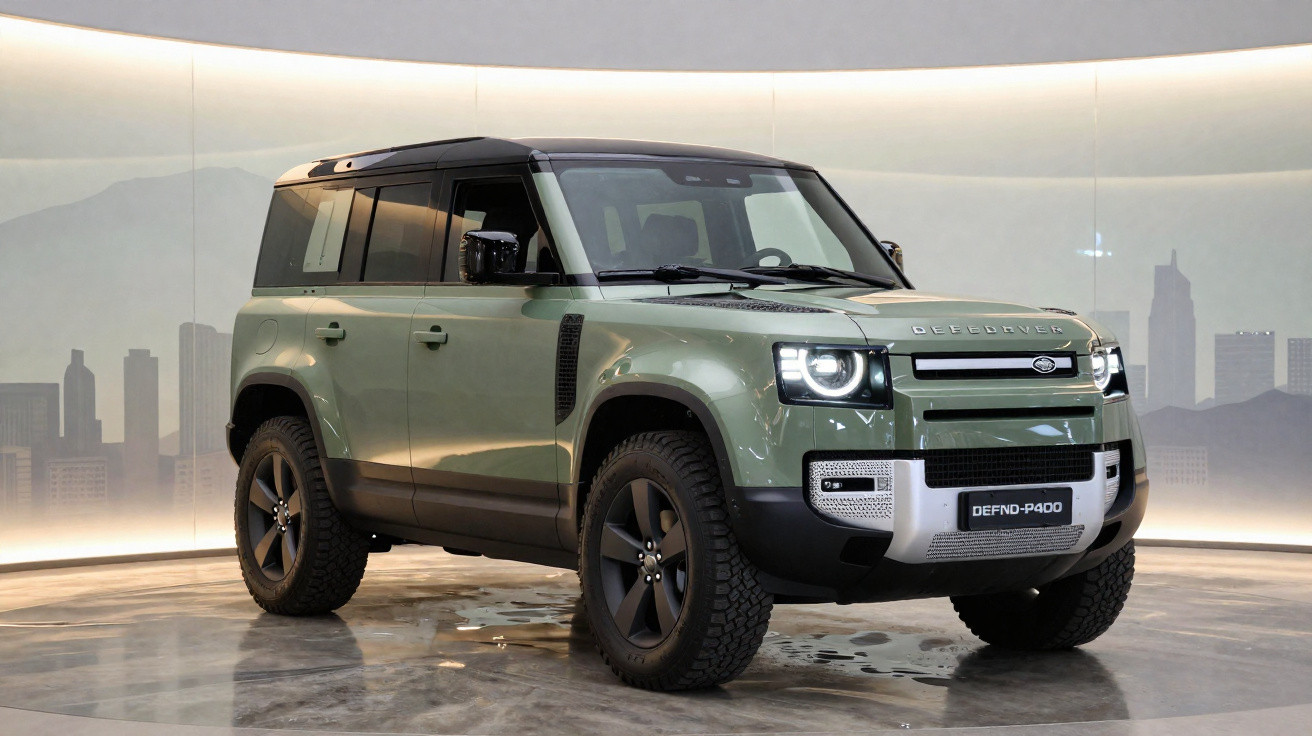
More than seven decades after the original model (which only stopped being built in 2016), the Land Rover Defender is back. Still guided by the idea of “getting anywhere”, the Defender has been rethought around a philosophy that fits today’s world far better.
It is clear there has been a real attempt to retain the styling DNA of a boxy, no-nonsense off-roader, but “remastered” so the design cannot be dismissed as retro - something styling directors almost never appreciate (Gerry McGovern says the new Defender “pays tribute to the past, without being held hostage by it”).
The upright front and rear sections remain (even if that harms aerodynamics), and it is still possible to bolt an enormous range of accessories to the bodywork - from the side-hinged tailgate’s rear-mounted spare wheel to the side ladder that helps you reach the roof.
That said, when you are not deep in the African interior but instead in the “urban jungle” - even with the odd detour along fields, valleys and quieter back roads away from city traffic - the Defender’s 4.76 metres of length (5 with the wheel “on its back”) and 2 metres of width can create a slightly “claustrophobic discomfort”.
The Defender’s “hearts”
Even the least powerful engine in the new Defender produces almost double the output of its predecessor, delivering performance that helps it slip past everyday traffic and shine in a completely different jungle: motorways and urban routes.
As a result, there are two diesel options - a 2-litre with 200 or 240 hp - plus two petrol units: a 2-litre four-cylinder with 300 hp, and a 3-litre V6 with 400 hp paired with a 48V mild-hybrid system.
In that latter version, an electric motor (supported by a lithium-ion battery) doubles as both generator and starter motor, while also feeding the petrol engine with extra energy in its “free moments”.
Electrification, a strong ally
It was precisely the mild-hybrid version (the most powerful in the entire new Land Rover Defender line-up) that we drove in this first dynamic contact.
The Defender P400 delivers an urgency that will make certain small GTis sit up and take notice (having 550 Nm under your right foot from 2000 to 5000 rpm certainly helps). The figures back this up: 6,1 s from 0 to 100 km/h and a top speed of 191 km/h.
The ZF-supplied 8-speed gearbox benefits from the electric assistance during in-gear acceleration, yet it also does an excellent job of “digesting” whatever the engine sends its way. At the same time, selecting “S” on the automatic gear selector encourages a more sporting style of driving.
It manages to be both quick and smooth - qualities that are welcome on tarmac and just as valuable on a rocky or muddy incline, where low range is as reassuring as a safety net to a trapeze artist.
The V6’s soundtrack remains consistently polished, with bass opera-singer frequencies but never becoming intrusive. That balance comes from joint work on engine refinement and cabin sound insulation.
When it is time to “lose speed”, the brakes earn praise for their strong initial bite and for not showing early signs of fade under harder use.
The one caveat appears on long descents with plenty of bends: after repeated heavy applications, the left pedal starts to travel slightly further.
Conquering new habitats
Unlike many modern SUVs, the Defender presents itself unapologetically as a 4×4. You can feel that in the natural body lean - not enough to make passengers queasy, and not to the point of causing worrying stability concerns. After all, we are talking about nearly 2 metres of height and 2.5 tonnes of mass…
And while its ability to leave the harshest terrain behind is already well documented, its suitability for city life has improved dramatically.
Alongside a better driving position, there is now steering that does far more than simply point the wheels where they should go, plus ride comfort and bump absorption (electronic dampers are standard) that make the original Defender feel like a cart.
As for real-world fuel use, everyday average consumption will sit close to 15 l/100 km, even with a restrained right foot.
Clear views for every kind of “jungle”
From behind the wheel, you immediately notice how strong outward visibility is, thanks to the low waistline, high seats and generous glass area.
Your arm is no longer “crushed” by the door, nor is your nose threatened by the closeness of the windscreen - two very pronounced character traits of the original model that have disappeared in the new Land Rover Defender.
On the subject of “assisted” visibility, the 360º monitoring system deserves special mention. It shows what is around - and even underneath - the Defender, whether that is tarmac, sharp rocks waiting to punish tyres, craters in the trail, or steep drops hidden by the bonnet.
Connectivity at a high level
Further signs of modernity include the head-up display, the digital instrument panel, and a central touchscreen flanked by more USB ports than you would expect to find in an office.
There is no doubt about it: the “motorised cart” has evolved into a computer on wheels, running more software than many commercial aircraft.
So what should you make of this “invasion” of screens and digital controls? On the road they are practical and intuitive (after a period of familiarisation), and they help free up space.
Off-road, amid jolts and body movement, it can be tricky to hit the exact point on the touchscreen to select the function you want - but that is technological progress, and there is no reverse gear.
The infotainment is permanently online, with the operating system able to update via 5G chips while you drive.
Meanwhile, the magnesium cross-car beam between the front seats not only provides a handhold for occupants, it also boosts body rigidity (the new Defender has the highest body stiffness of any Land Rover).
Finally, to ensure the new Land Rover Defender keeps its “Meccano-like” feel, the British brand deliberately leaves certain screw heads visible, both on the doors and on the centre console itself.
Room for 5, 6 or 7
When configuring the cabin, you can choose a third front seat. It can carry a passenger (as long as they are not too large, or the journey is short), and it also functions as a central armrest.
When that third seat is in use (or the rear window is obstructed), the interior mirror displays an image captured by an external digital camera, allowing the driver to continue seeing behind the car without compromising safety.
Although clever, this feature slightly reduces depth perception, making it seem as if any vehicle following you is about to strike the Defender’s rear…
The five-door version we drove is called the 110 (a reference to the wheelbase, in inches, of its forebears) and it is noticeably larger than the three-door 90.
Interestingly, despite being much shorter than the 110 and having 44 cm less wheelbase, the three-door version can still carry six passengers (except for the commercial variant).
Speaking of wheelbase, the Land Rover Defender 110 measures 3 metres (10 cm more than a Discovery), which is why it can carry five to seven people across two or three rows, while still offering generous space with five aboard.
Finally, the boot area has a rubberised floor to make cleaning straightforward. Second-row passengers also benefit from direct air vents with independent temperature adjustment.
Technology to ensure you never get stranded
No matter how much the new Defender courts digital natives and makes driving feel as close as possible to a simulation, none of that stops it from remaining, above all, a highly capable vehicle for serious “hardcore” off-roading.
There are still enough conventional switches and buttons, but it is clearly less “pure” because electronics and automated or semi-automated processes now manage many operations.
One of the most valuable aids for anyone who truly subjects the Defender to “proper hardcore” routes (in this case, deeper water crossings) is the “Wade Sensing” system.
It tells you how deep the water is before you “dive in”. Even though the Land Rover Defender can still “touch bottom” up to 900 mm, it is best not to exceed that.
On the central screen you can see the water depth ahead and an animation of the Defender moving through the stream.
At the same time, the system sets the ventilation to recirculate cabin air, softens the throttle response, raises the body height and adjusts differential operation.
Back on dry ground, it presses the brake pads against the discs to clean and dry them. Impressive.
The extensive electronic arsenal shapes much of the onboard atmosphere and influences how the Defender moves: “Terrain Response2” is the name of the central assistance system that Land Rover has refined to turn any novice into an expert with Dakar ambitions.
And it does so while using a monocoque chassis (instead of ladder rails), independent suspension at all four wheels with double wishbones up front and a multi-link layout at the rear - with additional links replacing a solid axle to improve lateral stiffness - plus extensive aluminium and a steel front and rear subframe.
These solutions help deliver torsional rigidity that is three times higher than that of the old predecessor.
The platform starts from what we know as D7 in the Jaguar XE and adds an “x”, for 4×4, to accommodate a longitudinal engine and, naturally, four-wheel drive.
4×4, low range, air suspension, electronic dampers…
All of it exists so the Land Rover Defender can adapt to whatever surrounds it. The suspension, stability control, automatic transmission and torque distribution of the four-wheel-drive system all “shape themselves” according to what the driver selects with simple taps on the central screen.
In deep sand, lowering tyre pressures and engaging low range will almost always be enough to avoid getting stuck.
If threatening rocks sit beneath the Defender, it is helpful to raise the suspension (up to 75 mm) via the air suspension (standard on the 110).
And on the way to a posh restaurant, the Defender can play the gentleman - helping a lady in high heels by lowering the suspension by 5 cm.
Regardless of wheel size (there are 18 to 22” rims), its off-road angles are the best in the market, beating the Jeep Wrangler, Toyota Land Cruiser or Mercedes-Benz G-Class.
Part of that advantage comes from the air suspension that those rivals do not offer (proof being that the Defender 90 can no longer stand out in this area, because it uses coil springs rather than air suspension).
For comfort and convenience, it is even possible to deploy the tow bar from inside the vehicle, or weigh the load you are about to tow.
There is also an advanced trailer assistance system that lets the driver control it with fingertips via a rotary controller on the centre console.
On the original Defender, the driver could manually lock the centre differential using the low-range lever. In the new model, you can prevent wheelspin at both axles by selecting electronic control of the centre and rear differentials in the relevant central-screen menu.
In that same menu, you can also choose between three response settings for the engine and 8-speed gearbox, the steering and the traction control, allowing you to “shape” the Defender to the driver’s experience and skill in these conditions.
More cautious drivers can always rely on the various “Terrain Response2” driving modes (Normal for tarmac, wading, rocks, mud/ruts, grass/gravel/snow or sand).
Technical specifications
Now available in Portugal, the new Land Rover Defender starts at 81 813 euros for the three-door version and 89 187 euros for the five-door variant.
Land Rover Defender 110 P400 S AWD Auto MHEV
| Item | Specification |
|---|---|
| Engine | |
| Architecture | V6 |
| Valvetrain | 2 a.c.c.; 4 valves per cylinder (24 valves) |
| Fuel system | Direct inj., turbo and supercharger |
| Capacity | 2994 cm³ |
| Power | 400 hp between 5500-6500 rpm |
| Torque | 550 Nm between 2000-5000 rpm |
| Transmission | |
| Drive | Four wheels |
| Gearbox | Automatic (torque converter) 8-speed |
| Chassis | |
| Suspension | Front/Rear: Independent double wishbones, air; Independent multi-link, air |
| Brakes | Front: Ventilated discs; Rear: Ventilated discs |
| Steering | Electric assistance |
| Turning circle | 12,84 m |
| Dimensions and capacities | |
| Length x Width x Height | 4723 mm x 1866 mm x 1372 mm |
| Wheelbase | 3022 mm |
| Boot capacity | 857 to 1946 litres |
| Fuel tank capacity | 90 litres |
| Weight | 2361 kg |
| Wheels | 255/35 R19 |
| Performance and consumption | |
| Top speed | 191 km/h |
| 0-100 km/h | 6,1s |
| Off-road ability | |
| Approach/departure angle | 38º/40º |
| Breakover angle | 28º |
| Ground clearance | 291 mm |
| Wading depth | 900 mm |
| Consumption | 11,2 l/100 km |
| CO₂ emissions | 255 g/km |
By: Joaquim Oliveira/Press-Inform.
Comments
No comments yet. Be the first to comment!
Leave a Comment