
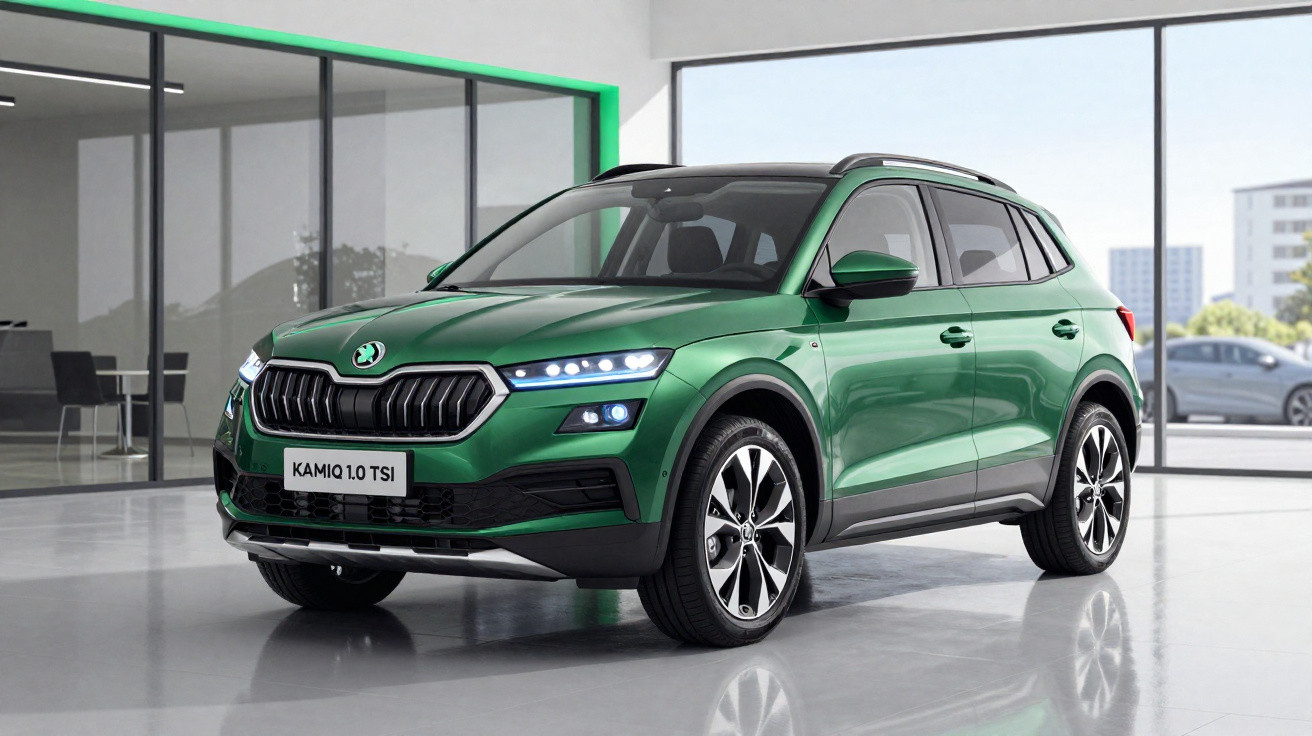
Not long ago we tried the entry step into the Skoda Kamiq range, fitted with the 95 bhp 1.0 TSI in Ambition trim. This time, it’s the range-topping petrol version that’s under the microscope.
The engine is still the same 1.0 TSI, but here it delivers an extra 21 bhp for a total of 116 bhp, paired with a seven-speed DSG (dual-clutch) gearbox. The trim level is also the highest one: Style.
So, is it worth choosing over its more modest sibling?
Typically Skoda
From the outside, the Kamiq sticks to the understated look that’s so characteristic of Skoda models. Interestingly, it feels closer to a crossover than a full SUV, helped by the lack of chunky plastic cladding and its relatively modest ground clearance.
Inside, that same restrained approach continues, and it’s backed up by solid build quality and pleasing materials in the main touch points.
As Fernando Gomes told us when he tested the base Kamiq, ergonomics have taken a small step backwards due to the removal of certain physical buttons used for controlling the air conditioning and the radio volume.
As for cabin space and interior flexibility, I’ll happily echo Fernando’s conclusion again: in this area, the Kamiq stands out as one of the strongest options in its segment.
Triple personality
To begin with-and this applies across the entire Kamiq line-up-the driving position sits a little lower than you might expect from an SUV. Even so, comfort is good, and the new steering wheel not only feels прият to the touch, but its controls also “borrow” a more “premium” air for the Czech model.
On the move, the Kamiq adapts to the driver’s needs (and mood) via the familiar drive modes - Eco, Normal, Sport and Individual (the latter lets you create an “à la carte” set-up).
In “Eco” mode, the engine’s responses feel noticeably gentler, and the DSG becomes especially keen to shift up as quickly (and as early) as possible. The outcome? Fuel consumption can drop to 4.7 l/100 km on open roads at a steady pace, along with a calmer character that makes you press the accelerator more firmly to wake up the 116 bhp-and to remind the quick-witted DSG that it needs to kick down.
Select “Sport” and you get the complete opposite. The steering gains weight (a bit too much for my taste), the gearbox holds on to each ratio longer before changing (meaning more engine revs), and the throttle becomes more sensitive. Everything happens faster and, while performance isn’t breathtaking (nor would you expect it to be), the Kamiq gains a level of confidence it otherwise keeps hidden.
The most surprising part is that consumption still stays at very reasonable levels, not rising beyond 7 to 7.5 l/100 km, even when you make full use of what the engine has to offer.
Finally, “Normal” mode appears-as it usually does-as the middle ground. Steering weight is as agreeable as in “Eco”, without the engine adopting that sense of lethargy; the gearbox shifts earlier than in “Sport”, but doesn’t constantly chase the tallest gear. And the consumption? On a mixed route combining motorway, A-roads and city driving, it settled at 5.7 l/100 km, which is more than acceptable.
On the dynamic front, I’ll once again refer back to Fernando’s assessment. Comfortable and stable on the motorway (where sound insulation also doesn’t disappoint), the Skoda Kamiq is defined above all by its predictability.
It may not be as entertaining on a twisty mountain road as the Hyundai Kauai or the Ford Puma, but the Kamiq delivers a high level of effectiveness and safety-always welcome in a car with family-friendly ambitions. At the same time, it consistently kept its composure, even when the surface was far from perfect.
Is it the right car for me?
In this top-spec petrol form, the Skoda Kamiq makes a strong case for balance. On top of the qualities shared by the wider range (space, robustness, a restrained design, and the “simply clever” touches), this Kamiq adds a little more “joy” from behind the wheel, thanks to the 116 bhp 1.0 TSI, which proved to be a helpful companion.
Compared with the 95 bhp version, it offers better day-to-day performance without presenting a real penalty at the fuel pump-an advantage if you more often than not drive with a loaded car. The only real drawback is the price gap versus the less powerful engine which, in the same trim level, starts at 26 832 euros - around 1600 euros cheaper.
The car we tested, however, included several optional extras that pushed its price up to 31 100 euros. And for not much more-32 062 euros-you can already move up to the larger Karoq with the same engine and the same trim level, albeit with a manual gearbox.

Comments
No comments yet. Be the first to comment!
Leave a Comment