
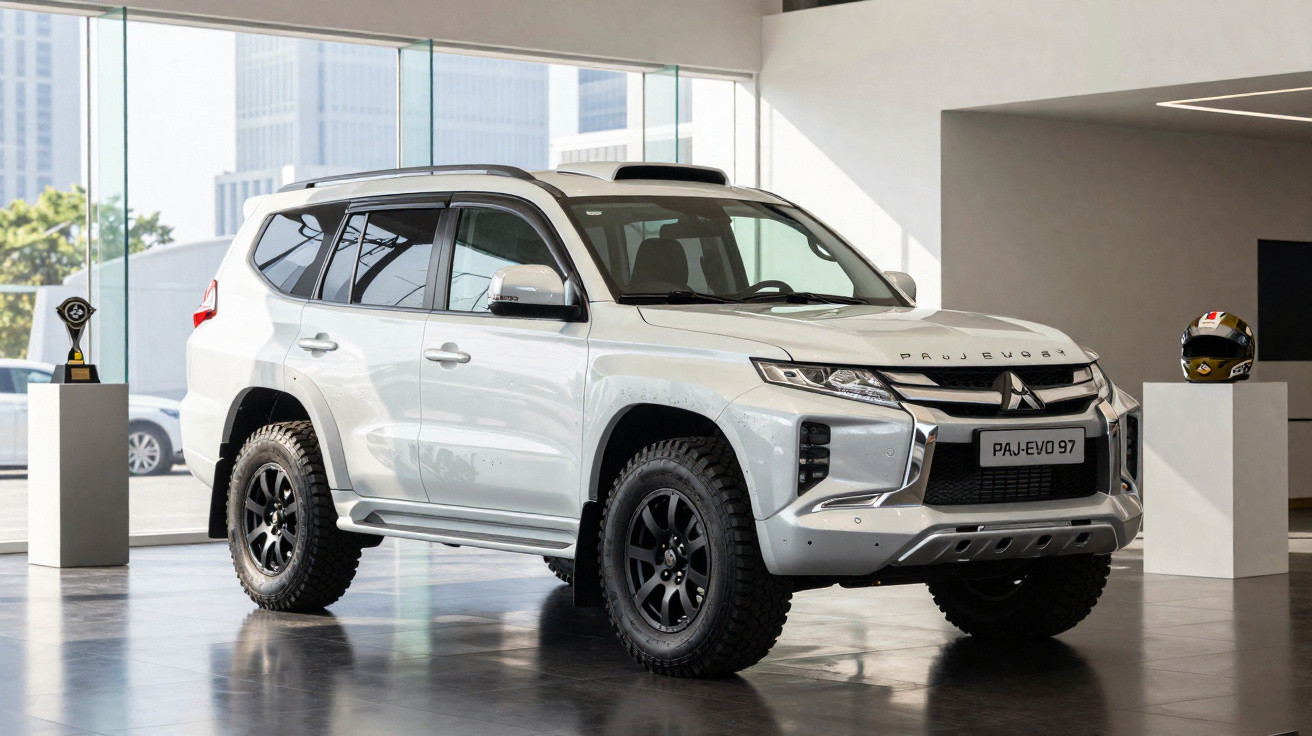
The Mitsubishi Pajero Evolution may be one of the most obscure homologation specials ever built, a long way from the fame earned by the other Evolutions that attacked-and dominated-WRC special stages on tarmac, gravel, and snow.
That lack of spotlight, however, does nothing to diminish the Pajero Evolution’s credentials.
Just as the Evolution we all know started life as a modest Lancer before being turned into a devastating weapon both in competition and on the road, the Pajero Evolution also began from a comparatively humble base.
The Mitsubishi Pajero Evolution: King of Dakar
The Mitsubishi Pajero is the undisputed King of Dakar, with 12 wins in total, far more than any other vehicle. Of course, if you look closely at the Pajeros that won across the years, the stand-outs are not the ones clearly derived from the road car, but rather the prototypes-true prototypes that kept little more than the Pajero name from the “original”.
It was the end of those T3-class prototypes in 1996-by Mitsubishi, Citroën, and (earlier) Peugeot, deemed excessively fast by the organisers-that ultimately created the opening for the Pajero Evolution. As a result, in 1997 the T2 class, for models derived from production cars, rose to become Dakar’s top category.
And that year the Mitsubishi Pajeros simply obliterated the opposition-they finished in the first four positions, with victory going to Kenjiro Shinozuka. No other car could match the pace the Pajeros were showing. Note that the 5th-placed finisher-the first non-Mitsubishi on the results sheet-was Jutta Kleinschmidt in the two-wheel-drive Schlesser-SEAT buggy, more than four hours behind the winner. The first non-Mitsubishi T2 entry, a Nissan Patrol driven by Salvador Servià, ended up more than five hours back.
The gap in speed was staggering. So how was it possible?
Mitsubishi’s “creative” side
We have seen this time and again. Finding an edge through a creative reading of the regulations has been part of motorsport since the very beginning.
Mitsubishi was following the rules: the rally car remained a T2 machine, derived from a production model. The twist was the production model it was derived from. Yes, it was a Pajero-but a Pajero unlike any other. In practice, Mitsubishi created a… super-Pajero-not so different from turning a Lancer into an Evolution-built it in the quantities required by the rulebook, and voilà!-ready to take on Dakar. Genius, isn’t it?
The mission
The job was anything but straightforward. Engineers in the three-diamond brand’s competition department spared no effort in turning the Pajero into a “lethal weapon” capable of winning a rally as punishing and as fast as Dakar.
If you know the Pajero of the period-code V20, second generation-you will appreciate there were “dunes” of differences in the Evolution. Externally it looked far more muscular, but it was what lay underneath that truly set it apart from every other Pajero.
The standard Pajero was a proper off-roader and was built accordingly: a ladder-frame chassis with crossmembers, plus a robust rear live axle for those keen on axle articulation. The big innovation with this second generation was the introduction of the Super Select 4WD system, which combined the benefits of part-time or permanent four-wheel drive, with several selectable modes.
More Revolution than Evolution
The engineers kept Super Select 4WD, but most of the chassis was simply discarded. In its place came the curiously named ARMIE-All Road Multi-link Independent suspension for the Evolution-meaning the first Mitsubishi Pajero with independent suspension on both axles. Up front it adopted double wishbones; at the rear, a multilink layout, all supported by bespoke springs and dampers. Specifications closer to a true sports car than an off-roader.
And the changes did not stop there. Torsen limited-slip differentials were fitted front and rear, while the centre differential from the regular Pajero was retained. The tracks were widened-and not by a small amount-by 125 mm at the front and 110 mm at the rear. To better handle the countless jumps that characterise Dakar, suspension travel also grew to 240 mm at the front and 270 mm at the rear.
It wasn’t only the chassis
The extravagance continued on the outside. The Pajero Evolution wore an aerodynamic body kit capable of intimidating any (Lancer) Evolution. The makeover was completed with a vented aluminium bonnet, and it was even possible to fit huge wheel-arch extensions, along with much more substantial wheels in size 265/70 R16. It is about as close as you can get to an off-roader with Group B ambitions-short and wide, with the only real difference being its generous ride height.
And the engine?
Under the bonnet sat the most powerful version of the 6G74, a naturally aspirated 3.5 l V6 with 24 valves and dual overhead camshafts. Unlike other Pajeros, the Evolution’s V6 added the MIVEC system-i.e., variable valve timing-with output set at 280 cv and torque at 348 Nm. Buyers could choose between two transmissions, manual or automatic, both with five speeds.
That figure reflects the era of the Japanese manufacturers’ “gentlemen’s agreement”, which limited engine outputs to 280 cv-some accounts suggest there were “hidden horses” in the Pajero Evolution’s engine. Even so, the official 280 cv still represented a gain of 60 cv over other Pajero V6 models. Performance figures? We do not know, because the brand never published them officially.
Instead, it is owners of this unusual machine who report 0–100 km/h times in the 8,0-8,5 second range, with top speed nearing 210 km/h. Not bad, given a kerb mass brushing two tonnes.
According to some reports, the impression on the road is of pace comparable to certain hot hatches, with the bonus that it can sustain that speed regardless of surface-asphalt, gravel, or even snow(!). Owners also single out the automatic transmission as the better option thanks to its greater robustness-the same unit used on the Pajero Evolutions competing at Dakar.
Ready for Dakar
Nothing was left to chance. The Mitsubishi Pajero Evolution (code name V55W) was prepared not for city streets, but for Dakar. Exactly as the regulations demanded, 2500 units were built (between 1997 and 1999). In doing so, the Pajero Evolution effectively worked around the restrictive T2 rules, giving it a colossal advantage over rival entries.
It was the dominant force at Dakar in 1997, as noted, and it repeated the feat in 1998, once again locking out the first four places and pushing the competition even further back-the first non-Mitsubishi would finish more than eight hours behind the winner, this time Jean-Pierre Fontenay.
This homologation special-perhaps because of its very nature-ended up being somewhat overlooked. So much so that, despite rapidly becoming a classic and being a genuine limited-run homologation model, it remains absurdly cheap: in the UK, prices fluctuate between 10 thousand and 15 thousand euros. Some of its rare accessories cost more-those wheel-arch extensions mentioned earlier can reach almost 700 euros(!).
The Mitsubishi Pajero Evolution was neither the first nor will it be the last road car created solely to gain an advantage in competition. The most recent and explicit example? The Ford GT.

Comments
No comments yet. Be the first to comment!
Leave a Comment