
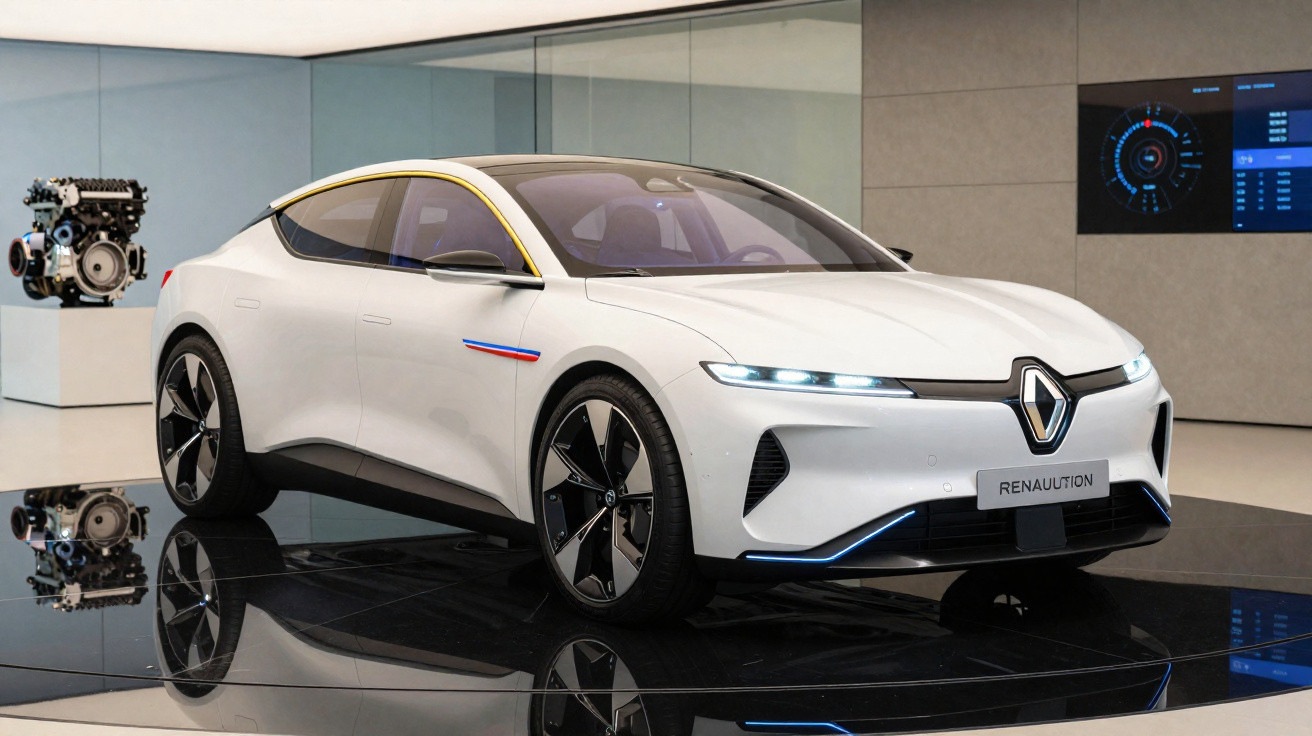
The Renaulution plan, unveiled at the start of the year, is designed to pivot the French group’s strategy towards profitability rather than chasing market share or sheer sales volume.
To lift profitability, Renault needs, among other actions, to cut costs. To achieve that, it intends not only to shorten product development time (from four years to three), but also to reduce technical variety in order to maximise economies of scale.
Alongside its target of having 80% of its models based on three platforms (CMF-B, CMF-C and CMF-EV) from 2025 onwards, Renault also wants to streamline its powertrain line-up.
Drastic reduction
For that reason, it is preparing to make a major “cut” in the number of engine families it offers. At present, across diesel, petrol, hybrid and electric options, the French brand has eight engine families:
- electric;
- hybrid (the 1.6-litre E-Tech);
- 3 petrol - SCe and TCe in 1.0, 1.3 and 1.8 litres;
- 3 diesel - Blue dCi in 1.5, 1.7 and 2.0 litres.
From 2025, Renault will halve the number of powertrain families, moving from eight down to just four:
- 2 electric - battery and hydrogen (fuel cell);
- 1 modular petrol - 1.2 litres (three-cylinder) and 1.5 litres (four-cylinder), with mild-hybrid, hybrid and plug-in hybrid versions;
- 1 diesel - 2.0 Blue dCi.
Diesel remains, but…
As we told you some time ago, Renault is no longer developing new diesel engines. As a result, only one diesel unit will remain in the French brand’s combustion-engine portfolio: the 2.0 Blue dCi. Even then, its use will ultimately be restricted to commercial vehicles. Still, it is not guaranteed to be deployed, as it will depend on the targets to be set under the new Euro 7 standard.
The 1.5 dCi, currently on sale, will continue for a few more years, but its future is already mapped out.
What about petrol?
The last “stronghold” of combustion engines at Renault, petrol units will also undergo sweeping changes. In effect, the three current families will be consolidated into a single one.
With a modular design, this powertrain will be offered, according to Gilles Le Borgne, the French brand’s director of research and development, in three- or four-cylinder forms, with 1.2 litres or 1.5 litres respectively, and with different power outputs.
Both can be paired with several levels of hybridisation (mild-hybrid, conventional hybrid and plug-in hybrid). The first to arrive will be the 1.2-litre three-cylinder (code HR12DV), due in 2022 with the launch of the new Renault Kadjar. The second variant will be a 1.5-litre four-cylinder (code HR15) and will take over from the current 1.3 TCe.
In other words, roughly midway through the new decade, Renault’s petrol-engine range will be structured as follows:
- 1.2 TCe
- 1.2 TCe mild-hybrid 48V
- 1.2 TCe E-Tech (conventional hybrid)
- 1.2 TCe E-Tech PHEV
- 1.5 TCe mild-hybrid 48V
- 1.5 TCe E-Tech (conventional hybrid)
- 1.5 TCe E-Tech PHEV
100% French electric motors
Overall, Renault’s new engine line-up will include two electric motors, both to be manufactured in France. The first, developed by Nissan, also follows a modular concept and is expected to debut in the new Nissan Ariya. The first Renault model to use it will be the production version of the Mégane eVision, with its reveal scheduled for the end of this year.
With outputs ranging from 160 kW (218 cv) to 290 kW (394 cv), this motor will be used not only in battery-electric vehicles but also in hydrogen (fuel cell) electric vehicles, notably the future Trafic and Master vans.
The second electric motor, meanwhile, is intended for city cars and compact models such as the new Renault 5, which will be electric-only and is expected to arrive in 2023. This smaller motor will have a minimum output of 46 cv.
Source: L’Argus
Comments
No comments yet. Be the first to comment!
Leave a Comment