
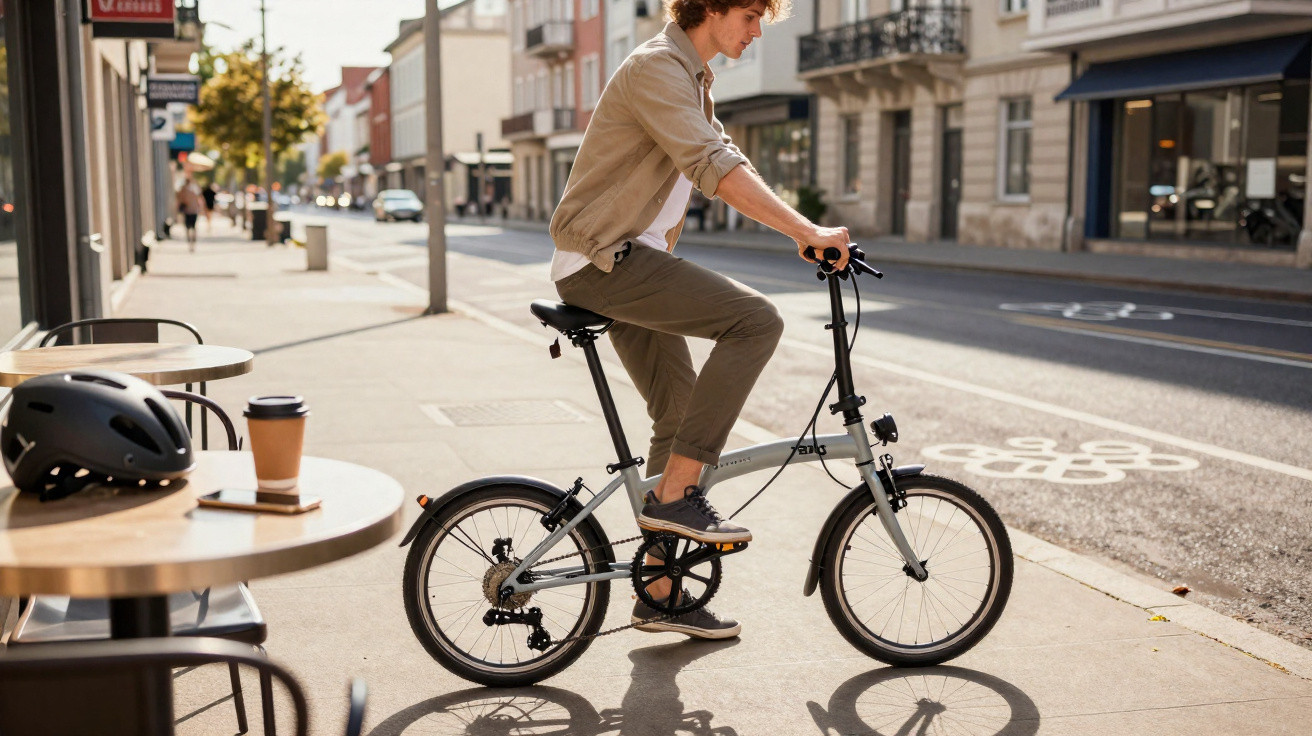
ENGWE’s promise with the ZIP is bold: an electric bike that folds in three seconds, weighs 16.9 kg, and takes up no more room than a carry-on suitcase. I spent a few weeks hauling it around Paris and the surrounding area to see whether the brand’s marketing had got carried away with unrealistic optimism. Here’s what I found.
Surprisingly compact, plus USB-C charging
The ZIP stands out from most e-bikes that land on my doorstep the moment it arrives: the box is astonishingly small, barely larger than a suitcase. Better still, the bike turns up 95% assembled. The instructions simply ask you to slot in the handlebar stem and seatpost, click the pedals into place, then screw on the rear rack.
From delivery to being ready to ride, it took barely 15 minutes. Almost-because the battery still needed charging.
The battery sits inside the bag mounted at the front of the bike, which can also hold accessories or a few shopping items. © Marc Mitrani for Presse-citron
The battery itself is a black rectangular block hidden inside that front bag. You can charge it while it’s fitted to the bike, or detach it and take it indoors with you. The standout detail here is that it charges using a straightforward USB-C GaN 100 W charger supplied in the box.
In other words, the ZIP’s charger is the same kind you might use for a MacBook Pro or a high-end smartphone. No more huge proprietary power brick that weighs a ton and only works with the bike. When you’re travelling, you can bring a single charger for everything. At this price point, that’s a luxury you almost never see on an electric bike-most rivals still cling to proprietary, early-2010s-style connectors.
One warning, though: if you use a third-party charger, it needs to deliver 100 W. You can also charge with a 60 W unit, but you’ll have to be patient. Even with the supplied power adaptor, getting to 80% takes 2 h 45, and a full charge to 100% takes 4 h.
Another key strength of the ZIP is just how easy it is to fold. It takes under a minute, and the bike becomes genuinely compact. Credit is due to the magnet system that keeps it securely folded, as well as the dedicated storage spot for the removable pedals. Two small rollers under the frame keep it pleasantly stable when folded and make it easy to wheel along.
Designed for short trips
Riding a bike with 16-inch wheels takes a little getting used to: it doesn’t feel like a 26- or 28-inch bike. The steering is more responsive, bumps make themselves felt more clearly, and you need a few kilometres to adapt.
That said, the ZIP surprised me with how stable it is. The 1.95-inch tyres (around 5 cm wide) offset some of the harshness you might expect from such small wheels. The suspended seatpost does a respectable job of smoothing out Parisian cobbles and poorly patched tarmac joins. ENGWE says it’s built for riders between 1.55 m and 1.90 m tall.
The 250 W motor in the rear hub produces 40 Nm of torque. That isn’t a powerhouse even in this category (some competitors push close to 60 Nm), but the real focus here is the torque sensor-and it’s impressively well tuned. Assistance comes in smoothly and scales with pedalling effort, without unpleasant surges. At Paris traffic lights, the ZIP pulls away cleanly without bogging down.
The three assist levels cover the essentials. Level one is for those who still want to put in some effort, level two suits a commute, and level three turns the ZIP into a little rocket (up to 25 km/h, of course). The very standard 7-speed Shimano drivetrain does its job without any flair. It’s not top-of-the-range, but it matches the bike’s urban positioning. Braking is handled by hydraulic discs front and rear, with a reassuring bite even in the rain.
Decent range
ENGWE claims a range of 60 to 120 km depending on the assistance mode. Those figures assume a lightweight rider in ideal conditions. Unfortunately, I’m neither lightweight nor “ideal”. I weigh 110 kg fully kitted out-around 30 kg more than the typical test rider.
That difference matters: with mixed use (a bit of mode 2, a lot of mode 3), I saw roughly 45–50 km. That’s enough for three to four days of everyday trips without reaching for the charger. So don’t expect to cross the country on it-but that isn’t the point of this bike anyway. A lighter rider will inevitably get more range, though still not the numbers ENGWE advertises (65–70 km for a 75 kg rider, for example).
Connected bike
The ZIP comes with a 3.2-inch colour LCD and Bluetooth connectivity for ENGWE’s companion app (available on iOS and Android). The display stays readable in direct sunlight and shows the basics: current speed, battery level, assistance mode, odometer, and the status of the front light.
The app does what you’d expect at this price, no more and no less. It lets you review trip statistics, tweak a few settings, and receive any updates. It’s a welcome extra that’s still uncommon on bikes sold for this kind of money.
So, is the ZIP the perfect folding bike for city use? Largely, yes-but it does come with a few drawbacks, because ENGWE has clearly made compromises to keep the price down. In that context, using a steel frame rather than aluminium is unfortunately a logical decision. An aluminium frame could have shaved off 1 to 2 kg, but the bill would have been higher.
And 40 Nm of torque is still 40 Nm. On flat ground and gentle inclines, it’s plenty. But around the Plateau de Gravelle, or on the climbing cobbles of Montmartre, you’ll need to drop into the easier gears and accept that you’ll be pedalling harder. If your daily ride includes serious elevation changes, a more powerful (and more expensive) model will likely be a better buy. That warning applies even more to heavier riders like me, because the motor is worked harder on climbs.
My verdict on the ENGWE ZIP
The ZIP isn’t a one-size-fits-all electric bike. It’s better understood as a specialist product aimed at a specific type of rider: a city dweller who mixes several modes of transport each day, lives somewhere with limited space, and needs a genuinely compact bike that can slide under a desk or into a cupboard.
There are plenty of thoughtful touches: rapid folding, a sensible weight, effective hydraulic brakes, and a torque sensor that performs brilliantly. Special mention goes to USB-C charging, which removes the need for a proprietary power brick-clearly, ENGWE has looked at how people move around cities in 2026 rather than recycling the usual playbook.
At €999 at launch (€1,099 afterwards), it’s hard to beat for value among compact urban folding bikes. If you live in a big city and routinely combine the underground, bike, tram or regional trains, the ZIP deserves serious consideration-especially if theft is a concern. If, on the other hand, you want a bike for relaxed Sunday rides, this isn’t the one: you’d likely end up disappointed.
ENGWE ZIP
Price: 999 €
Overall score: 9
| Category | Score |
|---|---|
| Design & ergonomics | 9.0/10 |
| Comfort in use | 9.0/10 |
| Range | 8.5/10 |
| Performance / price ratio | 9.5/10 |
We like
- Compact once folded
- Standard USB-C charging
- Effective hydraulic brakes
- High-performing torque sensor
We like less
- Steel frame choice
- Struggles on steep climbs
Buy the ENGWE ZIP


Comments
No comments yet. Be the first to comment!
Leave a Comment