
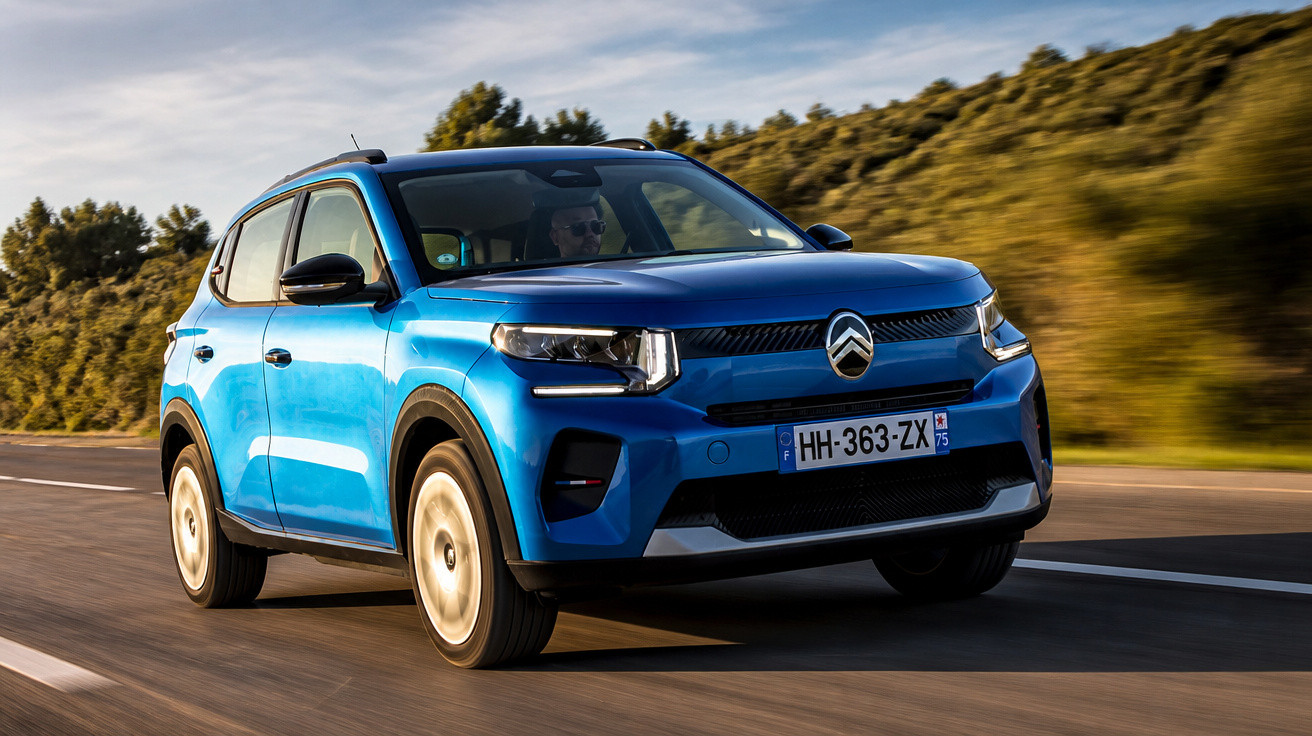
Hang on, this isn’t new, is it?
No. But yes. But also no. The current Citroen C3 arrived a couple of years back, bringing with it that quirky styling influenced by the Oli concept and – for the first time in the developed world – a fully electric drivetrain.
In its original form, the e-C3 matched a 111bhp electric motor with a 44kWh battery, offering up to 199 miles of range and an eye-catching starting price of around £22k. Against rivals such as the Fiat 500, Mini Cooper Electric, Peugeot e-208 and Vauxhall Corsa Electric, it stood out as notably strong value. And it’s a lot more comfortable than any of those, I should add.
So what is this Citroen e-C3 Urban Range, then?
This is the e-C3 Urban Range. It keeps the same 111bhp, front-driven electric motor, but swaps in a much smaller 30kWh battery, cutting the WLTP range to 130 miles.
That’s fewer battery cells than you’ll find in a plug-in hybrid GLC, and it runs counter to the recent small-BEV trend of ever-larger batteries. Which makes it Officially Interesting.
But what you're saying is it’s… worse?
Sort of, but that misses the point – it’s right there in the badge. The e-C3 Urban Range is aimed squarely at city and suburban drivers, where a “long journey” might just mean a slight detour between the school run and Lidl.
Citroen says that if you stay within urban boundaries it can manage up to 186 miles WLTP – extended motorway stints are very much not part of the brief.
Why not just buy a car that can do both?
Mostly because of price. The e-C3 Urban Range opens at £19,995, and because it’s eligible for the Government’s Electric Car Grant you can immediately lop £1,500 off – taking it to £18,495.
At the moment, the only new electric cars priced below that are the Leapmotor T03 (£14,495/165 miles/37.3kWh battery) and the Dacia Spring (£15,990/140 miles/26.8kWh), but this feels like it’s playing in a different division to those two.
How so?
Because, aside from the smaller battery, it’s essentially the same car as the regular e-C3 (now renamed e-C3 Standard Range). Visually there’s nothing to separate them inside or out, and it comes in the same ‘Plus’ trim (though you can’t step up to the higher ‘Max’ spec with the Urban Range). That means you still get 17in alloy wheels, LED headlights, black two-tone paint, roof rails, a 10.25in colour touchscreen with smartphone mirroring, cruise control, rear parking sensors… and plenty more besides.
That includes Citroen’s party trick: Advanced Comfort Seats and Suspension. The seats are basically armchairs designed to be kinder to your backside, while the suspension uses hydraulic bump stops to soften the sharp edges of our cratered roads – a setup you also find on pricier models from the French brand. Ahh.
How does it cope in the real world?
Very similarly to the standard e-C3, which is good news because it’s a car we rate at Top Gear. Our drive took us through central Marseille, where the tiny Citroen felt perfectly in its element. The small steering wheel (reminiscent of Peugeot’s i-Cockpit arrangement) helps it feel light on its feet, and the 10.6-metre turning circle reinforces that nimble impression.
It’s not cramped, either – it’s entirely plausible to carry four adults (or two adults and three children) without it turning into a punishment.
Performance is sprightly right up until it isn’t: 0–62mph takes 10.4 seconds. That’s absolutely fine for urban work where you’re rarely far above walking pace, but the shove fades noticeably once speeds rise.
And if you do stray beyond the city, it doesn’t become instantly overwhelmed. On French B-roads and autoroutes it coped far better than the Spring and T03, which can feel totally out of their depth in that environment. This doesn’t.
Can’t be good for the range though?
Er, no. Over a 60-mile mixed route I saw 3.3 mi/kWh – which works out to roughly 100 miles of real-world range. That was with the air conditioning running (it was 25°C, cut me some slack) and, as noted, a decent chunk of autoroute. Just because it can handle quicker roads doesn’t mean it should.
Especially when there are plenty of electric superminis that will travel further for not a lot more money. The Renault 5 starts at £21,495 and we’ve extracted 3.5 mi/kWh from it for 140 miles of range; the Nissan Micra costs the same, has the same WLTP figures (it’s effectively the same car)… and we’ve managed 4.8 mi/kWh (about 190 miles) from that. The Spring, too, is a genuine efficiency monster.
Knew it was sounding far too positive…
Here’s the sting in the tail. DC rapid charging tops out at just 30kW – a huge drop from the Standard Range car’s 100kW capability. Worse, you have to pay £440 to enable it; otherwise you’re stuck with a maximum of 7.4kW on AC. Yikes.
Surely that’s money you’ll want to spend, even if you swear you’ll never take the Urban Range further than the parish boundary. At 30kW it’ll charge from 20 to 80 per cent in 36 minutes at a motorway services stop; without it, you’re looking at charging sessions that take several hours. That’s fine if you’re parked on the driveway, less fine if you fancy a spontaneous day trip to the beach. Best check the train timetable...
Hmm. Any cost-cutting on the inside?
No more than in the normal e-C3. The modern-day throwbacks are all present: a manual handbrake, rear windows you wind up by hand, and an ignition that requires you to physically turn a key. What is this, 2003?
We’re keen on the head-up display-style instrument cluster, but the touchscreen looks and feels a bit cheap and doesn’t offer a huge amount of functionality – though, to its credit, you still get proper physical air conditioning controls.
The piano-black plastic around the centre console also drags down an otherwise characterful cabin (complete with door “clothes labels” reading ‘have fun’, ‘be happy’, ‘feel good’, ‘be cool’). The fabric-trimmed dashboard is genuinely pleasant, but it can’t disguise the sheer quantity of nuclear-proof plastics spread around the interior.
So the Standard Range is still the one to have?
Yes. The Urban Range targets a very specific buyer with very narrow requirements – realistically, why choose something this restrictive when spending only a little more keeps your options open?
The Standard Range also qualifies for the Electric Car Grant, meaning it’s only £2,100 more than the Urban Range. On Citroen finance, that equates to roughly £10 a month extra over two years – a small premium for the additional range and the faster charging. And for not having to get the train, obvs.


Comments
No comments yet. Be the first to comment!
Leave a Comment