
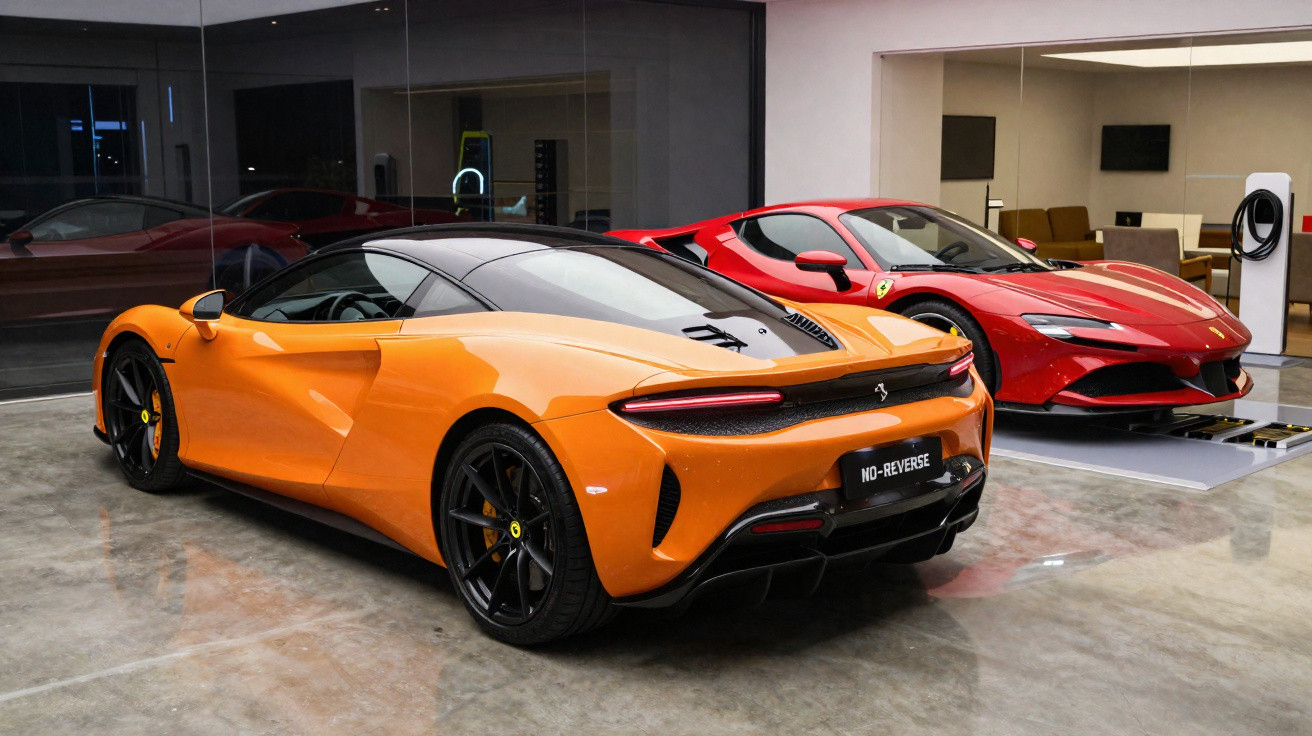
The McLaren Artura is a landmark for Woking: it is the first McLaren to use a V6 engine and the brand’s first series-production electrified model (setting aside the limited-run P1 and Speedtail). In that sense, the Artura signals the start of a new chapter for McLaren.
The Ferrari SF90 Stradale also represents a major internal milestone. For Maranello, it is “simply” the most powerful road-going Ferrari ever, and it is likewise the first plug-in hybrid Ferrari to be built in series production without the restrictions that applied to the LaFerrari.
What the McLaren Artura and Ferrari SF90 Stradale have in common
Both cars are plug-in hybrids, and they share an unusual detail: despite using an eight-speed dual-clutch gearbox in both cases, neither transmission includes a traditional reverse gear.
A question of weight
So why delete the reverse ratio? Put very simply, removing reverse on this kind of hybrid avoids duplication and can also shave off a little weight.
Because plug-in hybrids are significantly heavier than pure internal-combustion models-thanks to one or more electric motors and, above all, the battery pack that feeds them-any strategy that helps keep mass under control is welcome.
And while extra weight is already an issue in a “normal” car (more inertia and a negative impact on handling), it becomes even more critical in two performance-focused supercars such as the McLaren Artura and the Ferrari SF90 Stradale.
Kerb weight figures and hybrid weight penalty
In the British car’s case, even with a 7.4 kWh battery and an electric motor, its kerb weight stays below 1500 kg: 1498 kg (DIN). The SF90 Stradale, meanwhile, has its hybrid system add 270 kg, taking total mass to 1570 kg (dry)-meaning you should add at least 100 kg for all the fluids required for it to operate.
Dropping the reverse gear is one small way to soften the impact of the electric side’s mass. For McLaren, it was the solution that allowed an extra ratio in the transmission without increasing its weight. For Ferrari, the change delivered a total saving of 3 kg compared with the conventional dual-clutch transmission they already used.
How do they reverse?
By now, you may be thinking: “OK, they don’t have reverse gear, but they can still reverse. How do they do it?” They can do it precisely because they are plug-in hybrids-in other words, because they have an electric motor that is powerful enough to handle the task.
As with electric cars (which typically have no multi-ratio gearbox, only a single-speed reduction gear), an electric motor can reverse its polarity and rotate in the opposite direction, enabling the Artura and the SF90 Stradale to move backwards.
The Artura’s electric motor role
In the Artura, the 95 cv electric motor mounted between the gearbox and the crankshaft not only provides the functions of “reverse”, assists the combustion engine and drives the car in 100% electric mode, but is also able to smooth out gear changes.


Comments
No comments yet. Be the first to comment!
Leave a Comment