
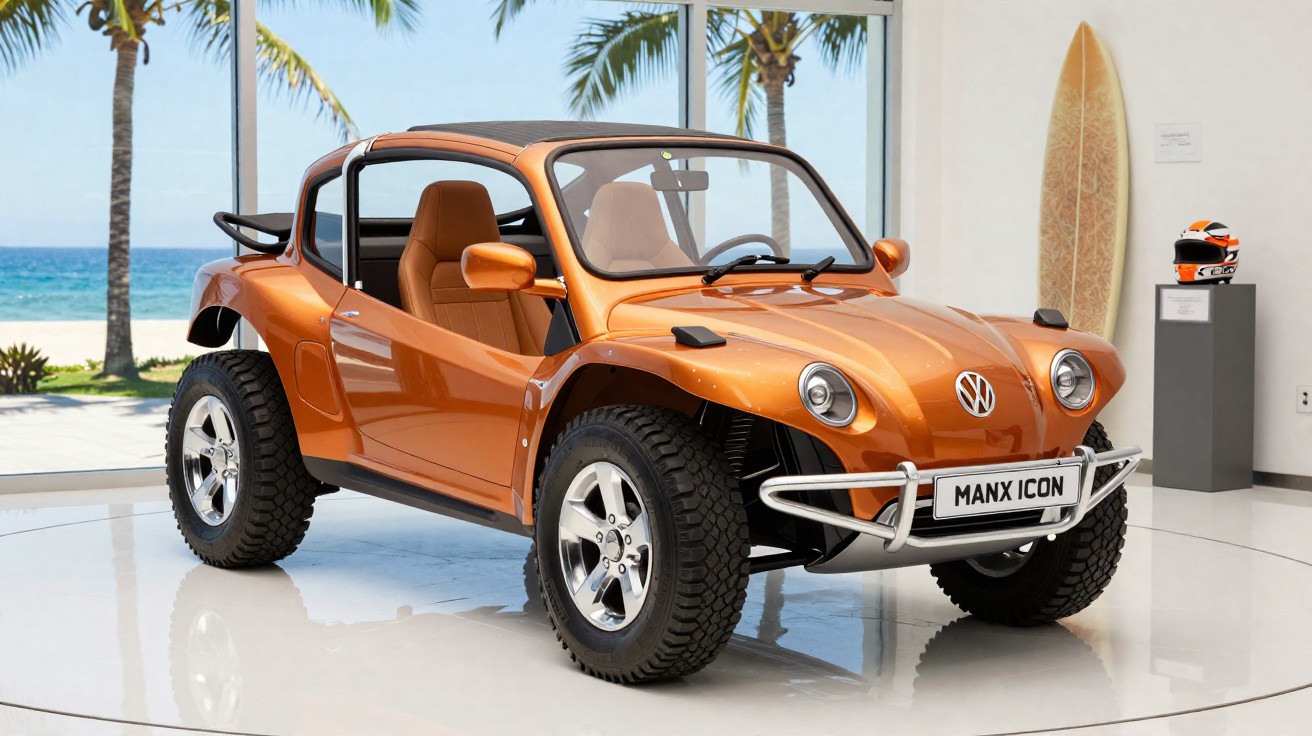
Few cars are so closely tied to summer and leisure time as the famous buggy that took the Meyers Manx (aka the Volkswagen Buggy), created by Bruce Meyers, as its original blueprint.
We want to take you through Meyers’ story and the origins of his best-known creation, as a fitting tribute to the man behind one of the most feel-good cars ever made.
It is, sadly, a posthumous tribute: Bruce Meyers died on 19 February, aged 94, just a few months after he and his wife sold Meyers Manx to Trousdale Ventures.
Bruce Meyers and the Meyers Manx Volkswagen Buggy
The car that made Meyers’ name is inseparable from the carefree, sunny image of dune driving, beach days and unpretentious fun-exactly the spirit that shaped the Meyers Manx from the start.
Necessity is the mother of invention
Born in Los Angeles in 1926, Bruce Meyers’ life took him from serving in the Navy during the Second World War, to off-road racing, and then to the beaches of California. There, as a keen surfer, he realised he needed a vehicle that could move across sand dunes far more easily than his 1932 Ford Hot Rod could manage.
A hot rod? Absolutely. Long before his most famous creation appeared, Meyers already had a deep history with cars-he even competed as a racing driver-and he was very much part of the Hot Rod phenomenon that flourished in the United States after the Second World War.
Fibreglass know-how: surfboards, catamarans and a car body
Cars were not his only focus. Meyers’ command of fibreglass-the material that would later define his buggy’s bodywork-came from making surfboards and even small catamarans.
With that experience behind him, he “took” a Volkswagen Beetle chassis-mechanically simple by nature-shortened it by 36 cm, removed the original bodywork and replaced it with a new shell made from the material he knew best: fibreglass. He stripped the design back to the bare essentials, creating a look that was instantly distinctive and, above all, fun.
That was how the first Volkswagen Buggy came to be: the Meyers Manx, known as “Big Red”. Launched in 1964, this light, versatile car-with rear-wheel drive and a rear-mounted engine-set the template for a “craze” that would spread around the world.
And it was more than a craze. Meyers and “Big Red” are widely credited as key drivers of organised off road racing. Meyers himself, together with his racing partner Tom Mangels, set the first four-wheeled record-faster even than motorcycles-at the first-ever Baja event, the Mexican 1000, held in 1967, which went on to become the forerunner of today’s Baja 1000.
The “price” of success
The Meyers Manx may have been propelled into the spotlight after appearing in the 1968 film “The Thomas Crown Affair”, and after featuring on the cover of “Car and Driver” in 1969, but not everything was plain sailing.
In 1971, Bruce Meyers left the company he had founded as it slid into bankruptcy, despite having already produced around 7000 examples of the famous buggy. Who was to blame? Taxes-and rivals who copied his design.
Even after taking the imitators to court-at the time, more than 70 companies were building similar models-the outcome did not go his way. Meyers was unable to patent his Volkswagen Buggy, and although he had created the concept, the business suffered severe damage.
Back to the Meyers Manx, and Volkswagen’s later tribute
Even so, the urge to build cars never left Bruce Meyers. In 2000, roughly 30 years after he had stopped producing his distinctive buggies, the Californian chose to return to what made him famous: building the Meyers Manx once again.
More recently, Volkswagen offered its own fitting nod to the Beetle’s more irreverent side when it unveiled the ID. Buggy in 2019, showcasing the flexibility enabled by its dedicated electric-vehicle platform, MEB.



Comments
No comments yet. Be the first to comment!
Leave a Comment