
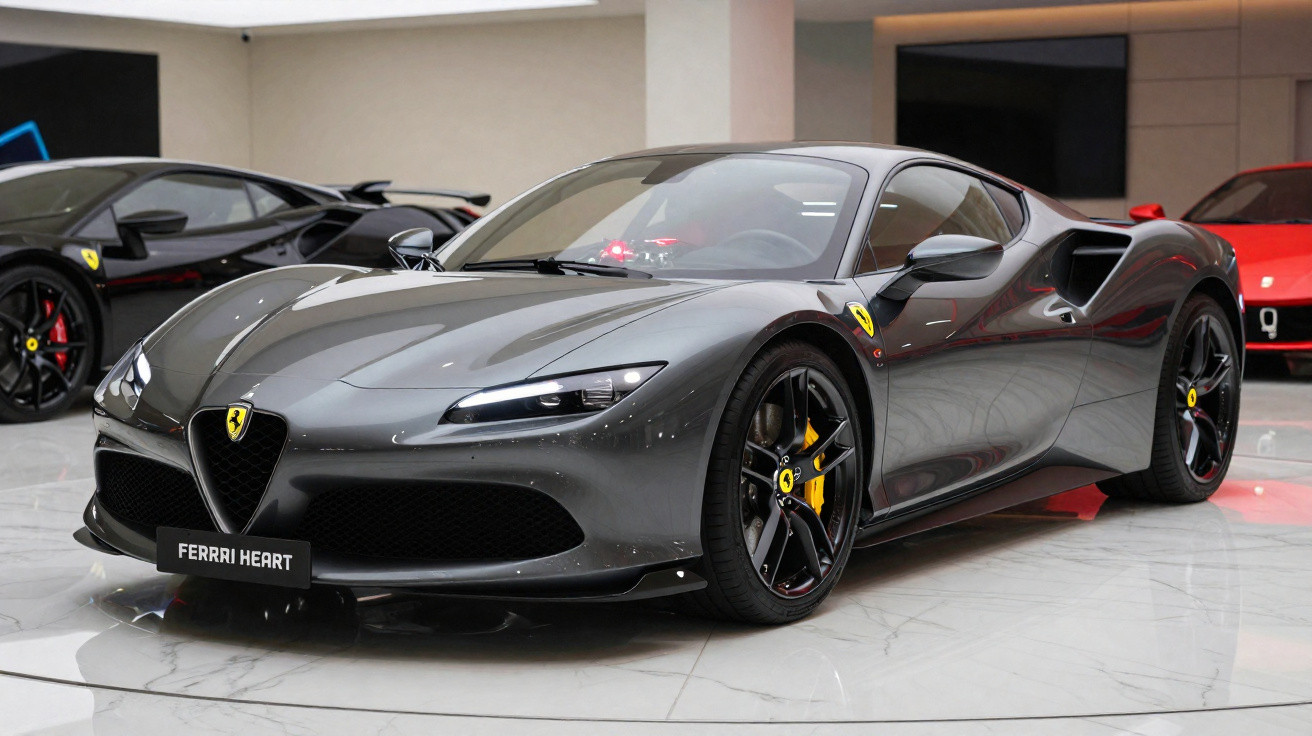
Seeing Ferrari engines under the bonnet of cars that do not wear the famous cavallino rampante is far from common, yet it has happened - and probably more often than you might think.
Some examples are very recent (and widely known), such as the twin-turbo V6 fitted to the Alfa Romeo Giulia and Stelvio Quadrifoglio. Others, however, sent us digging deep into automotive history - including the little-known ASA 1000 GT.
All the cars we found share one thing: they are Italian.
ASA 1000 GT and a Ferrari engine
Today, V8s - and now even V6s - are a familiar part of the Ferrari line-up. But in the 1950s and 1960s, the Maranello brand was far more “exclusive”.
In its road cars, anything less than a noble V12 simply did not appear under the bonnet, which naturally reinforced both the exclusivity and the price of its models.
As a more affordable counterpoint to its V12 cars, Enzo Ferrari explored the idea of creating a new model to fill that gap.
That thinking gave shape to the ASA 1000 GT, a compact sports car developed by Ferrari and powered by a small four-cylinder with just 1.0 l of capacity () - effectively one third of Ferrari’s 3.0 l aluminium V12.
So why wasn’t it called a Ferrari? Enzo Ferrari was reluctant to put the cavallino rampante badge on a car that did not use a V12, and he also had no desire to expand Ferrari’s facilities to cope with a projected output of more than 3000 units per year.
Instead, thanks to his close relationship with the Nora industrial family, he turned to them to build the small sports car, creating ASA (Autocostruzioni Società per Azioni) in the process.
Unveiled at the 1961 Turin Motor Show, the ASA 1000 GT only entered production in 1964. Its styling came from Giorgetto Giugiaro (then at Bertone), while the chassis was developed by another major name in the Italian car industry: Giotto Bizzarrini.
Built until 1967, the ASA 1000 GT quickly picked up the nickname Ferrarina (little Ferrari), a clear nod to its Ferrari ties.
Even though it was meant to be attainable, the ASA 1000 GT reached the market at a high price - helped along by “luxuries” such as four disc brakes and a Ferrari engine - and as a result it fell a long way short of the success its creators had hoped for.
In the end, only 90 units were produced.
The Dino V6 Ferrari engine arrives
Co-developed by Alfredo ‘Alfredino’ Ferrari and Vittorio Jano - the “father” of the first production V6 (Lancia) - Ferrari’s first V6, the Dino V6, was created with a single purpose: to compete in Formula 2.
However, the rules required that, for homologation, the engine had to be fitted to road cars and produced in at least 500 units over a 12-month period.
With no ability to build that many cars in Maranello in the time available, Ferrari asked Fiat for help - and Fiat, in return, received a V6 to create one of its most special models ever: the Fiat Dino.
The Fiat Dino was offered as the Dino Spyder (styled by Pininfarina) or the Coupé (penned by Bertone). It was rear-wheel drive and used the same 2.0 V6 found in the Dino 206 GT (a mini-Ferrari missing only the badge). It produced 160 cv and was paired with a five-speed manual gearbox.
In 1969, the Dino V6 was updated: displacement grew from the original 2.0 l, and the aluminium block was replaced by a 2.4 l unit with a forged iron block, with output rising to 180 cv.
As well as continuing in the Fiat Dino and in the Dino 246 GT and GTS, this engine also found its way into one of the most iconic cars in the industry: the Lancia Stratos, launched in 1973.
The rest is, of course, history. The Stratos was the first car designed specifically for rallying, and its mid-rear-mounted V6 - here delivering 190 cv - helped Lancia secure three consecutive manufacturers’ titles.
Lancia again
Between 1975 (the final year of Stratos production) and 1986, Ferrari engines once more appeared only in Ferraris. The Lancia Thema 8.32 changed that.
Fitted with a 2927 cm³ Ferrari V8, the Thema 8.32 marked Ferrari power’s return to Lancia.
Shared with the Ferrari 308 Quattrovalvole, this engine produced, in the non-catalyst version, 215 cv, allowing Lancia’s executive saloon to run from 0 to 100 km/h in 6,8s and reach a top speed of 240 km/h.
As for the 8.32 badge, it came straight from the V8’s layout: “8” for V8 and “32” for 32 valves.
Maserati’s turn
When Luca di Montezemolo took charge of Maranello in the 1990s and, later on, of Maserati as well, it was only a matter of time before Ferrari engines began appearing in models from the Trident brand.
That is exactly what happened in 2002, when the Maserati Coupe and Spyder (also known as the 4200 GT) received the same naturally aspirated V8 as the Ferrari F430: the F136.
To better suit Maserati’s character, the 4.2 l V8 (4244 cm³) used a cross-plane crankshaft (smoother running and a stronger emphasis on torque) rather than the flat-plane crank (lighter, more balanced and able to rev higher) used by Ferrari.
Beyond the Coupe and Spyder, the V8 also powered the Quattoporte and later evolved into a 4.7 l version used in other models such as the GranSport and, later, the GranTurismo and GranCabrio - with those two retiring in 2019.
Outside Maserati, the naturally aspirated 4.7 V8 also found a home in the beautiful Alfa 8C Competizione and 8C Spider.
Alfa Romeo keeps the tradition alive
The 8C came first, but it was the Alfa Romeo Giulia and Stelvio Quadrifoglio that truly tightened the relationship between Alfa Romeo and Ferrari.
The “culprit”? The 2.9 l twin-turbo V6, by Ferrari, producing 510 cv and 600 Nm of torque. Finally, in the Giulia GTA and GTAm, power climbed to an impressive 540 cv, making them the most powerful Alfa Romeos ever.
Which non-Ferrari will be next to receive a Ferrari engine?
Comments
No comments yet. Be the first to comment!
Leave a Comment