
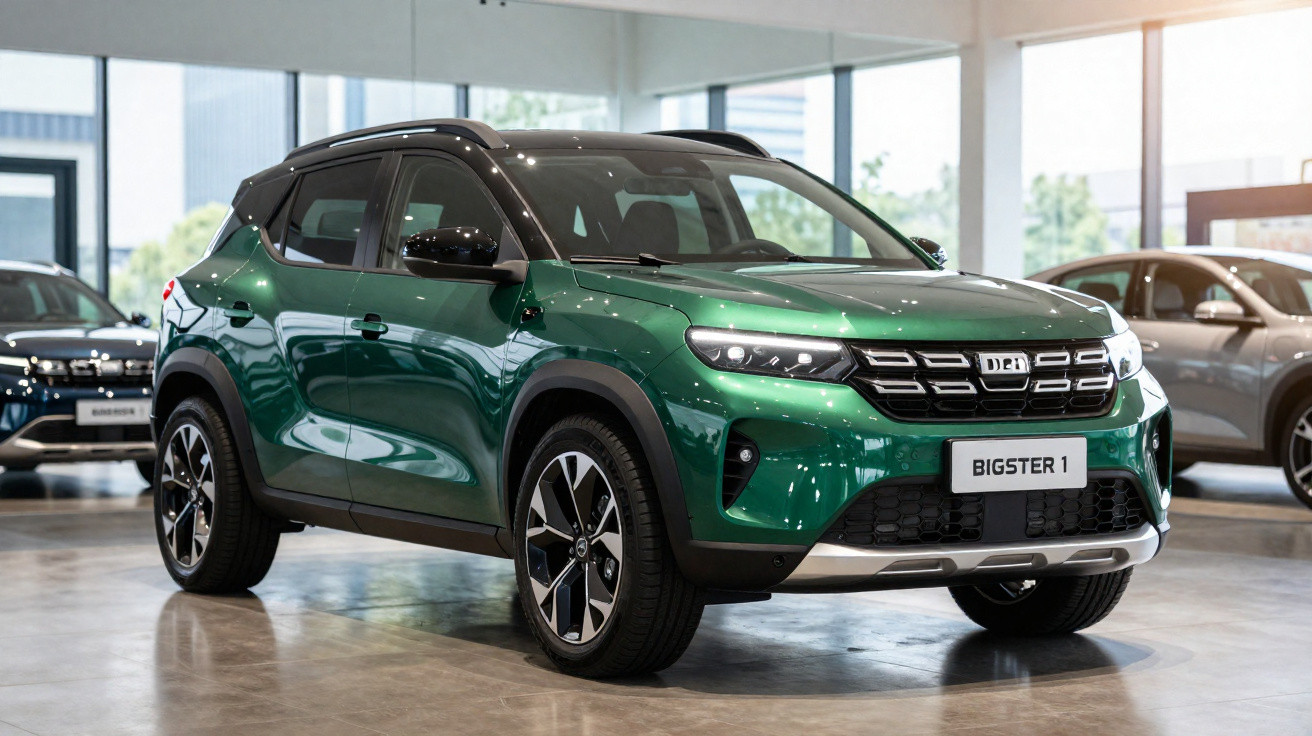
Is it worth paying more for the Dacia Bigster, or does the Dacia Duster remain the one to choose?
Almost everything has already been said about the new Dacia Bigster: it is the biggest model the brand has ever built and it aims straight at a category it had never previously dared to enter - the C-SUV segment, which racks up roughly three million sales a year in Europe.
Even with that level of ambition, Dacia has stuck to the recipe that has served it so well in recent years: a no-nonsense, tough vehicle with a price that is very hard to beat - particularly when you look at the hybrid version.
But is that enough to justify the price gap between it and its smaller sibling, the ever-popular Dacia Duster? We drove it to find out:
Size matters
At 4.57 m long, the Bigster is 23 cm longer than the Duster, and that extra length brings real gains in space and flexibility. In fact, it is one of the roomiest SUVs in the segment: rear passengers get plenty of legroom and, in this hybrid version, the boot offers 546 litres of capacity - around 120 litres more than the equivalent Duster.
If you choose the other powertrains - mild-hybrid or GPL - that figure can be higher, with the Bigster offering up to 667 litres of luggage space. I did the maths, and I can tell you it won’t run out of room when you head off on holiday.
Things have changed…
The days when choosing a Dacia meant accepting a long list of compromises on comfort and technology are long gone. Today, that simply isn’t the case: it delivers what any modern customer expects to find in a brand-new car.
That includes plenty of driver assistance systems, such as autonomous emergency braking and adaptive cruise control, as well as conveniences like Android Auto and Apple CarPlay (wireless on every version), dual-zone automatic air conditioning and a 10.1" digital instrument cluster.
It’s true the cabin still follows the straightforward, functional approach found across the brand’s line-up, but it’s at the best level Dacia has ever achieved. And despite the many visual similarities with the Duster, there’s a clear step forward in sound insulation and seat comfort.
The Bigster’s biggest trump card…
…is its hybrid system, which is a complete first within the Renault Group. The hybrid set-up fitted to the Duster (and to many Renault models) has been developed further: instead of a 1.6-litre naturally aspirated engine with 94 hp, it now uses a 1.8-litre naturally aspirated unit producing 107 hp.
The electric motors are unchanged (the traction motor keeps its 49 hp and the starter-generator remains at 20 hp), but the battery is slightly larger, increasing from 1.2 kWh to 1.4 kWh.
The outcome is a maximum output of 155 hp - 15 hp more than the previous hybrid system, which you’ll find, for instance, in the Duster. And given the size of this SUV, that extra power is genuinely welcome.
Managing all of this is the familiar Renault Group multi-mode gearbox, but it feels better than ever here. It’s smoother, quicker and less erratic than the one in the Duster Hybrid.
That translates into a more pleasant driving experience and, above all, very impressive fuel consumption.
Speaking of fuel consumption
I covered around 1000 km at the wheel of the Dacia Bigster and the vast majority - about 750 km - were on the motorway. Always at roughly 120 km/h and always with the air conditioning on, consumption stayed below 6 l/100 km throughout.
The remaining 250 km were completed on secondary roads and in urban settings, where the figures were noticeably better: it’s fairly easy to sit around 4.5 l/100 km.
Only one thing really changes versus the Duster
On open roads, in terms of dynamic behaviour, I didn’t notice any major differences between the Bigster and the Duster. But that’s exactly what you’d expect, given they share the same platform and suspension layout (McPherson struts at the front and a torsion beam at the rear).
That said, the passive suspension is impressively adaptable, letting you venture off-road and make use of the 19.5 cm ground clearance, while still feeling very capable when you stay on tarmac.
It isn’t an SUV that’s exciting to drive - but nobody is asking it to be. What it is, though, is easy to place on the road and nicely balanced, always coming across as predictable. And that gives the driver confidence.
Keeping the comparison with the Duster, the Bigster feels a touch more refined, which is explained almost entirely by the extra acoustic insulation work Dacia has put into it.
An unbeatable price
In Portugal, the Dacia Bigster is available with the bifuel (petrol + GPL) engine from €24,250 - a hard-to-ignore figure when you consider the space and equipment on offer.
But the same logic applies to the version we drove, the Hybrid 155, which starts at €29,500 - €2,000 more than the equivalent Duster. The best-equipped trim, like the one we tested - Journey and Extreme cost the same - starts at €32,505.
And honestly, unless you truly don’t need the extra room, I think paying that difference and going for the Bigster makes perfect sense. Without the slightest doubt, it stands out as one of the best models a family can buy.
Comments
No comments yet. Be the first to comment!
Leave a Comment