
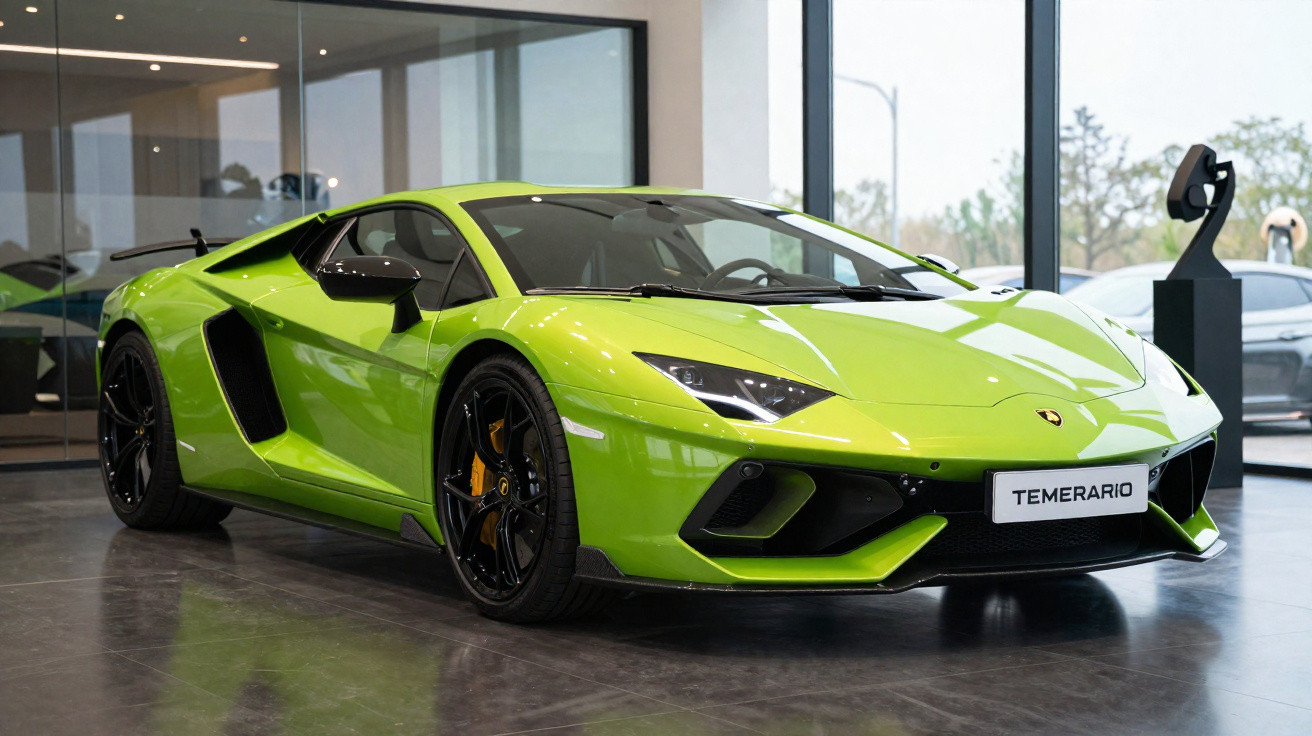
The Huracán and its naturally aspirated V10 will be sorely missed, yet the new Lamborghini Temerario does not appear to be short of credentials.
Like the larger and more powerful Revuelto, it follows a hybrid formula. The key distinction between the two hybrid powertrains lies in the combustion engine: in the Temerario it is a more compact 4.0-litre twin-turbo V8.
This is not the same V8 you’ll find in various Porsche and Audi models, nor the one used in the Urus. Despite sharing the same capacity, it is a different unit (code name L411). This "monster" produces 800 cv on its own between 9000 rpm and 9750 rpm - with the limiter set at 10,000 rpm(!) - something the other twin-turbo V8 simply cannot match.
We can’t recall a road car with a turbocharged engine that will rev this high. That feat alone deserves the spotlight.
Plug-in hybrid, but forget the range
As if that weren’t enough, the Temerario also adds three electric motors (all axial-flux) - each with a peak output of 110 kW (150 cv).
At the front, there are two motors (one per wheel). Each delivers 60 kW continuously (82 cv), giving the Italian supercar four-wheel drive without any physical connection between the axles. The electrified front axle adds 73 kg, with each motor contributing just 15.5 kg.
The third electric motor is "wedged" between the transverse-mounted eight-speed dual-clutch gearbox - arranged like the Revuelto’s - and the twin-turbo V8. One of its jobs is to eliminate turbo lag by "injecting" up to 300 Nm of torque when required.
With octane and electrons working together, the Lamborghini Temerario develops a combined 920 cv (we don’t know the combined peak torque, although the V8 alone produces 730 Nm).
Unlike other plug-in hybrids that prioritise efficiency and electric range, the Lamborghini Temerario has a single objective: performance. That helps explain why the lithium-ion battery is only 3.8 kWh. Lamborghini does not even state how many kilometres can be covered in electric mode.
Even so, the Italian brand claims the electrified system is enough to cut the Temerario’s CO₂ emissions by 50% compared with the Huracán.
How quick is it?
While the Temerario’s 920 cv is far beyond the 640 cv of the most powerful Huracán, the added complexity and ballast of the hybrid system also bring a significant weight penalty.
Lamborghini quotes a dry weight of 1690 kg for the Temerario, making it 310 kg heavier than the rear-wheel-drive Huracán Tecnica. Once the fluids required for operation are added, the Temerario should sit north of 1800 kg.
From any angle, that is a hefty figure. To soften the blow, Lamborghini offers an optional Alleggerita pack, replacing several parts with CFRP (carbon-fibre-reinforced polymer) components to shave off a few kilograms.
Even so, it improves every performance measure: 2.7s from 0 to 100 km/h and a top speed of 343 km/h.
To stop as convincingly as it accelerates, it comes standard with carbon-ceramic brakes - 410 mm x 38 mm at the front and 390 mm x 32 mm at the rear - plus fixed aluminium monobloc calipers, with 10 pistons up front and four at the back.
What else?
The new Lamborghini Temerario also stands out for using an all-new, all-aluminium space-frame platform (based on extrusions). Torsional rigidity is up by 20%, and this construction has also allowed improvements to interior dimensions and visibility.
Even so, the exterior styling reads more like an evolution of the Huracán blended with cues from the Revuelto - although the Revuelto’s “Y” theme has been replaced by a hexagonal motif on the Temerario.
Inside, it feels even more like a cockpit, again dominated by multiple hexagonal elements. As mentioned above, the new structure means the Temerario offers more space than the Huracán - Lamborghini says it can accommodate people up to 2 m tall. The front boot provides 112 litres of capacity, and there is additional storage space behind the occupants.
The brand also highlights the use of physical controls for critical functions, leaving secondary tasks (such as navigation) to the central 8.4″ display. It is not the only screen: the instrument cluster measures 12.3″, and even the passenger - or co-driver, in Lamborghini terminology - gets a 9.1″ screen in front.
When does it arrive?
It will be difficult to label the new Lamborghini Temerario as a junior supercar in the way its predecessors were. Not with these figures.
It is therefore reasonable to expect pricing to be well above that of the more basic Huracán when sales begin towards the end of this year or early next.
Finally, it’s hard not to notice that its numbers exceed those of its pre-defined rival: the Ferrari 296 GTB.

Comments
No comments yet. Be the first to comment!
Leave a Comment