
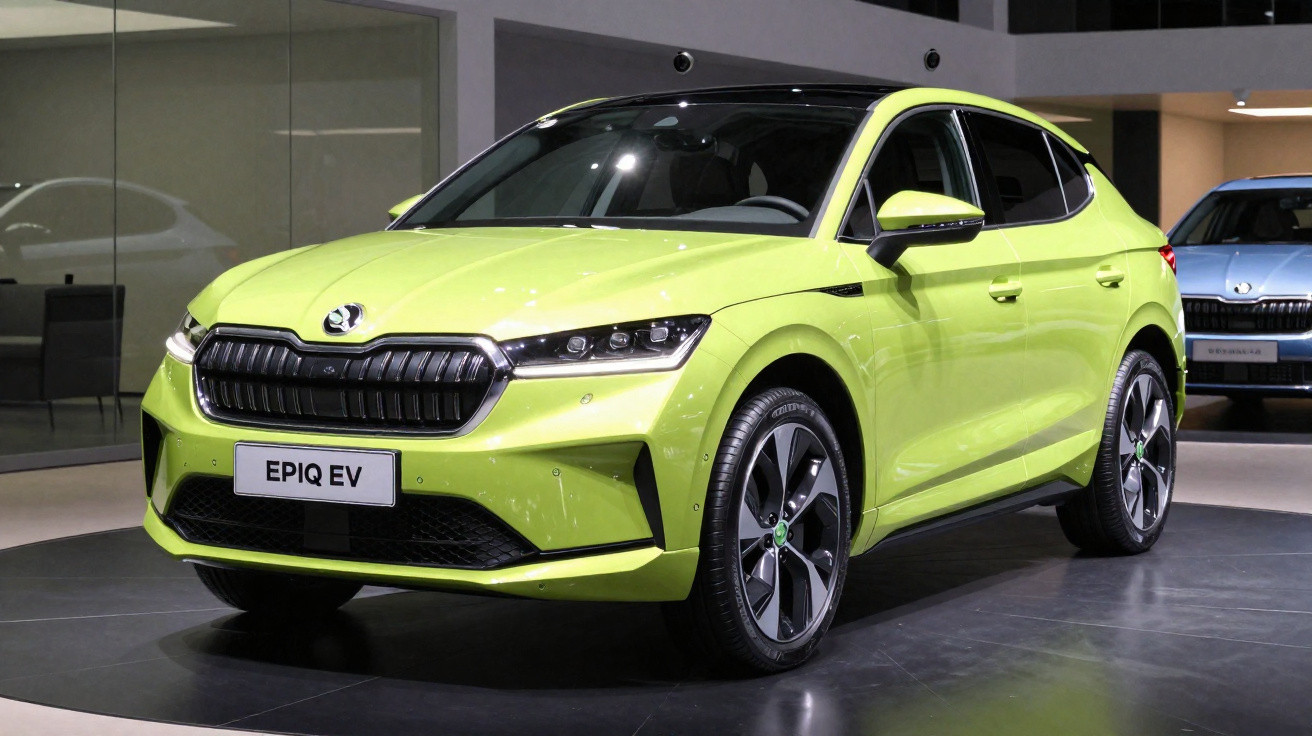
The Skoda Epiq is a B-segment SUV set to play a pivotal role in the Czech brand’s strategy, acting as the new entry point to its fully electric line-up.
It is built on the latest MEB Plus platform, created with cost reduction in mind, and forms part of the Volkswagen Group’s new EV push-centred on compact dimensions, more efficient use of resources and entry prices hovering around €25,000.
The Czech SUV is only due to be officially unveiled in the coming months, but we got ahead of that schedule and travelled to Porto to see it and drive it first-hand, albeit in a camouflaged pre-production vehicle. This first encounter made the Epiq’s intentions clear, with positioning aimed squarely at urban and family use. Here are our initial impressions.
True to Skoda’s defining trait
Even under camouflage, the Skoda Epiq shows just how closely it mirrors the concept car. With a 2.6 m wheelbase, overall length that stays under 4.1 m, and the typical SUV ride height, everything points to a tough-looking stance, helped by pronounced bumpers and strongly sculpted wheel arches.
And, as you would expect from Skoda, space is a major talking point. In that respect, the electric B-SUV claims 475 litres of boot capacity-comfortably above the segment norm. Put into context, that is 75 litres more than the longer Kamiq, and 95 litres more than the Volkswagen Golf, which sits in the larger C-segment.
At the same time, the Epiq becomes the first Skoda model to fully adopt the new Modern Solid design language. Key cues include the closed-off black front panel-echoing the refreshed Elroq and Enyaq-and the T-shaped lighting signature at both the front and rear.
The interior, meanwhile, remains under wraps. Still, aligning with what the brand has already indicated, it should feature clean, simple lines and practical, clever solutions: generous storage, physical buttons, bag hooks and hidden compartments.
First impressions from behind the wheel
From the driver’s seat, it immediately feels unmistakably like a Skoda-and that is a good thing. With light steering, nimble low-speed manoeuvring and very predictable responses, the Epiq is clearly tuned to be a comfort-oriented option.
The test vehicle paired the larger-capacity battery (52 kWh) with a stated range that, according to the manufacturer, can exceed 430 km (WLTP), alongside the more powerful electric motor rated at 155 kW (211 hp). Even so, the power delivery is smooth and easy to modulate, avoiding the abrupt punch found in some other EVs.
Compared with the familiar MEB platform, one of the key changes with MEB Plus concerns the rear suspension: it is no longer independent and instead uses a torsion beam. Although it is a simpler arrangement, I did not feel it compromised either comfort or stability.
Helping matters is this EV’s sensible weight, at around 1500 kg-certainly not light, but far from excessive by electric-car standards. On the road, that translates into suspension behaviour that avoids the harsh, brittle ride some fully electric models can exhibit.
And what else?
The new Skoda Epiq is due to be revealed between May and June, and it will be offered in the 55 version I drove, as well as the entry-level 35 and 40 variants. The latter two stand out for using the smaller 37 kWh battery and less powerful motors, at 70 kW (95 hp) and 85 kW (116 hp), respectively. Even so, the promised range remains respectable: up to 310 km between charges.
Pricing is not final yet, but Skoda representatives point to a starting figure of around €25,000. Better-equipped, higher-output versions, however, are expected to go beyond €30,000. Even so, that keeps the Epiq in line with other offerings in this segment.
A final verdict will have to wait, but the early signs are very encouraging. Overall, the Epiq delivers on what the brand is promising: a compact, fully electric SUV that prioritises space, comfort and ruggedness, with range that suits most users and pricing broadly aligned with equivalent internal-combustion alternatives.



Comments
No comments yet. Be the first to comment!
Leave a Comment