
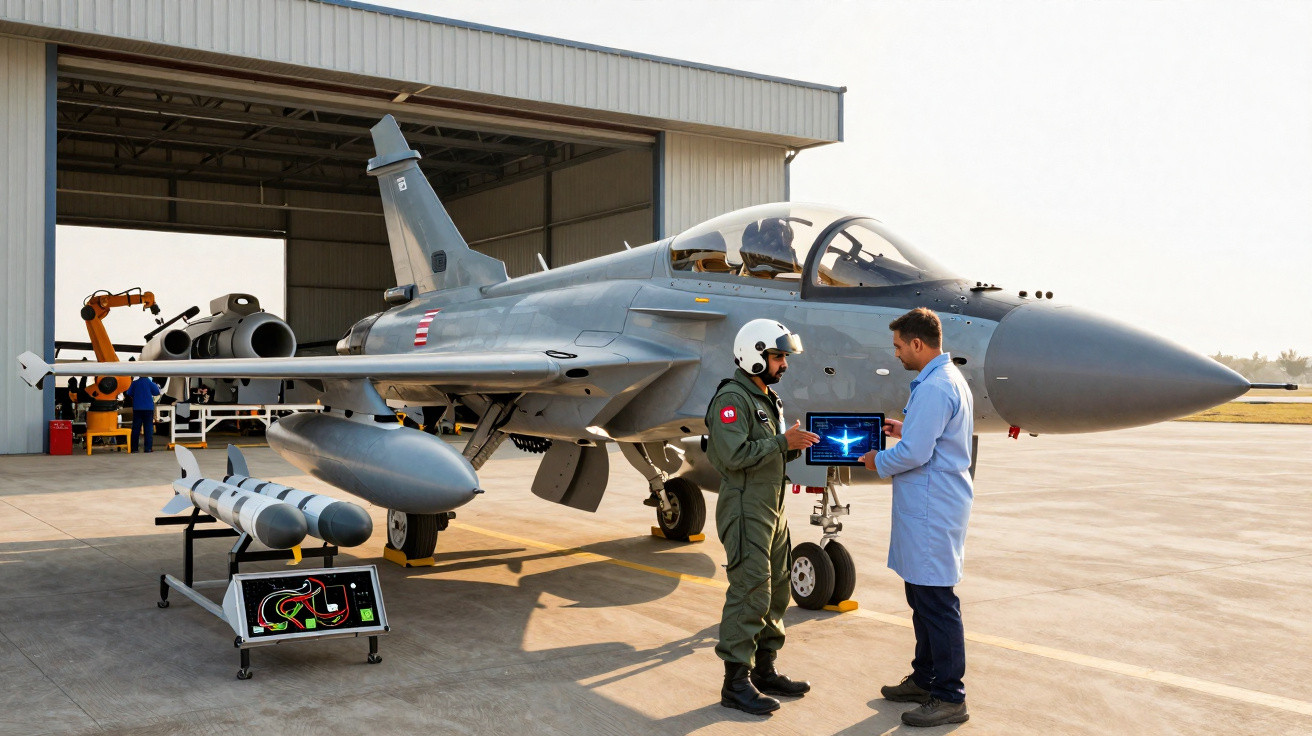
According to local media reports, the Swedish company Saab is once again pushing proposals to equip the Indian Air Force with its Gripen E/F fighters, adding different options for local production of the aircraft in a bid to secure approval from New Delhi. In doing so, the firm is looking to recover ground after losing the competition that led to the selection of the Dassault-built Rafale-an especially significant deal that could translate into orders for around 114 aircraft to expand the country’s number of operational squadrons.
Saab’s renewed Gripen E/F offer to New Delhi
This latest development was recently highlighted by the current Gripen marketing director and Saab vice-president for aeronautics business, Mikael Franzen, who said: “In our contacts with the government of India, we proposed the creation of the most advanced aerospace industrial plant in the world, covering design, production and maintenance at multiple levels”. Later, the executive argued that the Gripen stands out from other market contenders thanks to its advanced technology, compatibility with platforms already in service in the country, and its positioning as an affordable model-factors that, in his view, would allow the Indian Air Force to buy it in large numbers and at speed.
Delivery timeline, initial Swedish build and local manufacturing in India
On that last point, it is worth noting that Saab’s proposals indicate the force could receive its first aircraft by the end of the third year after the contract is signed. This would mean building an initial batch of roughly 18 aircraft in Sweden, until the required conditions are in place in the Asian country for domestic manufacturing to begin. As for those locally produced units, India would also be able to integrate national technologies, while-once its own fleet is complete-it could consider export opportunities.
Electronic warfare updates, weapons integration and Artificial Intelligence
Further backing the Gripen as an advanced combat platform for India, Franzen emphasised that, beyond the option to produce it in large volumes, the aircraft would be delivered with the latest electronic warfare updates and the ability to integrate a wide range of weapons. Another selling point cited is the integration of Artificial Intelligence technology, which remains under development and which, according to Saab, makes the platform a pioneer compared with other alternatives.
Technology transfer, industrial participation and Saab’s Carl-Gustaf M4 partnership
From an industrial standpoint, the company also signalled it is prepared to ensure the technology transfer needed to carry out the programme-something New Delhi has historically regarded as a key factor when acquiring new systems. In short, to make the offer more economically attractive, the Swedish firm stated that collaboration with Indian partners would make it possible to involve more than 300 industrial players of different sizes, who could later draw on lessons learned and apply them to home-grown projects.
Finally, it should be borne in mind that, if it comes to fruition, this would not be the only project of this kind linking India and Saab in the military-industrial sphere. Of particular note is the partnership focused on Carl-Gustaf M4 recoilless guns, which are produced in the state of Haryana through Saab FFVO India Pvt Ltd. As would be the case with the Gripen, local production has helped speed up manufacturing and delivery processes, while also giving the country opportunities to sustain industrial plants through export agreements aimed at the system’s more than 40 users.
Images used for illustrative purposes.
You may be interested in: *India officially unveiled its new LR-AShM hypersonic missile during the Republic Day parade*


Comments
No comments yet. Be the first to comment!
Leave a Comment