
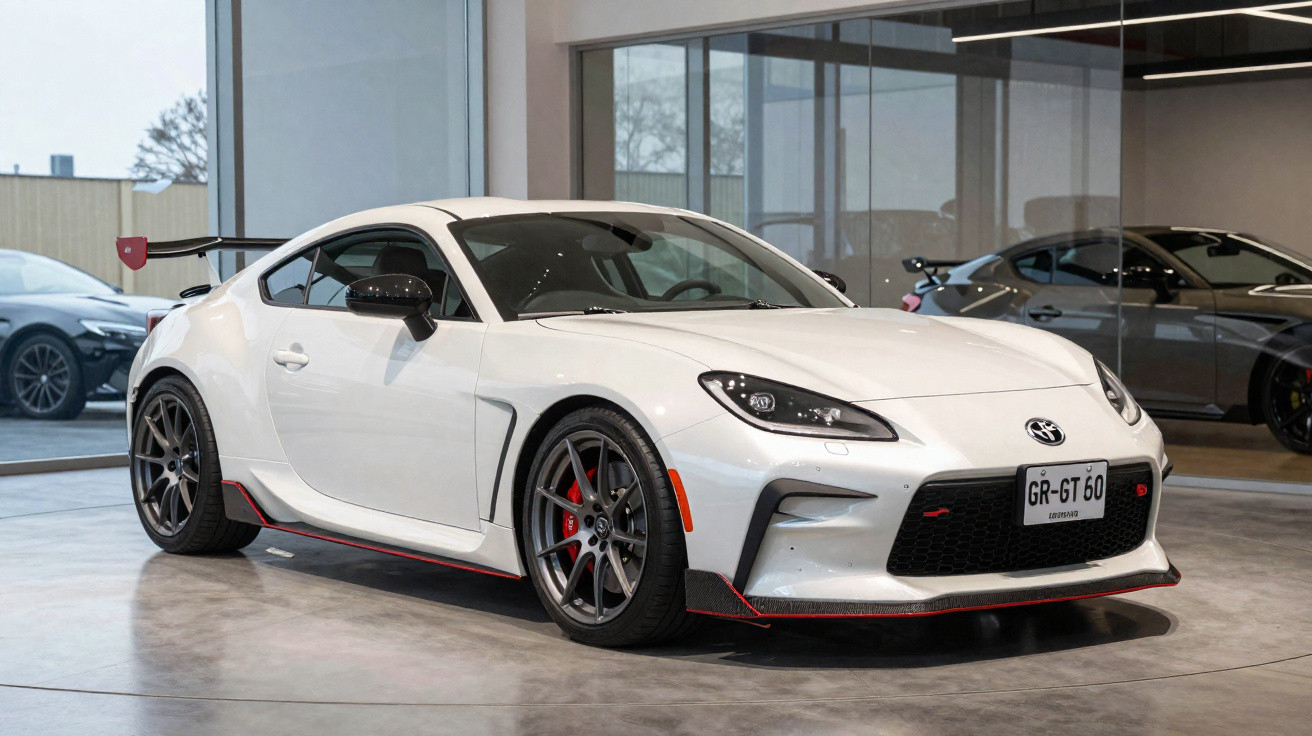
The wait is over. After months of teasing, Toyota has finally pulled the covers off its new supercar, the GR GT - widely seen as a spiritual successor to the legendary Lexus LFA.
The unveiling took place at Woven City, near the Fuji circuit in Japan, where the brand presented two cars side by side: the road-going GR GT and the GT3 version built for the track.
Adding to the significance, and as the name hints, GR GT marks Gazoo Racing’s debut as a standalone brand. Look closely and you won’t find a Toyota badge anywhere on this supercar.
As with the GR Supra, GR Yaris and GR 86, the GR GT is effectively a personal project of Toyota president Akio Toyoda, driven by a clear target: create a competition car that can be registered and used on public roads.
And, as becomes clear further on, the Toyota GR GT also acts as a statement of intent. At a time when almost every new performance car is chasing electric powertrains with more than 1,500 hp and massive batteries, Toyota Gazoo Racing is putting the emphasis back on what matters most in a sports car: lap time.
For that reason, the road car and the GT3 variant were engineered in parallel - a strong signal of just how serious Toyota (or, in this case, Gazoo Racing) is about this supercar.
Twin-turbo V8 makes its Toyota debut
Although it’s an all-new model, the GR GT sticks to an unmistakably classic layout: a front-mid mounted V8, rear-wheel drive, a long bonnet and a strict two-seat cabin. The target is clear - take on anything with GT3 credentials: Porsche, Ferrari, Mercedes, Aston Martin and more.
The headline, though, is the V8 itself, designed from the ground up for this car. It’s a 4.0-litre twin-turbo unit in a Hot-V configuration, complete with dry-sump lubrication. Enough talk - listen to the first notes of this V8:
This is also the first time Toyota has installed an engine of this type in a production model. Official figures haven’t been confirmed yet, but Gazoo Racing is aiming to “extract” at least 650 hp and 850 Nm from the drivetrain, which is further supported by an electric motor mounted on the rear axle.
On performance, Toyota will only commit to a top speed above 320 km/h. The 0–100 km/h time remains unknown - because in a car like this, the number that counts is the lap time.
Balance is the key ingredient
This V8 story isn’t just about power. The engine sits behind the front axle to sharpen mass distribution, helping the GR GT achieve a 45:55 weight balance - an unusually rear-biased figure for a front-mid-engined car.
That balance is helped in part by Gazoo Racing’s transmission solution: an eight-speed automatic with a wet clutch (rather than a conventional torque converter), located behind the rear axle.
The V8 connects to it via a carbon-fibre torque tube, while the gearbox also uses a clever helical-gear arrangement to redirect drive to the differential.
Alongside this, the GR GT runs an independent suspension set-up with double wishbones and forged aluminium arms - components so strong they were left largely unchanged for the GT3 version.
For braking, Gazoo Racing turned to Brembo, fitting carbon-ceramic hardware. The car rides on Michelin Pilot Sport Cup 2 tyres developed specifically for this model.
Aluminium and carbon fibre construction
Measuring 4.79 metres long, the GR GT is around 6 cm longer than a Mercedes-AMG GT, which helps underline the “athletic presence” of the car - despite a quoted weight target of under 1,750 kg.
A major contributor is a new aluminium structure, with aluminium also used for several body panels. It’s paired with multiple components made from carbon-fibre-reinforced plastic (bonnet, roof, doors and boot lid).
A modern-day Lexus LFA?
In styling terms, comparisons with the iconic Lexus LFA are hard to avoid, even if the GR GT adopts much sharper, more aggressive lines and surfaces.
Even so, when you focus on its stance and overall proportions, the similarities to the LFA quickly add up.
Aerodynamic intent is also unmistakable: the creases running along the bonnet, the huge front bumper air intakes and, of course, the massive rear diffuser. That diffuser frames four large exhaust tips, adding extra drama to the GR GT’s rear view.
Driver-focused interior
Inside, the GR GT steers clear of the tech excess that’s become common and instead opts for a cleaner, more driver-centred approach.
There’s still a large central infotainment display and a fully digital instrument cluster, but Toyota has kept plenty of physical controls on a notably sturdy centre console, along with a sporty, flat-bottom style steering wheel that appears to have just the right number of buttons and switches.
Arguably the cabin’s biggest highlight is the pair of Recaro carbon-fibre sports seats, positioned very close in feel and form to the bucket seats used in competition.
Now it’s a question of when it goes on sale - and how much it will cost. Until then, there’s reason enough to celebrate: new V8-powered supercars don’t come along every day. And if the GR GT delivers on its promise, it could end up as one of the most compelling cars on the market today.


Comments
No comments yet. Be the first to comment!
Leave a Comment