
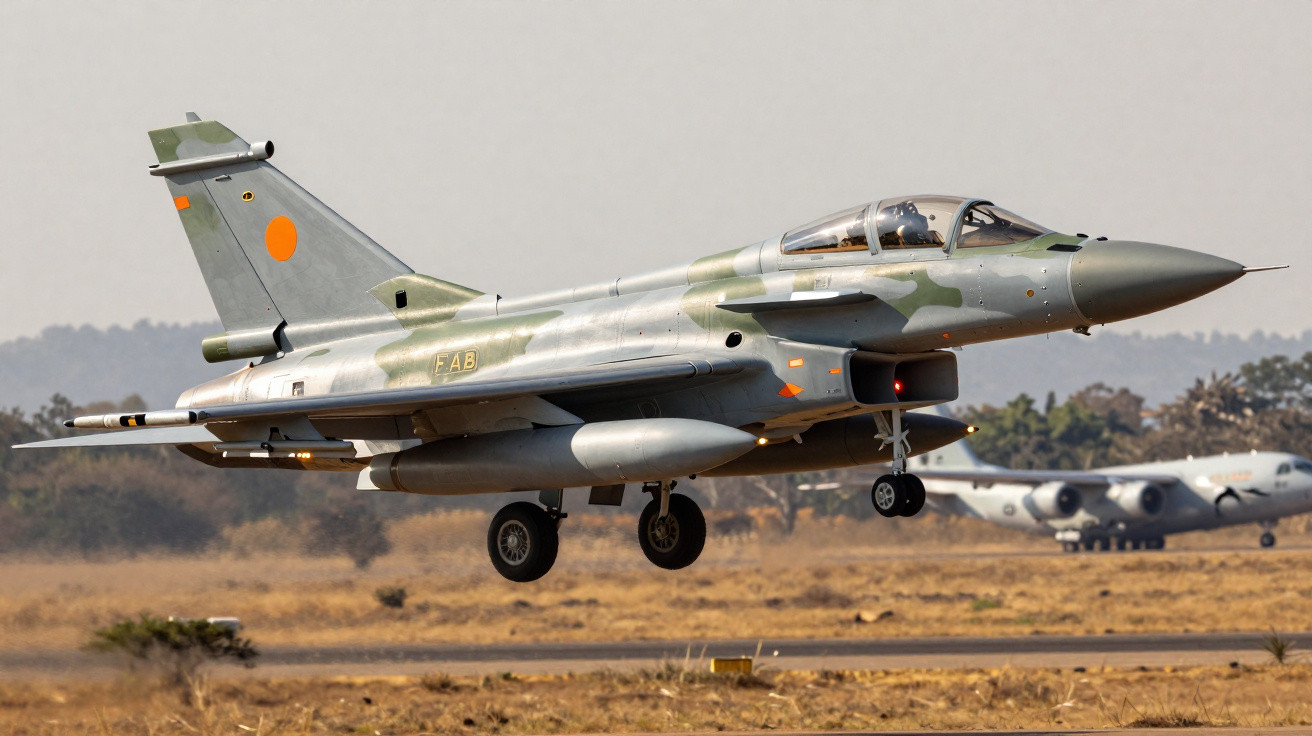
In the latest stage of the programme to bring the Saab F-39E Gripen into service, the Brazilian Air Force’s experimental aircraft (FAB registration 4100) has begun release trials with both guided and free-fall bombs as part of Operation Thor at Natal Air Base (Brazil). This development further cements the Gripen’s progress towards proven air-to-ground strike capability, following the achievement of full operational capability in late 2025.
Operation Thor: validating F-39E Gripen bomb release at Natal Air Base
During Operation Thor, the Gripen E went through demanding evaluations designed to confirm that bombs can be released safely, with consistent and stable separation that does not jeopardise the aircraft’s integrity. Colonel aviator Alisson Henrique Vieira, the operation’s general coordinator, noted that weapon release is among the most sensitive stages of flight because “aerodynamic phenomena may occur that generate unsafe situations or damage to the aircraft; therefore everything is meticulously analyzed prior to operational certification.”
First Brazilian bomb drops from FAB 4100 and range support
The campaign used aircraft 4100 from the Gripen Flight Test Centre in Gavião Peixoto (São Paulo). The aircraft was flown by Major aviator Thiago Camargo of the Institute of Flight Research and Testing (IPEV), who became the first Brazilian pilot to release bombs from an F-39. Each drop was tracked in real time to confirm the fighter’s stability and the precision of separation across different conditions. The work was backed by teams at the Maxaranguape firing range, tasked with setting up targets and recording impacts so the results could be reviewed afterwards.
Operation Thor concluded successfully on 6 February, according to Saab’s Head of Flight Testing, Mikael Olsson. He underlined that Brazil became the first operator to conduct releases of Mk-84 bombs and laser-guided Lizard 500 bombs from the Gripen. On this point, he said that “the data obtained reinforce how the aircraft significantly expands the capabilities of the Brazilian Air Force.” The result is a major step towards continuing F-39 operational testing for ground-attack and tactical support roles.
2025 milestones: Meteor integration, cannon firing and weapons progress
Operation Thor builds on several key milestones delivered by the Gripen programme during 2025. In November, the Brazilian Air Force carried out the first launch of the MBDA Meteor air-to-air missile, confirming full integration of what is described as the most advanced weapons system in Brazilian combat aviation. The test verified the F-39E’s capacity to detect and neutralise threats at more than 150 kilometres, placing Brazil among the limited number of nations fielding this long-range capability.
A few weeks after that, the fighter completed its first live-fire activity with the 27 mm Mauser BK-27 cannon at Santa Cruz Air Base, validating accuracy and performance in combat-representative scenarios.
Extreme-condition trials with external loads in Anápolis
Earlier in 2025, the experimental Gripen also underwent strict trials in challenging conditions at Anápolis Air Base, aimed at assessing performance with external stores in high temperatures and at altitude. Carrying external fuel tanks as well as Diehl IRIS-T and MBDA Meteor missiles, it flew 14 missions in conditions of 32 °C and 1,100 metres above sea level, including eight hot ground refuellings. The results supported the strength of the flight-control system and the engine’s efficiency under heavy load, helping to confirm operability in the demanding climatic conditions common across Brazilian territory.
Refuelling advances with the KC-390 Millennium
Another significant advance came in August, when a Gripen was refuelled on the ground from a KC-390 Millennium using the FARP (Forward Arming and Refuelling Point) procedure. The manoeuvre showed interoperability between the two platforms, cutting turnaround time and increasing the fighter’s combat autonomy.
Later, in November 2025, Saab and Embraer formally certified the KC-390’s ability to refuel the Gripen in flight. This technical milestone reinforced integration between the two systems and represented a new level of operational reach for the Brazilian Air Force.
It is worth noting that each of these test efforts-ranging from missile launches and cannon firing, to extreme-environment trials and refuelling certifications-underscores the Brazilian Air Force’s determination to keep improving training and readiness for its Gripen fleet, expected to form the backbone of its combat aviation for decades to come.
Image credits: Brazilian Air Force.
You may also like: The entry into service of the multi-purpose vessel Oiapoque, acquired by the Brazilian Navy from the United Kingdom, now has a date





Comments
No comments yet. Be the first to comment!
Leave a Comment