
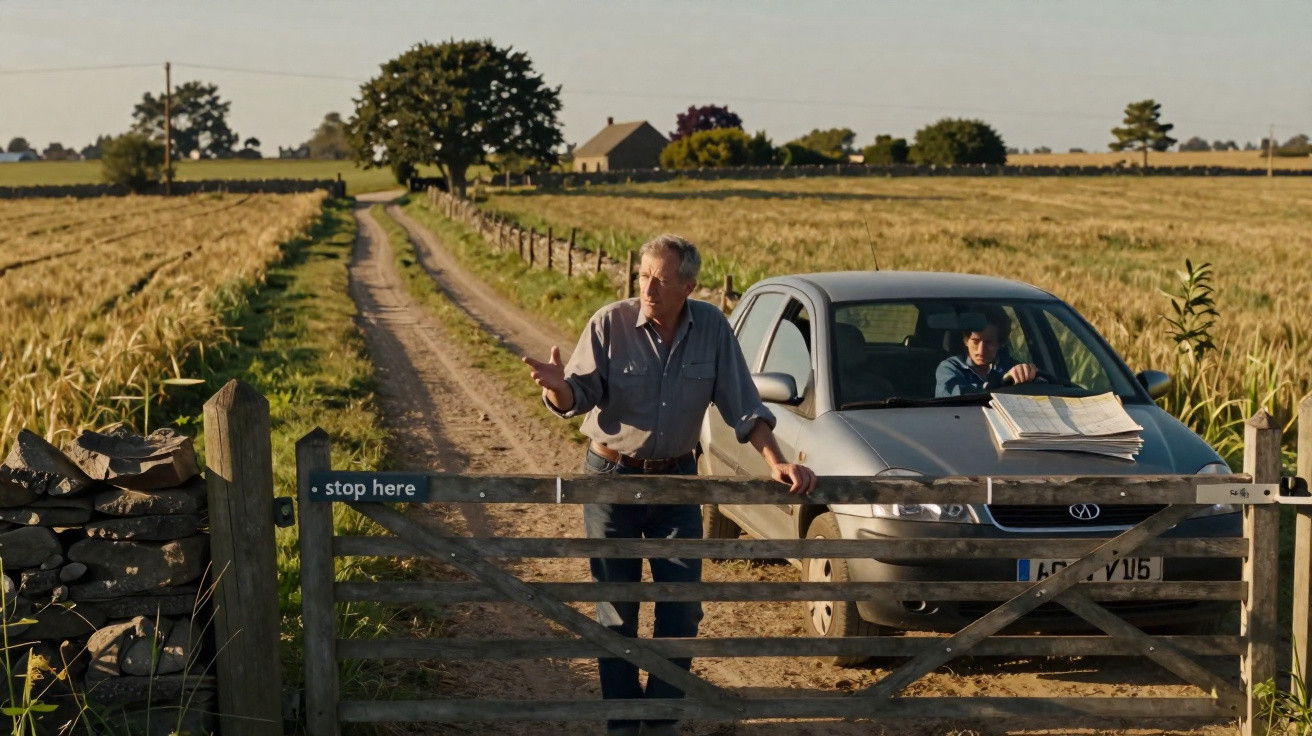
The earliest tyre marks can look almost harmless: a pale curve slipping off a tight country lane, threading between hedgerows, cutting a diagonal across a farmer’s field like a quietly shared trick. But then the grooves deepen-the wet-season damage where SUVs and pick-ups have chewed the ground into muddy wounds, following the same “hidden” line passed around in pubs and group chats. For years, few people paused to ask who actually owned that sliver of land, or whether the route existed in law rather than only in local habit.
This week, a Supreme Court decision cut through that assumption.
Decades of shortcuts don’t create a right-of-way
On the face of it, the dispute sounds dry: landowners on one side, motorists on the other, clashing over an unofficial route that’s been used for years. In the real world, it’s anything but abstract. These are the familiar wheel-worn tracks across fields that satnavs don’t reliably show, but locals insist on. The sort farmers resent in silence and commuters rely on in private because it knocks six minutes off the journey.
The Supreme Court has now made the point plainly: repeatedly cutting across a farmer’s land does not, by itself, hand drivers a legal right to continue.
The judges considered what seems like a straightforward question: when people drive the same informal shortcut over private land for 20, 30, even 40 years, can that long-standing use turn it into a public road? Some drivers said it should, arguing that persistent, unchallenged use ought to harden into a “right of way”, particularly where no-one stopped them at the start. Landowners argued the opposite. From their perspective, every set of ruts was a slow, incremental takeover-one set of tyres at a time.
The court agreed with the owners, tightening the legal position in a way that clashes with what many treat as rural “common sense”.
Under the legal wording sits a simple rationale. If unauthorised use over decades could convert private ground into a public right-of-way, then farmers and rural residents would live under constant risk: one missing “no entry” notice, one moment of tolerance, and they might lose control of their own land. The Supreme Court effectively drew a clear boundary: using land without permission remains trespass, even if your dad did it, your grandad did it, and a neighbour insists “everyone’s always done it”.
Tradition, it turns out, is not a legal defence.
What drivers need to change starting now
For ordinary motorists, the impact is immediate and practical. That well-known cut-through behind the industrial estate, or the muddy strip between two fields that your navigation app occasionally recommends, is now legally toxic unless it is plainly a public route or you have explicit permission from the landowner. The relaxed logic of “it’s fine-I’ve driven it for years” suddenly looks like wishful thinking.
The dull but dependable approach is also the safest: keep to signposted public roads and officially recorded byways, and treat anything else as out of bounds unless you can confirm its legal status.
Many people will feel tempted to ignore this. Most drivers recognise the scenario: traffic is crawling, and there’s a tempting track breaking away into the countryside. It can feel like a victimless choice-some dust in summer, some mud in winter, and you arrive home quicker. Then, one wet autumn, the same line churns up a field, clips a fence, or unsettles walkers who thought they were in a vehicle-free area. What felt minor turns into a dispute.
And, frankly, hardly anyone sits down to read the entire Highway Code every single year.
This ruling means drivers have to read the landscape with new caution. Landowners can point to the decision to push back more firmly, and some are already doing so-installing cameras, locking gates, and sending blunt letters. As one countryside solicitor told me last night:
“The myth that ‘if we’ve always done it, we have the right to do it’ just died in court. People will feel it most in rural shortcuts and informal farm tracks.”
To adjust without making life unbearable, keep three basic rules in mind:
- Drive only on clearly public roads, byways, or signed permissive routes.
- If you are unsure, assume it is private land-particularly across fields and farmyards.
- A satnav suggestion is not legal evidence that you are allowed to use the route.
A quiet shift in how we share space
This judgment subtly shifts the focus from “what’s the quickest way?” to “who lives and works on the land I’m crossing?” It may look like a narrow, technical case, but it feeds into something larger: the friction between pressured drivers, apps that promise faster routes, and rural communities who feel repeatedly overrun-both literally and figuratively. Some will welcome it as a clear win for property rights. Others will view it as another tightening of everyday life-more restricted, more monitored.
The reality probably sits somewhere in that uncomfortable middle.
| Key point | Detail | Value for the reader |
|---|---|---|
| Shortcuts aren’t rights | Long-term use of a track does not, on its own, create a legal right-of-way | Helps you avoid accidental trespass and expensive disputes |
| Landowners have stronger ground | The Supreme Court confirms private control over unofficial tracks | Explains why more gates, signs, and enforcement are appearing |
| Drivers must adapt habits | Use official routes, not “everyone uses it” paths | Lowers legal risk, reduces tension with locals, and prevents damage to land |
FAQ:
- Can I keep using a field track I’ve driven for years? If it is private land and not a legally recorded right-of-way, long use on its own does not give you a legal entitlement to carry on.
- Does a satnav route mean a road is public? No. Navigation apps are not legal authorities and often include private tracks or farm access roads.
- How do I know if a route is a public right-of-way? Check local authority maps, on-the-ground signage, or official online mapping that marks public roads and byways.
- Can a landowner suddenly block a track we’ve always used? If it was never a legal right-of-way, the owner can usually restrict access-especially now that this ruling supports their position.
- What’s the safest rule to follow as a driver? Keep to clearly public roads, obey barriers and signs, and treat unmarked tracks across fields as off-limits unless you have clear permission.






Comments
No comments yet. Be the first to comment!
Leave a Comment