
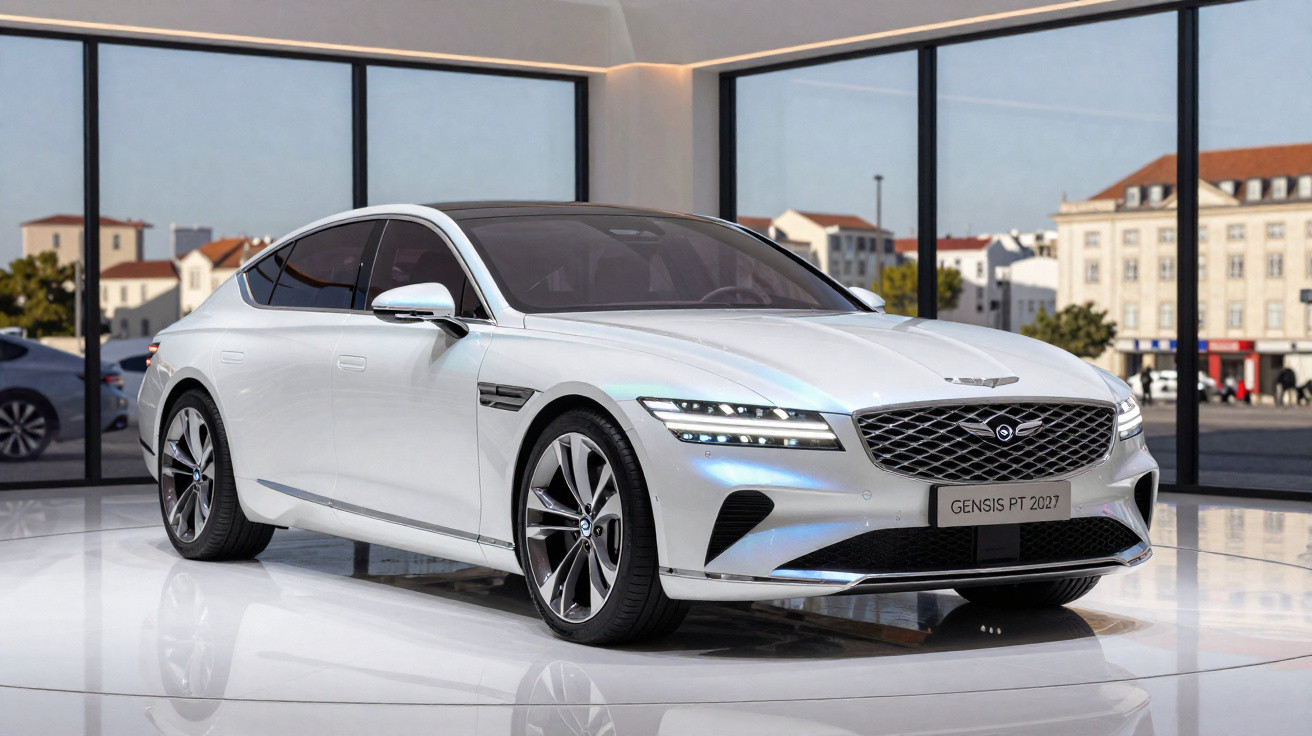
Genesis arrives in Portugal in 2027
Genesis is gearing up to enter Portugal in 2027. Hyundai Motor Group’s premium brand will add the country during the third phase of its European rollout.
Even so, the plan is not to chase the kind of volumes achieved by Audi, BMW or Mercedes-Benz. In 2025, Genesis sold around 2500 cars across the three European markets where it was present. The target is to increase that figure fivefold by 2030, reaching 12 500 units per year.
A changing strategy for Genesis in Europe
Genesis’s arrival will come at a time of transition for the brand in Europe. After focusing its European line-up on electric cars, Genesis is preparing to introduce petrol hybrids from the second half of 2027, followed by electric vehicles with range extenders in 2028.
Worldwide, the intention is also to grow beyond the current level of just over 200,000 units a year - 220,000 units in 2025, with South Korea as the main market, followed by the US and the Middle East.
The aim is to reach 350,000 units globally by 2030, while also supporting Hyundai Motor Group’s ambition of selling 5.5 million vehicles per year by the end of the decade. More crucial than that, however, is strengthening the group’s profitability - as is typical for premium marques in the automotive industry.
Are these ambitions enough to take on the German premium manufacturers and deal with rising competition from Chinese brands? That is exactly what we discussed when we spoke with Peter Kronschnabl, Managing Director of Genesis Motor Europe, about Genesis’s European strategy.
Japanese groups’ premium brands have had little (if any) success in Europe’s tough market, where demanding consumers place huge value on brand equity. How does Genesis intend to overcome that major challenge?
Peter Kronschnabl: Our strategic approach is to develop cars in Europe. We have design and engineering centres in Frankfurt, which allows us to create models that better match European customer preferences. On top of that, the quality of our interiors is top-tier, even when measured against the German premium brands.
Among the three German premium brands - Audi, BMW and Mercedes-Benz - which do you feel is closest to Genesis in terms of model range and customer profile?
PK: Those brands dominate the premium segment in Europe and, yes, they are our aspirational competitors. And I do not mean in sales volumes, but in quality, design and technical capability. That said, we want to follow our own path rather than simply copy others.
Hyundai and Kia are the group’s brands most exposed to the Chinese offensive, globally and in Europe too. Do you lose sleep over Chinese brands moving into the premium segments?
PK: We have a great deal of respect for what Chinese brands have managed to achieve over the last 2–3 years. And, yes, they are getting closer to the premium customer who is our target audience. We are not worried, but we are also not arrogant enough to ignore that reality. “Alert” is the right word.
In any case, our group has half a century of experience in this industry, we have brands that customers trust deeply, and we have an established service network that we can naturally leverage for Genesis.
What sets Genesis apart
German premium brands are known for engineering, Japanese brands for reliability and efficiency, and Chinese brands for value for money and EV technology. What attribute could lead a customer to choose a Korean premium brand like Genesis?
PK: I would say our biggest differentiator is how we treat customers. The guiding concept behind Genesis is “Hospitality: be my guest”. We want every customer to feel like a genuine guest, not simply another buyer. This philosophy exists across Hyundai Motor Group, but at Genesis it is taken to another level.
Because we are smaller than the German premium manufacturers, we can provide far more personalised support and ensure each customer genuinely feels unique. Beyond that, we are building a level of service that goes further than what is typical in the segment, with a five-year manufacturer warranty and services such as collecting the car from the customer’s home for maintenance and returning it after the work is completed.
Genesis powertrain plans for Europe
What is Genesis’s powertrain strategy for Europe?
PK: In Europe we stopped selling petrol cars in 2025 and became a 100% electric brand. However, we recognised that EV adoption has not progressed at the pace lawmakers expected and that, up to 2035, it will be essential to complement our offer with hybrid solutions (not plug-in) from the second half of 2027 and, in 2028, with electric vehicles with range extenders (EREV).
In recent years, Hyundai and Kia have been at the forefront of innovation, introducing 800 V EV architecture and, more recently, technologies such as a system that simulates a gearbox and the sound of a combustion engine in Hyundai N electric models. Does Genesis also need a “signature” technology to stand out from other premium brands?
PK: It is a huge advantage to have centres of technical excellence both in South Korea and in Europe, where we have been significantly increasing investment.
I would also highlight the push we are making into motorsport, via the Magma programme in the World Endurance Championship (WEC), which gained greater visibility thanks to successful participation in the most recent 24 Hours of Le Mans.
All premium brands have a strong presence in competition because it serves as a real development laboratory, making it possible to improve precision, software and hardware quality, electric powertrain efficiency and, naturally, vehicle performance.
Genesis has been stepping up its motorsport presence, but Formula 1 still delivers the greatest global exposure for car brands. Does Genesis see F1 as part of its plans in the future?
PK: There is no doubt that F1 has global impact, with audiences of around 800 million people. But the World Endurance Championship is the second-largest discipline by audience, at roughly 400 million. In addition, it makes sense because the vehicles we race in WEC are much closer to the cars we sell, which makes technology transfer easier, as I mentioned earlier.
Future objectives
Five years after launching in Europe, what has Genesis learned about its distribution model and expansion into other countries in the region?
PK: We have learned a great deal since arriving in Europe in 2021, when we entered the UK, Germany and Switzerland. At the time, we chose an agency distribution model - or direct sales, if you prefer.
However, it became clear that using a dealer network makes more sense, and that is the strategy we are now implementing in the second wave of expansion, which includes the Netherlands, France, Italy and Spain. Naturally, the same model will be used in the third wave, covering Portugal, Austria, Denmark and Poland.
The aim is to grow from the current 23 sales points to more than 50 dealerships in 2027. Meanwhile, the service network is expected to expand from 65 to more than 200 service points by the end of next year. The first exclusive dealership opened in Amsterdam in April this year, and the second was inaugurated at the end of June in Padua, Italy.
This pace of openings is expected to continue throughout the brand’s expansion, using a mix of exclusive dealerships and dedicated spaces - with their own entrance and premium services - even when integrated within facilities that also host other Hyundai Group brands.
Looking at Genesis’s global sales in 2025, the regional mix is roughly 40% in South Korea, 37% in the US and 23% across the rest of the world (Europe + UK, Middle East, Australia). How will Europe’s share develop by the end of the decade?
PK: I can share our view of where we believe we will stand in 2030, which is also aligned with the expectations of Hyundai Motor Group’s President and CEO, José Muñoz.
In 2025 we sold around 2500 cars in the three markets where we were present, and there are currently around 12,000 Genesis vehicles on the road in Europe. Our minimum goal is to multiply that annual sales volume by five by 2030 - in other words, to reach at least 12 500 registrations per year.
Even so, it is important to understand that we are not focused on achieving very high volumes. The priority is to grow Genesis in Europe sustainably and for the long term as a premium brand.
Portugal has a high share of sales in more affordable segments and a relatively weak economy by European standards. Yet Genesis decided it was a country to enter as early as 2027…
PK: Yes, Portugal is a relatively small market, but it has an interesting characteristic: premium brands have very high market shares. The same applies in even more exclusive segments, such as Porsche, which manages to deliver very strong performance in the Portuguese market.

Comments
No comments yet. Be the first to comment!
Leave a Comment