
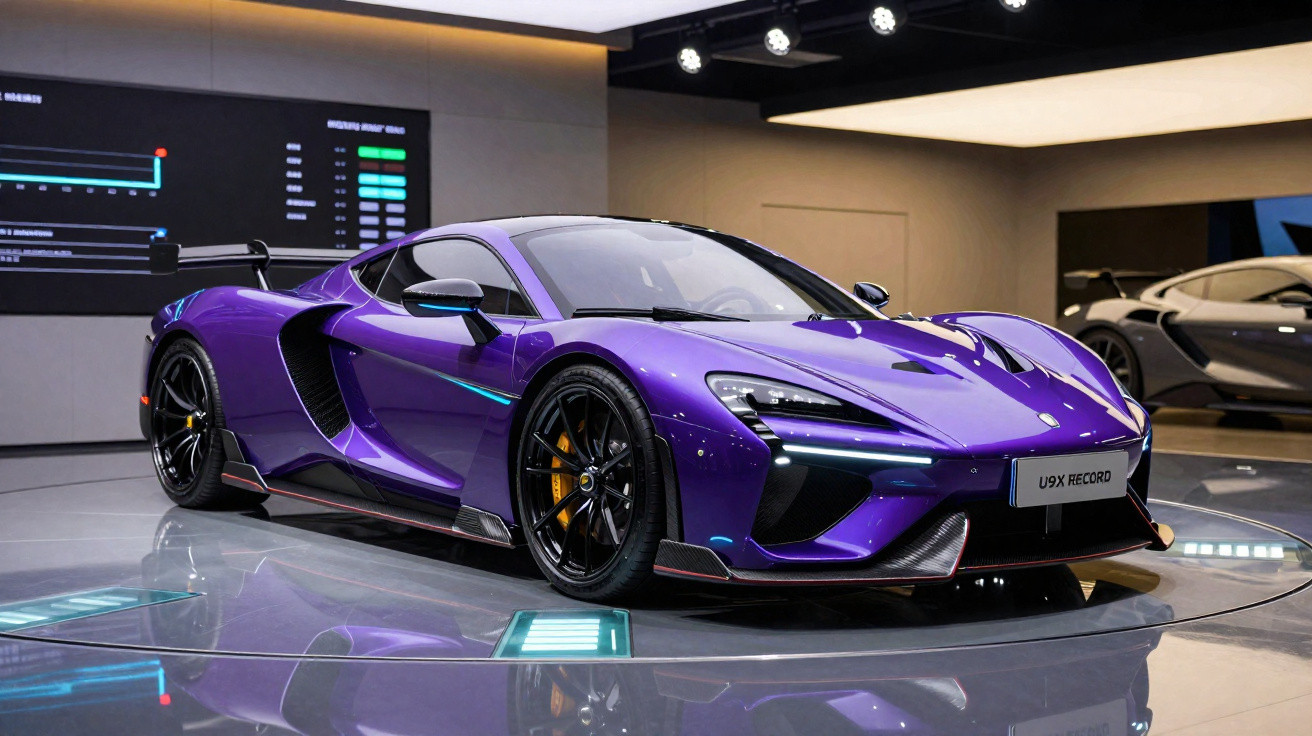
The automotive world has just chalked up a fresh landmark. On 14 September, at the ATP proving ground in Papenburg, Germany, the Yangwang U9 Xtreme recorded 308.4 mph, equivalent to 496.3 km/h. That makes it a new world speed record for a production car, and it also crowns an electric model as the fastest on the planet.
The figure betters the U9’s own previous test-configuration run, and it also surpasses the combustion-engined Bugatti Chiron Super Sport 300+, which set 490.484 km/h. With this achievement, BYD-through its luxury sub-brand Yangwang-moves to the top of the all-time list of the fastest production cars.
Record run at Papenburg: 308.4 mph / 496.3 km/h
The high-speed attempt was carried out on the ATP test track in Papenburg, with the car running in U9 Xtreme specification. The end result is not simply a marginal improvement: it establishes a new benchmark that shifts the record from a traditional internal-combustion hypercar to a battery-electric one.
Yangwang U9 Xtreme (U9X) engineering changes
Known as the Yangwang U9 Xtreme-or simply U9X-the car shares its underlying architecture with the U9 already on sale in China, but it has been substantially reworked. One of the most significant updates is a 1200 V electrical system (up from 800 V in the road-going version), alongside a Blade Battery LFP (lithium iron phosphate) pack featuring an eye-catching 30C discharge rate.
Power comes from four electric motors capable of spinning up to 30,000 rpm. Together, they deliver around 3,000 hp. As a consequence, several other areas required strengthening and upgrading too, with particular attention paid to components such as the tyres and the suspension.
Behind the wheel was German driver Marc Basseng, a racer with extensive experience in endurance events and competition machinery. After the run, he remarked that “something like this would not be possible with a combustion engine”. Basseng also highlighted the smooth delivery and the lack of load fluctuations typical of electric motors-qualities he said helped him stay fully focused on track.
Limited production and what “Xtreme” signifies
Series production is also confirmed. Yangwang will build just 30 examples of the U9 Xtreme, allocated to selected customers. The model name is drawn from “Extreme”, pointing to the idea of limits and absolutes, while the “X” is intended to represent the unknown and the ambition to explore new territory.
A milestone for electric mobility
For BYD, the occasion is presented as more than a number on the speedometer. Stella Li, the group’s Executive Vice President, stated that “Yangwang is a brand that does not recognise the impossible”, and that only this innovation-led mindset could produce a car like the U9X. She also thanked the driver and the development team for their role in delivering what the company describes as a historic feat.
With this result, the U9 Xtreme now sits ahead of famous names such as the Bugatti Chiron Super Sport 300+, which reached 490.484 km/h in a single run, and the Koenigsegg Agera RS, which recorded 447.2 km/h as an average across two runs. Even the SSC Tuatara, which managed 455.3 km/h, is now behind BYD’s electric hypercar.
Rather than treating it purely as an outright record, BYD says the achievement reframes what a sustainable hypercar can be. The Chinese manufacturer aims to demonstrate that electric mobility can match-or even outperform-combustion engines on every metric, pairing zero tailpipe emissions with previously unseen levels of performance.
Comments
No comments yet. Be the first to comment!
Leave a Comment