
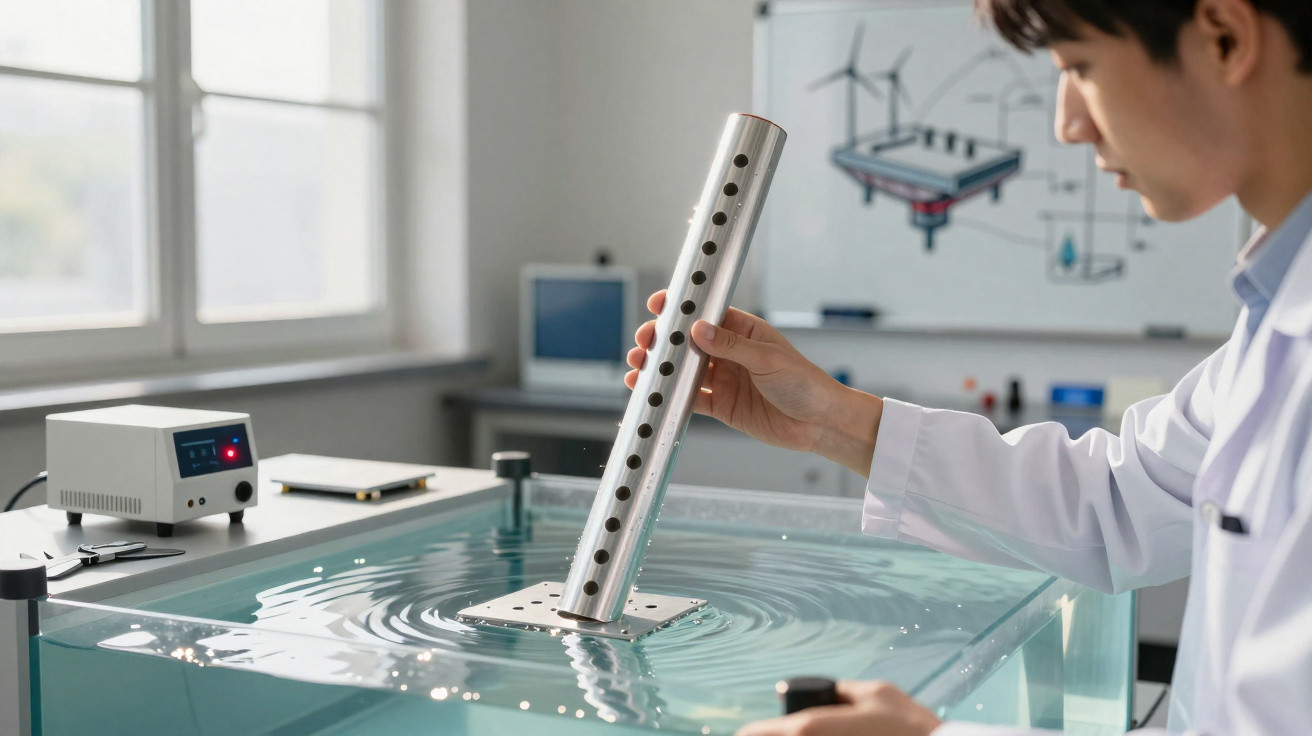
Imagine a metal object riddled with holes that can still stay afloat. It sounds unlikely, but a new study suggests it is achievable.
More than 100 years after the Titanic disaster, researchers are still trying to find stronger ways to prevent ships and other floating structures from going under.
A team at the University of Rochester (URochester) has now taken a step towards that aim. The scientists developed metal tubes that will not sink, even after significant damage and extended time submerged.
Transforming a regular material
The work was carried out at URochester’s Institute of Optics and was led by Chunlei Guo, senior scientist at the Laboratory for Laser Energetics (LLE).
Rather than redesigning the tubes or adding buoyant foam, the researchers began with standard aluminium tubes and concentrated on modifying the inner surface of each one.
Using a specialised laser process, the team etched extremely small pits and patterns into the metal. These features exist on microscopic and nanoscale levels-far too small to be seen with the unaided eye.
That engineered texture produces a strong effect: water struggles to adhere to the surface. This is known as being superhydrophobic, meaning it repels water to an extreme degree.
Trapped air keeps metal tube floating
When the treated tube is placed in water, it behaves in an unexpected way. Instead of water entering the hollow interior, the liquid is kept out. As a result, a pocket of air remains sealed inside the tube, helping it stay light and buoyant.
Because air is much less dense than water, the tube avoids filling and sinking as long as the air pocket remains.
The concept has clear parallels in nature. Diving bell spiders bring air bubbles underwater so they can breathe, while fire ants connect together and trap air to create floating rafts during floods.
“Importantly, we added a divider to the middle of the tube so that even if you push it vertically into the water, the bubble of air remains trapped inside and the tube retains its floating ability,” says Guo.
This divider is crucial because it helps keep the trapped air in place, even when water pressure acts on the tube from different directions.
Ship metal that’s unsinkable
Typically, floating structures fail once cracks or holes appear, because water rushes in and replaces the trapped air. In this case, that usual failure mode is avoided. Even after major damage, the superhydrophobic inner surface continues to drive water away.
“We tested them in some really rough environments for weeks at a time and found no degradation to their buoyancy,” says Guo.
“You can poke big holes in them, and we showed that even if you severely damage the tubes with as many holes as you can punch, they still float. If you severely damage the tubes with as many holes as you can punch, they still float,” says Guo.
Many researchers found the outcome striking. Holes would normally mean the end of buoyancy, yet here the trapped air remains effectively shielded by the strongly water-repellent interior.
Better stability in rough water
Guo and his group first demonstrated superhydrophobic floating devices in 2019.
That earlier approach relied on two flat, water-repelling discs sealed together. It worked well in still water, but severe tilting created a weakness: at steep angles, the trapped air could escape.
The newer tube approach addresses that limitation. Its cylindrical form holds air more reliably and is less prone to wave-driven movement. In tests, the tubes were placed in turbulent water conditions intended to resemble ocean environments, and they continued floating for weeks without losing buoyancy.
This step forward makes the concept appear more practical for real-world applications.
From floating tubes to large platforms
Although a single tube can float on its own, linking multiple tubes opens up broader possibilities. The researchers connected several tubes together to create raft-like structures.
In laboratory experiments, these rafts remained steady and were able to support added weight. During testing, tube lengths reached nearly 0.5 metres.
Guo says scaling the concept up should not pose a significant obstacle. Larger assemblies could potentially carry heavy equipment, people, or built structures. Suggested applications include ships, floating platforms, buoys, and offshore structures.
A role in clean energy
The findings also point towards renewable power generation. Rafts built from these tubes can move with waves, and that movement represents mechanical energy. If devices were attached, the wave-driven motion could be converted into electricity.
Wave energy is still a relatively underused renewable resource, and this floating approach could offer a more durable way to capture energy from oceans and rivers.
Overall, the work highlights how small changes to a surface can produce major performance differences. Once treated, a simple metal tube gains the ability to keep floating despite damage, time underwater, and rough conditions.
The ambition of creating safer floating structures now seems closer than before.
The project was funded by the National Science Foundation (NSF), the Bill and Melinda Gates Foundation, and the Goergen Institute for Data Science and Artificial Intelligence at the University of Rochester.





Comments
No comments yet. Be the first to comment!
Leave a Comment