
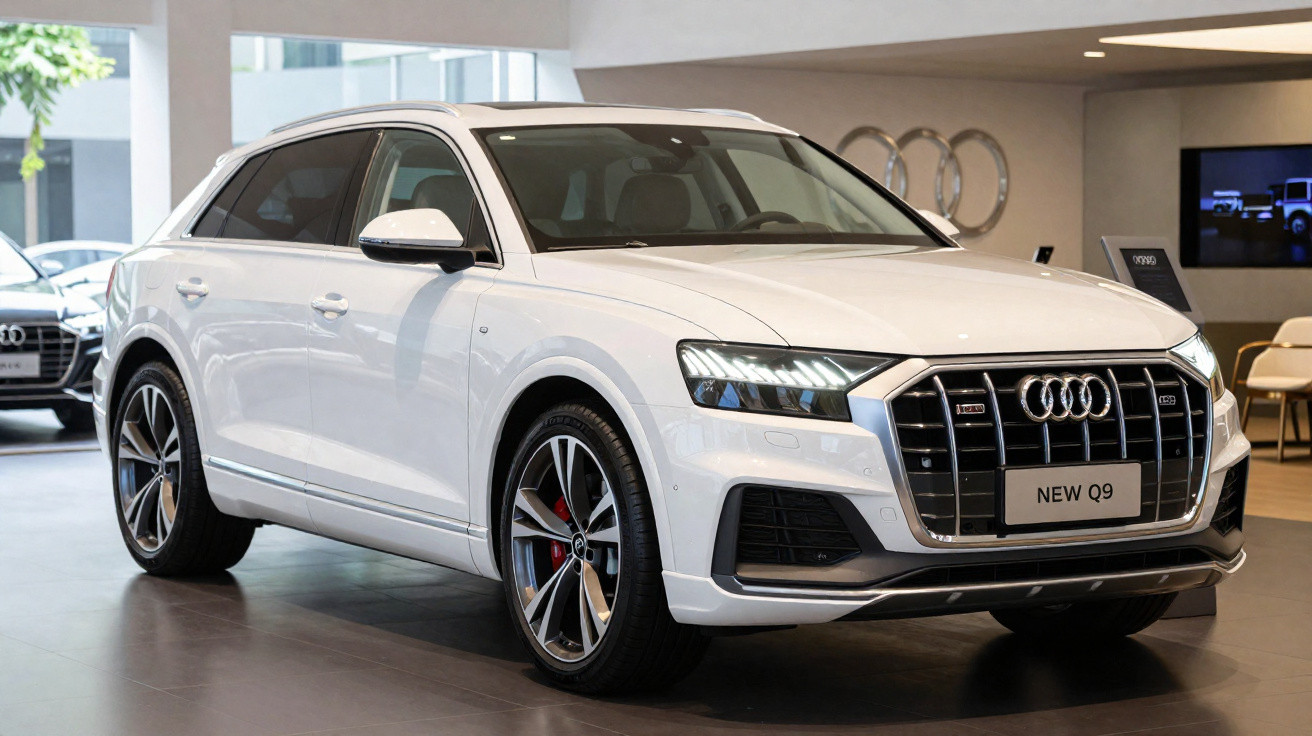
At 5.31 metres long, the new Audi Q9 leaves no room for doubt: it is the largest series-production model ever built by the four-ring brand.
It stretches 24 cm beyond the new Q7, taking Audi into a segment where it previously had no direct presence - full-size luxury SUVs. That is territory long dominated by cars such as the Mercedes-Benz GLS and BMW X7, with particular weight in markets like North America, the Middle East and China.
For that reason, it is no surprise Audi chose North American soil (New York) for the Q9’s global debut. From the end of 2026, this side of the Atlantic is expected to account for the highest volumes, with the United States and Canada identified as the brand’s leading world market for the model.
This is also Audi’s first mass-production vehicle to carry the number 9 in its name - a detail likely to be warmly received in China, where the digit is linked to longevity and power, and where vehicles of this size fit especially well into the local automotive landscape.
Underneath sits the PPC platform, the same technical architecture used by the new Q7. As a result, the Q9 shares much of its engine line-up and technology with that model, while the current Q8 continues to rely on the older MLB platform.
One of the most eye-catching features is the upright front grille, which runs almost down to the lower edge of the bumper. Depending on specification, it can feature chrome or black vertical bars, optional illumination, and a sportier treatment on S line versions and the SQ9, where it adopts an open honeycomb structure.
Highly advanced lighting
The Q9 introduces a new generation of OLED lighting technology, using elements that can be just 0.1 mm thick. This makes it possible to create curved digital panels that follow the bodywork’s contours.
At the rear, a light bar spans the full width of the vehicle and incorporates Audi’s four rings. Altogether, the rear signature uses 512 individually controlled OLED segments.
The indicators can project guidance onto the road surface, and the system is able to display hazard warnings to other road users. There are also eight different light signatures for the driver to choose from.
Access to the cabin is designed to be equally effortless. The doors open and close electrically, can swing out to 90°, and use sensors to prevent contact with people or objects. There is also an assisted closing function that finishes pulling the door shut if it has not fully latched.
Comfort and luxury for six or seven people
Inside, the Q9 is positioned as a lounge on wheels. The standard layout offers seven seats, although buyers can choose a six-seat configuration that replaces the second-row bench with two individual armchairs with fully electric adjustment.
The front seats are electrically adjustable and can be specified with heating, ventilation and massage functions. Even the front and rear armrests can be heated.
With the seven-seat set-up, the second row can be split 35/30/35 or 65/35. There are three Isofix mounting points, and the two outer seats can slide forwards and backwards electrically without folding the backrests. That means child seats do not need to be removed in order to alter the available space.
The backrests in the second and third rows can be folded and raised electrically using controls located in the boot. Even with all seven seats in place, the quoted capacity remains generous at 684 litres.
Measuring 1.5 m², the panoramic roof is the largest ever fitted to an Audi. Its transparency can be adjusted individually across nine segments and, according to the brand, the laminated glass can block 99.5% of ultraviolet radiation.
A premium living-room atmosphere would not be complete without a high-end audio system. The top option, supplied by Bang & Olufsen, features 22 speakers, 1360 W of power and a 4D sound effect. Four speakers are integrated into the front headrests.
Three screens as standard
The dashboard is dominated by three curved-glass OLED displays. The digital instrument cluster measures 11.9”, the central infotainment screen is 14.5”, and the front passenger display has a 12.3” diagonal.
Material quality is expected to match the flagship status Audi is aiming for with this SUV. In many markets, including several in Europe, the Q9 will effectively take over the role left by the A8, which has since been withdrawn from sale.
Buyers will be able to choose from finishes including wood, leather, brushed aluminium and carbon-fibre mesh, complemented by extensive personalisation programmes.
Long live Diesel!
As with the new Q7, the 3.0-litre V6 Diesel is expected to be the cornerstone for Europe. It will be offered with 245 PS and 500 Nm, or with 299 PS and 630 Nm.
In both versions, the combustion engine is supported by a mild-hybrid system featuring an 18 kW (24 PS) electric motor producing 370 Nm. Beyond improving acceleration and lowering consumption, it is intended to reduce lag in throttle response. To do so, it uses an electric compressor capable of generating up to 1.2 bar of pressure in just 1.2 seconds.
In North America, the leading role will be played by the SQ9 with a 4.0 V8 biturbo engine. In China, attention is expected to focus on a 3.0 V6 petrol variant.
For Europe, a plug-in hybrid version will be particularly important, and is scheduled for early 2027. All powertrains use an eight-speed automatic transmission with a torque converter and Audi’s quattro four-wheel-drive system.
A very sophisticated chassis
To manage an SUV measuring over 5.3 m and weighing at least 2605 kg, Audi has not held back on chassis sophistication. The Q9 comes with independent suspension on all four wheels, air springs and adaptive dampers as standard.
Rear-wheel steering allows the back wheels to turn by up to five degrees. At low speeds they steer opposite to the front wheels to reduce the turning circle, while at higher speeds they steer in the same direction to improve stability.
There are seven driving programmes and a total suspension height range of 90 mm. The system can raise ground clearance for use off-road or lower the body for improved stability and easier entry.
When will it arrive?
The new Audi Q9 will be built at the Bratislava plant in Slovakia, alongside the Q7 and other large Volkswagen Group SUVs such as the Porsche Cayenne.
The first versions are due to reach customers at the end of 2026, although the line-up will only be complete in the first half of 2027, when the remaining powertrains are introduced.
In Germany, the Q9 V6 TDI with 299 PS will have a reference price of 108 400 euros. There are no figures yet for Portugal, but all signs suggest entry to the range will be around 130 000 euros.
Comments
No comments yet. Be the first to comment!
Leave a Comment