
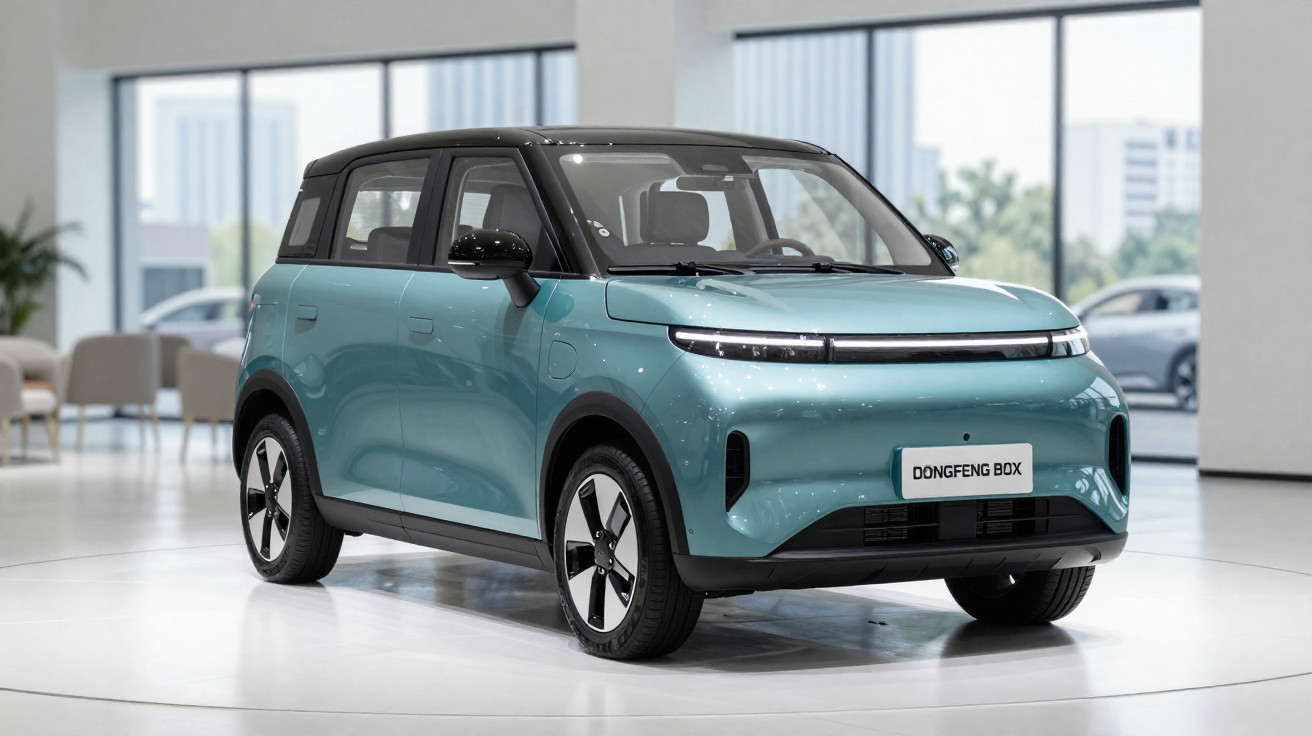
Dongfeng, one of China’s biggest car manufacturers, has just landed in Portugal with the Box: a small, B‑segment electric hatchback priced from €26,750.
Even though it’s roomy and packed with kit, the Dongfeng Box falls short on a few basics: there’s no FM/AM radio, the charging speeds are modest, and the instrument display is almost impossible to read (the graphics really are tiny).
Is that enough to decide this model’s fate in Portugal? Or is there still room for the Dongfeng Box to carve out a place in a segment that, in 2025, will be flooded with options such as the Renault 5 E‑Tech, Citroën ë‑C3 and Hyundai Inster? The answer is in the video:
Smart #1 vibes
I can’t be the only one seeing it: from the front, the Dongfeng Box gives off Smart #1 vibes, especially thanks to the light signature that stretches across the car’s full width.
That said, it’s hard to discuss the Box’s looks without raising a criticism that applies to many models arriving from China: the styling is generic, with very little that immediately signals it’s a new brand in the Portuguese market.
Yes, the flush door handles and the frameless upper window line are unusual-almost unheard of in this class-but overall, the Box comes across as too conventional.
Plenty of equipment
Inside, the Box makes a stronger impression, particularly considering it’s a B‑segment offering.
The many surfaces wrapped in stitched synthetic leather certainly stand out, as do the hard, lower‑grade plastics on the tops of the doors and across the dashboard.
Another negative is the electric window switches on the doors, which operate the opposite way to what we’re used to. And on that point, I can’t help asking: what were Dongfeng’s engineers thinking?
Still on the downsides, there’s only one USB‑A port-in 2025, that’s difficult to defend-and the infotainment system doesn’t include any FM/AM radio receiver.
Yes, really: if you want to listen to radio, it has to be via your smartphone. Thankfully, you can connect it to the Box by cable through Android Auto and Apple CarPlay.
However, Dongfeng supplies a dongle in Portugal (standard on every version) which, once paired with your phone over Bluetooth, enables wireless Android Auto.
This small device-provided free with every Box sold in Portugal-makes it easier to connect your phone to the infotainment system and also helps get around the lack of FM/AM radio: you can listen to radio using apps installed on the smartphone.
Finally, it’s impossible not to mention the instrument cluster, which offers virtually no legible information while you’re driving. This needs to be addressed.
It’s not all bad, though. Alongside a long list of driver‑assistance systems, the Box stands out for its 12.5‑inch central screen and for offering a driver’s seat with heating, cooling, electric adjustment and memory functions.
Satisfactory space
The Box isn’t the biggest car in the segment, but it holds its own. In the rear, for instance, there’s plenty of legroom and headroom, yet the seating position feels odd. The cabin floor is high and the seats sit quite low, which takes away a lot of support under your thighs.
Practicality also takes a hit because the rear bench is a single piece. If you need to fold it to expand the boot, you lose all rear seating. Rivals allow split folding (40/60).
Then again, you may not need to fold it often: with 326 litres, the Box’s boot is among the largest in its class. That’s 16 litres more than the Citroën ë‑C3 and 50 litres more than the Renault 5 E‑Tech.
Only one version
In Portugal, the Dongfeng Box is offered with a single powertrain: a compact electric motor producing 70 kW (95 hp) and 160 Nm.
So don’t expect thrilling performance: 0–100 km/h takes 12.5s. Around town that’s more than enough, but one of the first things I noticed is that after 60/70 km/h, the Box starts to feel slightly strained.
Away from the city, these figures feel limited and there were a few times I wanted more power and responsiveness-especially during motorway runs.
Steering needs work
The suspension is very soft and clearly tuned for comfort. As a result, the body moves around quite a bit, even though stability is never really in doubt.
The steering, on the other hand, feels vague, light and very artificial. On top of that, it barely changes as you switch between the different driving modes.
So don’t expect any sporting edge from the Box: it’s much happier at calmer, more relaxed city speeds.
What about efficiency?
The Box makes up ground with an efficient electric system and impressively restrained energy use. Over more than 500 kilometres, I ended up with an average of 14.6 kWh/100 km.
That’s a strong result, especially given my daily route is genuinely mixed: around 50% motorway, with the remaining 50% split between dual carriageways, secondary roads and urban areas.
When I drove only in town, it could do even better: it’s fairly easy to stay around 12.5 kWh/100 km.
If we take the 14.6 kWh/100 km average as a reference and factor in the 42.3 kWh LFP battery, you can expect roughly 290 kilometres per charge. That’s not far off the official 310 km WLTP combined figure. In town, using the 12.5 kWh/100 km I recorded, that rises to close to 340 km.
But as mentioned earlier, one of the biggest drawbacks shows up when it’s time to charge. That’s because the Box is limited to 6.6 kW AC charging and 87.8 kW DC charging.
Does it make sense to buy?
With prices starting at €26,750, the Dongfeng Box isn’t among the very cheapest EVs on sale: there’s the Dacia Spring (under €20,000) and the Citroën ë‑C3 (€23,300, though it will get a version for under €20,000). The Renault 5 E‑Tech is also about to receive a variant expected to cost around €25,000.
What’s more, this year we’ll see a wave of fully electric models, all priced around €25,000: Hyundai Inster, CUPRA Raval, Skoda Epiq, Volkswagen ID.2, Fiat Grande Panda and Kia EV2. For that reason, the Dongfeng Box is unlikely to have an easy time in the Portuguese market.
Once you start going through the Box’s standard equipment list, it becomes clear that those €26,750 (or €28,600 for the tested version) aren’t out of step.
Even so, a potential buyer needs to value that equipment over, for example, sharper driving dynamics or a less anonymous design.
And on the version I tested-which already goes beyond €28,000-it’s hard to justify details like the lack of a radio or the reversed operation of the electric window switches.
Even so, the brand has already confirmed that in the next update for the model in Portugal, both the radio and Android Auto will be included as standard within the infotainment system, and the issue caused by the missing parcel shelf will also be resolved. The next update, or new Model Year for the Dongfeng Box, arrives in a few months.
Comments
No comments yet. Be the first to comment!
Leave a Comment