
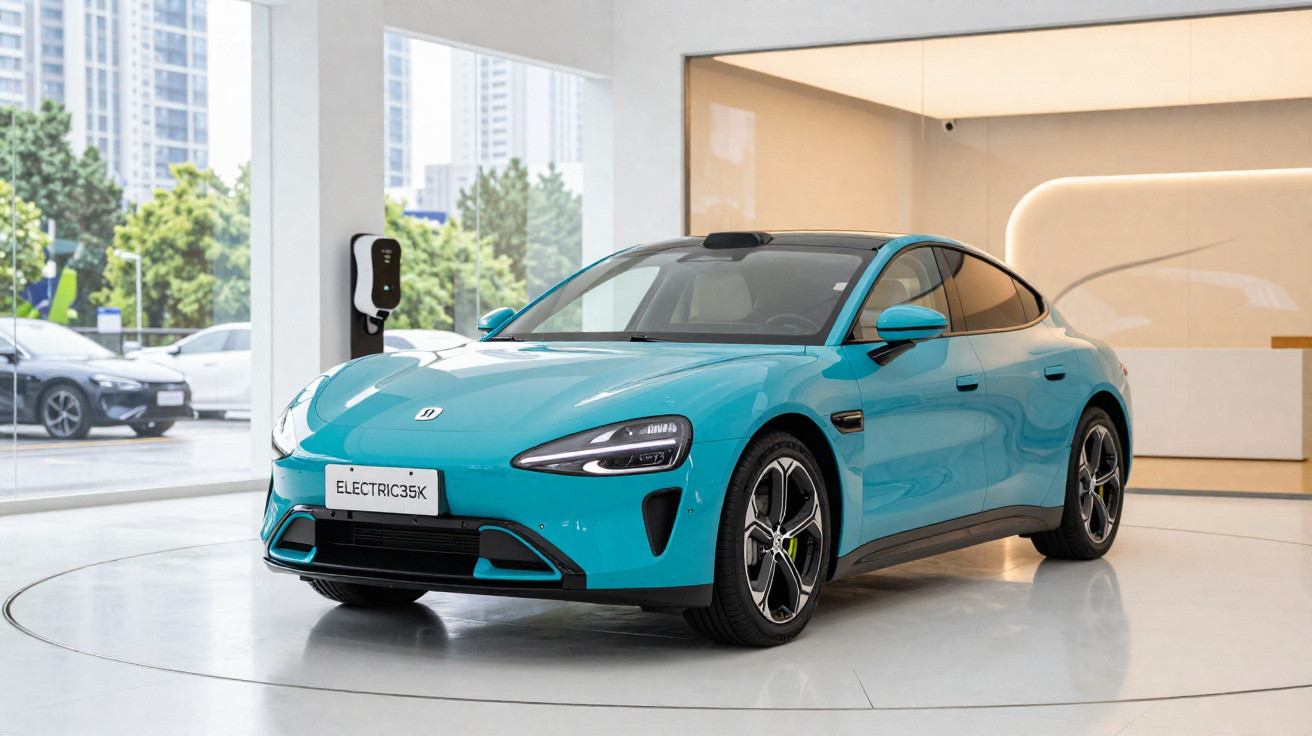
Even though this roundup brings together the cheapest brand-new electric cars on the Portuguese market, it quickly becomes clear that the asking prices for almost all of them still sit beyond what most people can afford.
Even so, that has not stopped sales from rising year after year.
Those high prices are mainly a reflection of the cost of electric technology, which remains significantly more expensive than internal-combustion engineering. A key factor is the price of one of the most important components in an EV: the battery pack.
Looking ahead to the rest of this decade, the expectation is that electric-car prices will come down. Several manufacturers, including Volkswagen and Renault, have already promised more options priced below €25,000 (before incentives).
For now, however, this is the reality. To compile the list below, we set a maximum price cap of €35,000. That said, a number of brands are currently running promotional offers that can cut several thousand euros from the list prices shown here.
DACIA SPRING
From €19,600
The Dacia Spring is, by a wide margin, the least expensive electric car on sale in Portugal. Overall, it comes in three versions: Essential, Expression, and the commercial Cargo variant.
Whichever trim you choose, the Spring is always fitted with a 44 cv electric motor (30 cv when ECO mode is selected) producing 125 Nm. Power comes from a compact 27.4 kWh battery, with a stated range of 230 km on the WLTP combined cycle (305 km on WLTP city).
Using a 30 kW DC rapid-charging point, the battery can be brought up to 80% in under an hour; on a 7.4 kW wallbox, a full charge takes up to five hours; from a 3.7 kW socket, the time rises to roughly 8h30min; and on a 2.3 kW socket, you will need under 14h.
SMART EQ FORTWO
From €23,160
Sold only as an electric model since 2020, the Smart EQ fortwo is currently the sole car in the German brand’s line-up still being marketed. The forfour is no longer on sale, and the new #1 only arrives at the start of 2023.
The EQ fortwo is built around a 60 kW (82 cv) electric motor paired with a 17.6 kWh lithium-ion battery, enabling up to 159 km between charges.
Because the battery is small, charging times are correspondingly short. With a 4.6 kW onboard charger fitted as standard, the EQ fortwo needs six hours on a domestic socket to restore a full charge, and only 3.5 hours to do the same on a wallbox.
It can also be specified with a 22 kW onboard charger, which cuts charging times significantly and allows the battery to go from 10% to 80% in just 40 minutes.
RENAULT TWINGO ELECTRIC
From €25,820
Before the Dacia Spring arrived, the Renault Twingo Electric was the cheapest electric car on the market. It no longer holds that crown, but it remains one of the most affordable ways into electric mobility.
Offered in Techno and Urban Night trims, the Twingo Electric uses an electric motor driving the rear wheels, delivering 60 kW (82 cv) and 160 Nm of torque. Its 22 kWh battery provides a range of 190 km, rising to 270 km for city driving (WLTP city).
On a 2.3 kW single-phase socket, a full charge takes 15 hours. Using a Green-Up socket or a 3.7 kW single-phase wallbox, it takes eight hours; that figure is halved (4h) with a 7.4 kW wallbox. At an 11 kW charging point, the Twingo Electric takes 3h15min to charge, dropping to 1h30min on a 22 kW unit.
FIAT 500
From €26,500
In this latest generation, the Fiat 500 has been reimagined and is offered exclusively as an EV, in three different body styles: the hatchback, the cabriolet (500C), and the distinctive 3+1 version, which adds a small extra rear side door that opens the “wrong” way, but only on the passenger side.
There are two powertrain choices: a 70 kW (95 cv) motor paired with a 23.8 kWh battery, or an 87 kW (118 cv) motor matched to a 42 kWh pack. In the first configuration, the claimed range is 180 km (240 km in town). In the second, it increases to 320 km on the WLTP combined cycle (400 km when measured on the urban cycle).
With the larger battery fitted, the 500 supports DC charging up to 85 kW, meaning it takes 35 minutes to go from 0 to 80%. On a wallbox of up to 7.4 kW, a complete charge requires six hours. Versions with the smaller battery only allow rapid charging up to 50 kW.
OPEL CORSA-E
From €31,395
Available in four equipment levels - Edition, Business, Elegance and GS Line - the Opel Corsa-e is not only the electric member of the Corsa family, but also the most powerful version of the range.
In total, the Corsa-e delivers 100 kW (136 cv) and 260 Nm from its electric motor. Energy is supplied by a 50 kWh battery which, thanks to efficiency improvements, now offers 359 km of range this year rather than the previous 337 km.
Charging the battery from a household socket takes between 25 hours (1.8 kW) and 5h15min (11 kW). With a 50 kW charger, you can add 100 km of range in 19 minutes, while a 100 kW charger needs only 30 minutes to take the battery from 0 to 80%.
NISSAN LEAF
From €33,400
The Nissan Leaf needs little introduction, having been a trailblazer in the modern electric-car market. It is also one of the few EVs under €35,000 in Portugal that is not a city car or supermini.
The Japanese model comes in six trim levels - Acenta, N-Connecta, Tekna, E+Acenta, E+ N-Connecta and E+ Tekna - although only the first two sit below the price ceiling used for this list.
In both cases, the Leaf uses a 40 kWh battery powering a 110 kW (150 cv) electric motor, for a maximum range of 270 km. Leaf versions with the larger 62 kWh battery and 217 cv can reach 385 km, but they exceed €35,000.
Returning to the Leaf with the 40 kWh battery, it can be charged in 16 hours using a 3 kW socket, or in eight hours on a 6 kW supply. With a rapid charger, it is possible to restore 80% of the battery’s capacity in 40 minutes.
RENAULT ZOE
From €33,550
The Renault Zoe was among the first electric superminis and has since become one of Europe’s - and Portugal’s - best-selling electric cars.
The French model is offered in three distinct versions: E.V. 40 R110 Equilibre, E.V. 50 R110 Equilibre and E.V. 50 R135 Evolution.
Given the €35,000 upper limit, only the E.V. 40 R110 and E.V. 50 R110 appear here, each using a motor rated at 80 kW (109 cv) with 225 Nm of torque.
The difference between them is battery size: 41 kWh for the Zoe E.V. 40 R110 and 52 kWh for the Zoe E.V. 50 R110, corresponding to ranges of 313 km and 395 km respectively.
From a standard socket (2.2 kW), going from 0 to 100% takes a full day; on a wallbox (7 kW), a full charge takes a night; at a 22 kW charging point, you can add 120 km of range in one hour; and with a rapid charger (up to 50 kW), 30 minutes provides an extra 150 km of range.
MG ZS EV
From €33,800
Once linked to sporty models, the “new” MG - now owned by China’s SAIC - has already established a presence in Portugal, and electric cars have become one of the most important parts of its range. One example is the MG ZS EV, a compact SUV that is also sold with a petrol engine.
In electric form, the ZS EV is available with a 50 kWh lithium iron phosphate battery or a 70 kWh lithium-ion pack, with only the smaller-battery versions priced below €35,000.
Interestingly, the 50 kWh version is the most powerful in the line-up at 130 kW (177 cv), whereas the larger-battery variant makes do with 115 kW (156 cv).
The 50 kWh MG ZS EV offers a range of 320 km. A full charge from a 7.4 kW supply takes seven hours, while a rapid charger can replenish the battery from 0 to 80% in 40 minutes.
Peugeot E-208
From €34,120
Closing out this list is the Peugeot e-208, which was one of the best-selling electric cars in Portugal in 2021.
Mechanically, it is essentially identical to its “German cousin”, the Corsa-e. As a result, the e-208 comes with 100 kW (136 cv) and 260 Nm, plus a 50 kWh battery. Following a set of improvements last year, the Peugeot e-208 can now travel up to 362 km on a single charge (22 km more than before).
When it is time to top up, the French model supports charging up to 100 kW, meaning the battery can be taken from 0 to 80% in just 30 minutes. If you choose a standard 7.4 kW charger, a full charge takes eight hours, while an 11 kW three-phase socket cuts that to 5h15min.
The “honourable mentions”
Outside this list, but with starting prices fairly close to €35,000, are two of the most rewarding electric cars to drive: the MINI Cooper SE and the Mazda MX-30.
The Cooper SE starts at €37,350, produces 184 cv, and its 32.6 kWh battery provides a range between 226 km and 233 km.
The Mazda MX-30, meanwhile, can be bought from €37,317 and features a 35.5 kWh lithium-ion battery that allows up to 200 km of driving (265 km in the city). It feeds a 145 cv motor producing 271 Nm.

Comments
No comments yet. Be the first to comment!
Leave a Comment