
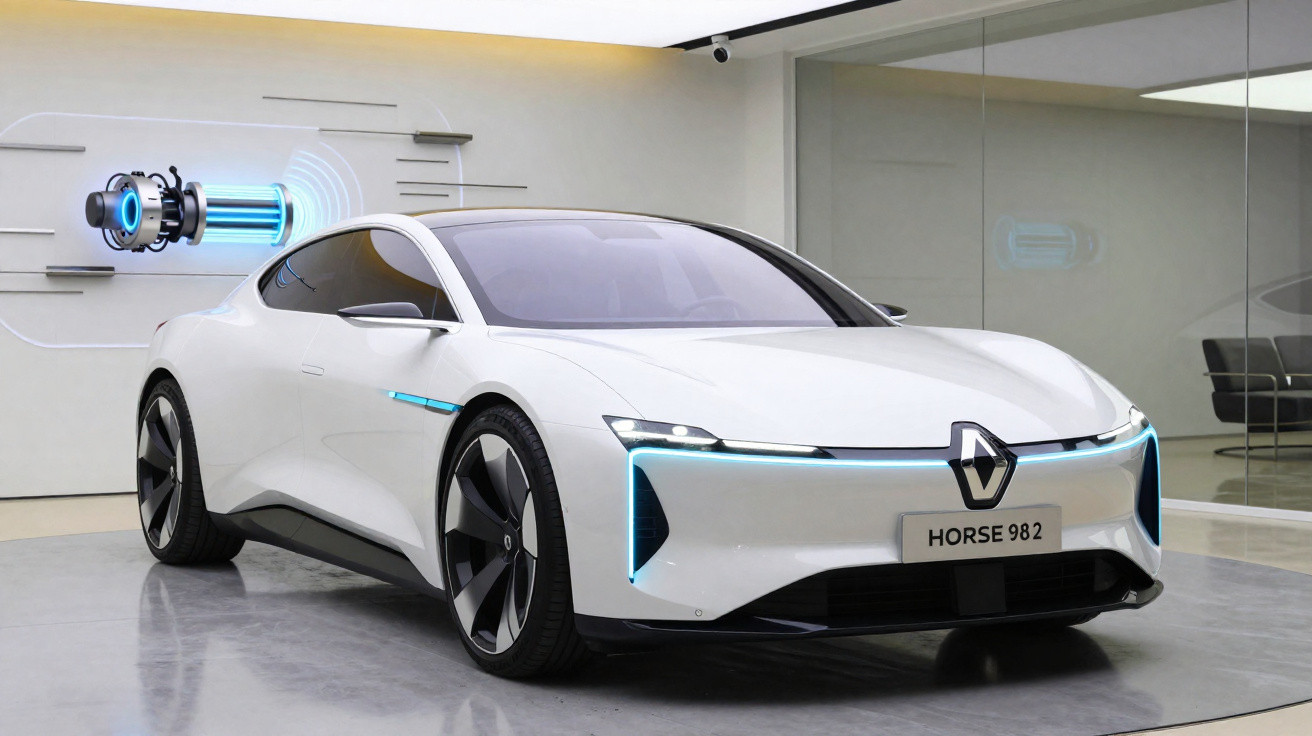
Renault and the Chinese group Geely have presented an electric motor via their joint venture Horse, which is said to reach an efficiency of up to 98.2%. That sounds like a lab headline, but the aim is for it to appear soon in everyday hybrids and plug-in hybrids-where it should gradually help to curb energy use.
What’s behind the new Renault–Geely motor
Horse is a Renault–Geely joint company focused solely on powertrain technology. This is where a new unit has been developed under the internal name “Amorfo”. The key idea is not a stronger magnet or an exotic cooling concept, but a component that looks unremarkable yet is extremely demanding to engineer: the stator.
In an electric motor, the stator is the fixed part around which the rotor turns. Traditionally, stators are built from laminated, crystalline electrical steel. Horse is taking a different route by using so-called amorphous steel-a metal whose atomic structure is not ordered in a regular crystal lattice.
“The new motor reaches an efficiency of 98.2% according to the manufacturer – a figure that stands out clearly even compared with modern electric drives.”
The idea is that the disordered structure helps prevent excessive formation of loss-inducing eddy currents when the material is exposed to a rapidly changing magnetic field. In simple terms, it’s about saving every tenth of a watt that would otherwise be wasted as heat.
Steel laminations thinner than a human hair
It is not just the material that matters, but especially the thickness of the laminations used to build the stator. Horse states a thickness of only 0.025 mm. By comparison, a human hair is usually between 0.05 and 0.08 mm. Conventional motors use laminations around ten times thicker.
Shrinking the laminations to this extent dramatically cuts eddy-current losses in the metal. Fewer losses mean less heat-and therefore more usable drive output from the same electrical energy.
- Stator lamination thickness: 0.025 mm
- Internal loss reduction in the motor: up to 50 %
- Announced efficiency: 98.2 %
- Power: 190 PS
- Torque: 360 Nm
Performance figures of this size are well suited to compact and mid-size vehicles using hybrid or range-extender layouts. That is exactly where Horse positions the motor: not as a pure performance drive, but as an efficiency building block for high-volume production.
What 98.2% efficiency means in real use
Today’s electric drives are already considered highly efficient. Depending on design and operating point, many motors sit around 93 to 97%. Against that background, moving to 98.2% may look like a small gain. However, engineers know that the closer you get to the final percentage points, the harder-and more expensive-each additional step becomes.
Horse says the new approach can halve the motor’s internal losses. That does not mean the car will suddenly use half as much energy, because the motor is only one element of the overall system. Even so, the contribution should be measurable.
“On a system level, Horse expects about one percent lower energy consumption – little for an individual car, but huge at the scale of millions of vehicles.”
One percent can sound almost trivial in day-to-day driving. But spread across 15 years of use, high annual mileages, and large fleets, it adds up to enormous amounts of energy. For manufacturers, every tenth of a litre and every kilowatt-hour matters when meeting fleet targets and CO₂ rules.
Lab vs reality: how robust are the figures?
The stated 98.2% comes from the manufacturer’s own measurements. Typically, such testing is carried out under idealised laboratory conditions: tightly controlled temperature, an optimal load point, no ageing effects, and perfectly matched peripheral components.
On the road, conditions change constantly. The motor rarely operates in its best efficiency window; materials heat up and cool down repeatedly; magnets and insulation age. Many engineers are familiar with the gap: bench results often look better than what data logging later shows in everyday use.
So far, Renault and Geely have not said which model will receive the motor first, nor when series installation will begin. What is clear is that the motor already appears in Horse’s product portfolio-meaning it is, in principle, available to all brands within the groups. That could include Renault, Dacia, potential Renault partners, and Geely-owned marques such as Volvo or Lotus.
Why Chinese groups are turning up the heat on powertrains
In recent years, Japanese and European manufacturers led the field of efficient drivetrains. Toyota and Honda set benchmarks with their hybrid systems, while German premium brands pushed sophisticated electric machines. Now Chinese brands are no longer willing to leave that territory to others.
Manufacturers such as Dongfeng and Changan have recently announced combustion engines with efficiencies close to 50%-a very high figure for petrol engines. BYD has presented an electric motor regarded as particularly innovative and optimised for extremely low consumption.
“The Amorfo motor is part of a wave of new powertrain concepts in which Asian manufacturers in particular are chasing efficiency records.”
For Renault, the partnership with Geely and the move to place powertrain development within Horse is a strategic decision: share development costs, combine know-how, and respond faster to new requirements. The amorphous-steel stator is one outcome of that alliance.
What amorphous steel actually is
The term “amorphous” can sound abstract. In materials science, it means the atoms in the material are not arranged in a regular crystal lattice, but are distributed in a more chaotic way. Glass is a classic example of an amorphous substance.
In electric motors, that brings two advantages:
- Magnetic properties can be tuned more precisely.
- Losses from alternating magnetic fields are reduced because there are fewer ordered “channels” that encourage eddy currents.
The downside is that producing these laminations is expensive and technically demanding. Ultra-thin layers have to be manufactured, punched, and stacked with very high precision. Making that work at mass-production scale is a genuine challenge.
What the new motor could mean for hybrid drivers
Anyone driving a hybrid or plug-in hybrid today often notices efficiency improvements first in two areas: quieter running and lower heat build-up. If the motor has fewer internal losses, the cooling system can be specified smaller; fans need less time at maximum speed; and the whole system operates with less strain.
There is also the gradual impact on consumption. If slightly less energy is needed per 100 kilometres, electric range in hybrid operation improves. In the best case, the car can stay in EV mode longer, bring the combustion engine in less often, and slow wear on its components.
It will be interesting to see how manufacturers integrate the motor within the complete system:
- as the main drive in full hybrids
- as the electric motor in plug-in hybrids with a larger battery
- as part of a range-extender concept, where a small combustion engine works only as a generator
How efficiency might show up in everyday driving
For drivers, what ultimately matters is the fuel or electricity bill-not the number after the decimal point on a data sheet. In practice, one percent less energy use could mean getting a few dozen kilometres further on a tank or a full charge.
That kind of seemingly minor advantage becomes significant very quickly for company fleets with thousands of vehicles. Lower energy demand not only reduces running costs, it also cuts lifecycle emissions across the fleet. That can give manufacturers extra headroom to offer more powerful variants without jeopardising fleet targets.
Tech-focused drivers will watch closely how the motor performs in independent testing later on. If real-world results come even close to the announced efficiency, the Amorfo motor could become a kind of template for future generations of electric drives.
Comments
No comments yet. Be the first to comment!
Leave a Comment