
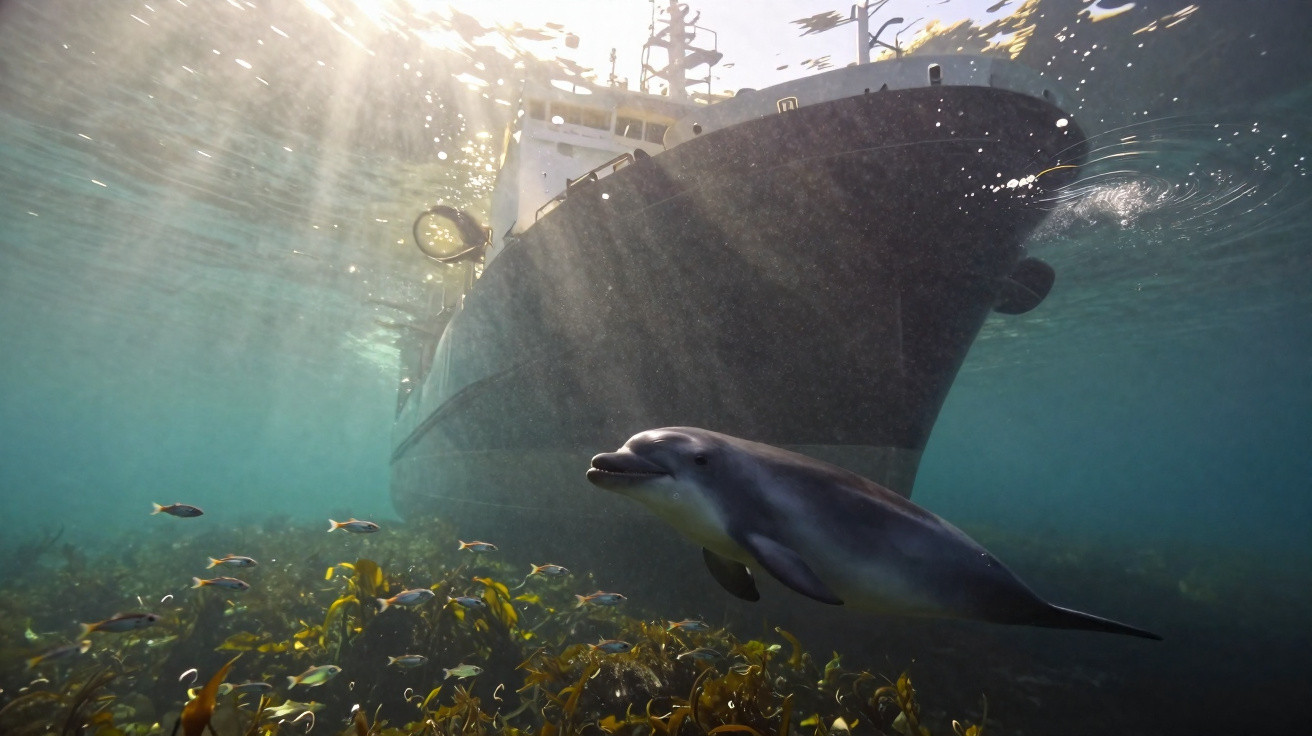
Harbour porpoises don’t have the option of taking long breaks between meals. Because they’re small and use energy quickly, they have to eat almost continuously just to meet the demands of their metabolism.
That’s why anything that cuts into their feeding time isn’t a trivial annoyance - it can cascade into effects on health, reproduction, and even survival.
Those risks sit at the centre of a new study that followed harbour porpoises in Denmark’s Little Belt, a narrow strait that serves as a heavily used marine corridor between the Baltic Sea and the North Sea.
To do this, scientists monitored porpoise activity with underwater microphones, then compared the sounds they recorded with vessel-traffic patterns moving through the same waters.
The outcome was clear, and troubling: during the periods with the most vessel traffic, the porpoises produced far fewer feeding-related “buzzes” - down by as much as 45 per cent.
Buzzing tracks porpoise feeding
Harbour porpoises rely on sound to move around and to interact, and one of the most informative signals they produce is the “buzz”.
These buzzes are brief, rapid bursts that tend to occur when porpoises are engaged in key behaviours - particularly foraging, and also socialising.
So a reduction in buzzing isn’t merely a shift in background noise. It signals that the animals may be feeding less, socialising less, or at least carrying out those behaviours differently (and probably less efficiently).
In this research, buzzing dropped steeply during the busiest vessel-traffic windows. When conditions became quieter again, the porpoises appeared to increase activity.
“Our findings suggest chronic boat traffic may be limiting porpoises’ ability to feed and socialize effectively in important coastal habitats,” said co-author Rachel Lennon of the University of Exeter.
Summer traffic hits hardest
The effect didn’t look the same at all times. The strongest reduction in porpoise activity was recorded during summer daylight hours - which fits with the fact that this is when the Little Belt sees the highest levels of vessel movement.
“Porpoise activity dropped most significantly during summer daytime hours, when the Little Belt is busiest with vessels,” Lennon said. “In moments when vessels were not present, porpoise activity increased.”
That rebound indicates the porpoises are not simply leaving the area altogether. Instead, they may be interrupting or holding back essential behaviours while ships are nearby, then attempting to compensate once the disturbance drops.
Porpoises need constant feeding
For larger marine mammals, skipping the occasional meal may be manageable. For harbour porpoises, it can be far more serious.
Unlike species that can store substantial energy reserves in fat and draw on them over time, harbour porpoises have high day-to-day energy demands and must feed often.
That’s what makes the findings matter in practical terms. “We know from other studies that disruption to foraging can affect porpoises’ health, body condition, and ultimately reproduction and survival,” said co-author Shannon Merkle from Exeter.
And although this work didn’t directly measure impacts at the population level, Merkle argues that “the disruption we found is likely to affect their ability to cope with other environmental stressors.”
Put simply, an animal already operating with little spare energy has less resilience when faced with food shortages, disease, extreme weather, or additional human pressures.
Porpoises can’t just leave
A common response in wildlife–human conflicts is to assume animals will avoid the disturbed area. The researchers say that isn’t straightforward here, because the Little Belt is not just any stretch of sea.
It is a narrow, productive passage - and harbour porpoises cannot necessarily replace it with a calmer location offering the same availability of prey.
“It’s also important to note that porpoises cannot simply move elsewhere – as other areas may not have the needed density of prey that exists in the narrow part of the Little Belt,” Merkle said.
That can force animals into a trade-off: remain in a disturbed habitat that provides good feeding opportunities, or shift into quieter waters where conditions for feeding are poorer.
Endangered population under pressure
Each year, several thousand larger vessels pass through the Little Belt, alongside an unknown number of recreational boats. The porpoises using these waters are part of the Belt Sea population, which HELCOM lists as “Endangered”.
With that conservation status, persistent disturbance becomes especially concerning, because even modest additional pressures can carry greater weight when a population is already strained.
“This study adds to the growing understanding of how underwater noise and the increasing vessel traffic affects our environment, and in particular a noise-sensitive species like the harbor porpoise,” said co-author Jonas Teilmann, a professor at Aarhus University.
Slower ships could help
The researchers are not arguing for a blanket ban on boats. Instead, they highlight measures that can lower disruption without halting shipping.
Options include reducing vessel speeds, controlling the number of vessels, and paying close attention to where traffic is concentrated - particularly within or near protected areas.
“Our hope is that the results of this study will be used in future managing of the number of vessels, how fast they may move, and their distribution in protected areas,” Teilmann said.
The reasoning is straightforward: if harbour porpoises reduce feeding and social activity when boats are present, then cutting the intensity of that disturbance could increase the amount of usable time they have in the habitats they rely on.





Comments
No comments yet. Be the first to comment!
Leave a Comment